Finding Indian food that is both flavorful and halal-friendly is becoming easier across Brooklyn, but Downtown Brooklyn presents a particularly interesting starting point for diners looking for Indian and South Asian cuisine. The area combines a large residential population, busy business districts, shopping destinations, entertainment venues, and convenient transportation, creating steady demand for restaurants serving a wide range of cuisines.
For Muslim diners, however, finding a restaurant that serves Indian food is only part of the search. The bigger question is whether the restaurant’s meat is halal and whether the restaurant can clearly explain its halal practices.
That distinction matters because Indian food and halal food are not automatically the same thing. Many Indian dishes are naturally vegetarian, but dishes containing chicken, lamb, goat, or other meats require diners to confirm their halal status when that is important to them.
Downtown Brooklyn and its surrounding neighborhoods offer opportunities to explore everything from biryani and tandoori dishes to curries, kebabs, naan, vegetarian specialties, and South Asian comfort food. Current local listings specifically identify Curry Spot at 151 Remsen Street as an Indian halal restaurant, while broader Brooklyn directories list numerous halal Indian and South Asian restaurants throughout the borough.
That makes Downtown Brooklyn a useful base for exploring halal Indian food—but diners should still verify the restaurant’s current halal status before ordering.
Why Downtown Brooklyn Is Great for Halal Indian Food
A Diverse Food Scene
Downtown Brooklyn is one of the most diverse dining areas in Brooklyn. Indian food fits naturally into this environment, with restaurants ranging from traditional North Indian cooking to South Asian fusion, casual curry shops, and restaurants specializing in particular regional dishes.
The broader Brooklyn food scene includes Indian, Pakistani, Bangladeshi, and other South Asian restaurants that serve halal meat. A current Brooklyn halal directory, for example, lists hundreds of halal establishments across the borough, including restaurants categorized as Indian, Pakistani, and Bangladeshi.
For diners, this creates an important advantage: if a specific halal Indian restaurant does not fit your schedule or preferences, nearby neighborhoods may provide additional options.
Halal Indian Food Offers Plenty of Variety
One of the biggest advantages of Indian cuisine is that a halal-friendly meal does not have to revolve around meat.
Indian cooking includes an enormous selection of vegetarian dishes, making it relatively easy to build a complete meal without ordering meat at all.
Popular options include:
- Chana masala
- Dal tadka
- Dal makhani
- Saag paneer
- Palak paneer
- Aloo gobi
- Bhindi masala
- Vegetable biryani
- Vegetable samosas
- Dosa
- Idli
- Naan
- Tandoori vegetables
For diners who prefer meat, halal Indian restaurants can offer dishes such as chicken tikka, tandoori chicken, lamb curry, goat curry, biryani, and kebabs—provided the restaurant confirms that the meat meets halal requirements.
Biryani Is a Major Attraction
Biryani deserves special attention when discussing halal Indian food.
This aromatic rice dish can be prepared with chicken, lamb, goat, vegetables, or other ingredients. Different Indian regions also have their own versions, with differences in spices, rice preparation, cooking techniques, and accompaniments.
For someone visiting a halal Indian restaurant for the first time, biryani is often an excellent dish to explore because it combines rice, spices, meat or vegetables, and aromatic ingredients in one meal.
Ask the restaurant what style of biryani they serve and whether the meat is halal.
North Indian Cuisine Is Easy to Explore
Many Indian restaurants in Brooklyn focus on North Indian dishes, making foods such as naan, tandoori chicken, kebabs, butter chicken, chicken tikka masala, paneer dishes, dal, and biryani readily recognizable to American diners.
Kashi Indian Cuisine & Bar, for example, describes its menu as a modern expression of North Indian cuisine and highlights slow-cooked biryanis and char-grilled kebabs. Its restaurant is located at 286 Livingston Street in Downtown Brooklyn.
However, diners specifically looking for halal meat should not assume that a restaurant’s North Indian menu automatically means its meat is halal. Halal status should be confirmed directly with the restaurant.
Vegetarian Diners Have Plenty of Choices
Halal dining does not mean limiting yourself to meat dishes.
Indian cuisine has one of the world’s richest vegetarian traditions. This makes it particularly convenient for groups where some diners want halal meat while others prefer vegetarian food.
A shared meal might include:
- Vegetable samosas
- Chana masala
- Dal
- Saag paneer
- Aloo gobi
- Vegetable biryani
- Garlic naan
- Basmati rice
- Mango lassi
If you’re dining with a mixed group, this variety makes Indian restaurants especially practical.
Downtown Brooklyn’s Location Makes It Convenient
Downtown Brooklyn’s location is another reason the area works well for Indian dining.
The neighborhood connects several important Brooklyn communities and is close to Brooklyn Heights, Boerum Hill, Fort Greene, Cobble Hill, Prospect Heights, and other areas with diverse restaurants.
That means diners are not necessarily restricted to restaurants located directly inside Downtown Brooklyn.
If you cannot find a halal Indian restaurant that fits your schedule, expanding your search by a short distance can open up considerably more choices.
For example, current listings identify halal Indian or South Asian restaurants in several Brooklyn neighborhoods, including locations farther from the Downtown core.
Halal and Authentic Indian Food Can Overlap
For diners who care about both halal status and authentic Indian cooking, there are two separate things to evaluate.
First, determine whether the meat is halal.
Second, look at the restaurant’s culinary identity.
A restaurant might serve halal chicken but offer a broad, Americanized menu. Another might specialize in a particular Indian region and also use halal meat.
If authenticity matters to you, look for restaurants that explain their regional cuisine, cooking methods, ingredients, and specialties.
For example, rather than simply ordering “curry,” you might explore a specific dish such as biryani, rogan josh, saag, chole, kebabs, or a regional thali.
What Does Halal Mean at an Indian Restaurant?
The word “halal” generally refers to food that is permissible according to Islamic dietary requirements.
For restaurant diners, the most important question is often whether the meat being served is halal.
But halal dining can involve additional considerations depending on the diner’s own requirements.
If you’re unsure, ask the restaurant:
“Is all of your meat halal?”
You can also ask:
“Is the chicken and lamb halal?”
And, if relevant:
“Are there any non-halal meats prepared in the same kitchen?”
Different diners may have different standards regarding shared cooking equipment, alcohol in sauces or beverages, or other preparation practices, so asking specific questions is better than relying on assumptions.
Check Before You Visit
Restaurant menus and operating practices can change.
A restaurant that previously offered halal meat may change suppliers, while a restaurant that did not previously advertise halal options may introduce them later.
This is especially important when an online directory says “halal” but the restaurant’s own current menu does not clearly mention it.
For this reason, use restaurant directories as a starting point rather than the final authority.
If halal status is essential to your meal, confirm directly with the restaurant before ordering.
Downtown Brooklyn Is Only the Starting Point
One of the most useful things to understand about this guide is that “Downtown Brooklyn” does not have to mean staying within a few blocks of the Downtown Brooklyn commercial district.
Brooklyn’s halal food scene extends well beyond Downtown.
Current listings include halal Indian and South Asian restaurants in neighborhoods such as Kensington, Prospect Park South, Crown Heights, and other parts of Brooklyn. Radhuni Sweets & Restaurant in the broader Brooklyn area, for example, explicitly describes itself as serving 100% halal food and identifies its cuisine as Bangladeshi and Indian.
This wider perspective is useful when you’re searching for a particular dish, a later closing time, delivery, or a restaurant with a clearly documented halal policy.
What Makes a Good Halal Indian Restaurant?
When evaluating a restaurant, consider several factors rather than relying on one label.
Halal status:
Is the restaurant clearly identifying its meat as halal?
Cuisine:
Does it specialize in Indian food, or is Indian food only one part of a much broader menu?
Regional identity:
Does the restaurant offer North Indian, South Indian, Mughlai, Punjabi, Bengali, or another identifiable style?
Menu variety:
Are there good choices for meat eaters, vegetarians, and vegans?
Food quality:
Do customers consistently mention specific dishes and preparation quality?
Convenience:
Are dine-in, pickup, and delivery available?
Hours:
Does the restaurant fit your schedule?
Transparency:
Can staff clearly answer questions about halal ingredients and preparation?
These factors can help you choose a restaurant based on your own priorities.
A Growing Halal Food Culture in Brooklyn
Brooklyn’s halal food scene is much broader than a simple collection of restaurants serving halal meat.
It reflects the borough’s diverse South Asian, Middle Eastern, Central Asian, African, and other Muslim communities.
Indian and South Asian cuisine is an important part of this food culture, particularly because dishes such as biryani, kebabs, curries, naan, samosas, and vegetarian specialties are naturally well suited to halal dining.
For visitors and locals alike, this means halal diners can explore a wide range of flavors rather than feeling limited to a small number of dishes.
Final Thoughts on Halal Indian Food in Downtown Brooklyn
Downtown Brooklyn provides a convenient starting point for discovering halal Indian and South Asian food, but the best search strategy is to look beyond a restaurant’s cuisine label.
Indian does not automatically mean halal, and halal does not automatically mean authentic Indian cuisine.
Instead, check both.
Confirm the halal status of meat, then explore the restaurant’s menu, regional identity, cooking style, and specialties.
If your search within Downtown Brooklyn produces limited choices, expand into nearby Brooklyn neighborhoods. The wider borough has a substantial halal dining scene, including Indian, Pakistani, Bangladeshi, and other South Asian restaurants.
Whether you’re craving a fragrant biryani, smoky kebabs, creamy curry, fresh naan, spicy chana masala, or a vegetarian thali, halal Indian food offers plenty of ways to enjoy the depth and diversity of Indian cuisine.
The key is simple: ask questions, verify halal status, explore regional dishes, and choose the restaurant that matches your own dining requirements.
Top Halal Indian Restaurants in Downtown Brooklyn
Finding a halal Indian restaurant in Downtown Brooklyn requires a little more research than simply searching for Indian food. While the neighborhood has several Indian restaurants, not every restaurant publicly confirms that its meat is halal.
For Muslim diners, that distinction is important. The restaurants below are therefore organized around documented halal status, Indian or South Asian cuisine, location, menu style, and convenience. Where a restaurant’s halal status is not clearly confirmed, it is identified separately rather than assumed.
Curry Spot
Located at 151 Remsen Street, Curry Spot is one of the clearest options for diners specifically searching for halal Indian food in Downtown Brooklyn. Current local listings categorize it as both Indian and halal, making it a natural starting point for this guide.
The restaurant offers familiar Indian comfort food that works well for both individual meals and casual group dining. Depending on the current menu, diners can look for dishes such as curries, rice dishes, naan, vegetarian preparations, and other Indian favorites.
Its Downtown Brooklyn location is particularly convenient for people around Brooklyn Heights, Court Street, Remsen Street, and the surrounding residential and business districts.
Current business listings place the restaurant in the $10–$20 price range and show regular daytime and evening service, generally closing around 9:45 p.m.
For anyone who wants a straightforward combination of Indian cuisine + documented halal listing + Downtown Brooklyn location, Curry Spot is one of the most relevant restaurants to investigate.
Kazi Halal Food
Kazi Halal Food
Kazi Halal Food at 61 Clinton Street is another nearby option worth considering for diners who prioritize halal food and want an Indian-style meal in the Downtown Brooklyn area.
The current business listing categorizes it as an Indian restaurant and halal food option, with a price range around $10–$20. Its hours are primarily daytime and afternoon, so it is more appropriate for lunch or an early meal than for late-night dining.
This can be a useful option when your priority is affordability and halal food rather than an upscale dinner experience.
Because halal food listings and menus can change, diners who require specific halal preparation standards should still confirm details directly before ordering.
Kanan Indian Restaurant
Kanan Indian Restaurant is located at 452 3rd Avenue in Brooklyn and is listed as an Indian, vegan, and halal restaurant. It is outside the immediate Downtown Brooklyn core but can be considered when expanding the search into nearby Brooklyn neighborhoods.
The combination of Indian, vegan, and halal categories makes it particularly interesting for groups with different dietary requirements.
A group might include Muslim diners looking for halal meat, vegetarians looking for Indian vegetable dishes, and vegan diners avoiding dairy. Indian cuisine naturally offers a large selection of plant-based dishes, so restaurants serving all three categories can make group dining easier.
Since it is not directly in Downtown Brooklyn, check the current location, hours, and menu before making the trip.
King of Tandoor
King of Tandoor, located at 600 Flatbush Avenue, is another Brooklyn restaurant currently listed as Indian and halal.
As the name suggests, tandoori-style cooking is an important part of the restaurant’s identity. Tandoor cooking is particularly popular in Indian cuisine for dishes such as chicken tikka, tandoori chicken, kebabs, and naan.
For diners who enjoy grilled Indian food, a tandoor-focused restaurant can provide a different experience from a curry-heavy Indian menu.
It is farther from Downtown Brooklyn than Curry Spot, so it makes more sense when you’re willing to travel for a particular style of halal Indian food.
Ashoka Grill Halal Indian Cuisine
Ashoka Grill Halal Indian Cuisine is located at 1436 Flatbush Avenue and is currently listed as an Indian halal restaurant.
The restaurant is outside Downtown Brooklyn itself, but it is useful to include in a broader guide because diners searching specifically for halal Indian food may prefer to travel farther for a restaurant with a clearly stated halal identity.
A restaurant explicitly presenting itself as halal Indian can also make the ordering process simpler for Muslim diners who do not want to repeatedly ask whether individual meat dishes are halal.
The restaurant is listed in the $20–$30 range, making it a mid-range option rather than a budget food stop.
Jalsa
Jalsa is located at 964 Coney Island Avenue and is currently listed as a halal Indian restaurant in Brooklyn.
It is considerably farther from Downtown Brooklyn, so it should be viewed as a Brooklyn-wide alternative rather than a walkable Downtown option.
For diners who are specifically searching for halal Indian cuisine and are willing to travel, however, it expands the selection considerably.
Jalsa is particularly relevant for people interested in a broader South Asian menu rather than restricting their search to the immediate Downtown Brooklyn neighborhood.
Bombay Masala Indian Dining
Bombay Masala Indian Dining is located at 7205 3rd Avenue and is listed as an Asian Indian halal restaurant.
Its location makes it another farther-away Brooklyn option rather than a Downtown Brooklyn restaurant.
The benefit of including restaurants such as Bombay Masala in a wider search is that halal Indian dining in Brooklyn is not limited to the Downtown core. If your priority is a clearly identified halal Indian restaurant, expanding the geographic radius can give you considerably more choices.
Omar’s Indian Fine Cuisine
OMAR’S INDIAN FINE CUISINE
Omar’s Indian Fine Cuisine at 568 Vanderbilt Avenue is another Brooklyn restaurant currently listed as Indian and halal.
The restaurant is positioned farther from Downtown Brooklyn, in the Prospect Heights area, but its location can make it relevant for diners who are already traveling through central Brooklyn.
Current business listings put it in the $20–$30 range and show service extending into the evening, generally until 11 p.m.
This makes it potentially useful for a sit-down Indian dinner when you’re willing to travel outside Downtown Brooklyn.
BK JANI
BK Jani at Dekalb Market Hall
BK JANI deserves a mention because it is a halal Pakistani restaurant located at 445 Albee Square West, directly in Downtown Brooklyn’s DeKalb Market Hall.
It is not technically an Indian restaurant, so it should not be presented as one. However, Pakistani and North Indian cuisines share many culinary traditions, including grilled meats, naan, rice dishes, kebabs, and heavily spiced curries.
Current local listings categorize BK JANI as Pakistani and halal, with a price range around $10–$20.
For someone searching for halal Indian or closely related South Asian food in Downtown Brooklyn, it can therefore be a useful alternative—especially when the desired meal is more about biryani, grilled meat, kebabs, or Pakistani-style comfort food than a specifically Indian regional dish.
Kashi Indian Cuisine & Bar — Verify Halal Status
Kashi Indian Cuisine & Bar
Kashi Indian Cuisine & Bar is one of the better-known Indian restaurants in Downtown Brooklyn and is located at 286 Livingston Street. It specializes in North Indian cuisine and currently operates daily through approximately 10 p.m.
However, it should not automatically be described as halal simply because it serves Indian food.
For Muslim diners, this is an important distinction. If you are considering Kashi, contact the restaurant directly and ask whether the meat currently served is halal and whether its preparation meets your dietary requirements.
This restaurant is therefore best included as a verify-before-ordering option, rather than a confirmed halal recommendation.
Dastaan Indian Kitchen — Verify Halal Status
Dastaan Indian Kitchen
Dastaan Indian Kitchen at 115 Smith Street is another popular Indian restaurant in the Downtown Brooklyn area. Current business listings place it in the $20–$30 range and show service until approximately 10:30 p.m.
Dastaan can be relevant for diners searching for Indian food in the Downtown Brooklyn area, but its inclusion should not be interpreted as confirmation that all of its meat is halal.
If halal meat is a requirement, ask specifically about the chicken, lamb, goat, and other meat products before ordering.
How to Choose Among These Restaurants
If you’re specifically searching for halal Indian food, the simplest approach is to divide the options into three groups.
Confirmed or specifically listed as halal Indian:
- Curry Spot
- Kazi Halal Food
- Kanan Indian Restaurant
- King of Tandoor
- Ashoka Grill Halal Indian Cuisine
- Jalsa
- Bombay Masala Indian Dining
- Omar’s Indian Fine Cuisine
These restaurants are currently identified in local listings as Indian and halal.
Halal South Asian alternative:
- BK JANI — Pakistani and halal
Indian restaurants where halal status should be confirmed directly:
- Kashi Indian Cuisine & Bar
- Dastaan Indian Kitchen
- Other Indian restaurants in the Downtown Brooklyn area
This distinction helps avoid a common mistake: assuming that an Indian restaurant automatically serves halal meat.
What to Order at a Halal Indian Restaurant
Once you’ve confirmed the restaurant’s halal status, there are plenty of dishes worth exploring.
For meat lovers:
- Chicken biryani
- Lamb or goat curry
- Chicken tikka
- Tandoori chicken
- Seekh kebab
- Chicken curry
- Rogan-style meat dishes
- Lamb biryani
For vegetarians:
- Dal tadka
- Dal makhani
- Chana masala
- Saag paneer
- Palak paneer
- Aloo gobi
- Bhindi masala
- Vegetable biryani
For sharing:
- Samosas
- Tandoori chicken
- Mixed kebabs
- Biryani
- Naan
- Rice
- Two or three curries
A combination of one rice dish, two curries, naan, and an appetizer can work particularly well for a group.
A Note About Halal Verification
Halal status is not necessarily permanent. Suppliers, menus, ownership, kitchen practices, and certifications can change.
Some online directories may retain an old halal designation even after restaurant practices change. Conversely, restaurants may offer halal meat without prominently advertising it online.
For that reason, diners who strictly follow halal dietary requirements should verify the restaurant directly.
Useful questions include:
“Is all of your meat halal?”
“Is your chicken halal?”
“Is the lamb or goat halal?”
“Do you serve any non-halal meat?”
“Is there any alcohol used in the preparation?”
These questions can help you make a decision based on your own dietary requirements.
Final Takeaway
For diners specifically looking for halal Indian food in Downtown Brooklyn, Curry Spot is one of the clearest local options because current directories explicitly categorize it as Indian and halal.
The search becomes much broader when you include nearby Brooklyn neighborhoods. Restaurants such as Kanan Indian Restaurant, King of Tandoor, Ashoka Grill Halal Indian Cuisine, Jalsa, Bombay Masala, and Omar’s Indian Fine Cuisine are currently listed as halal Indian options elsewhere in Brooklyn.
Meanwhile, restaurants such as Kashi and Dastaan remain useful Indian dining options in the Downtown area, but their halal status should be confirmed directly rather than assumed.
The best strategy is therefore simple: verify halal status first, then choose based on cuisine, dishes, price, location, and dining style.
Best Neighborhoods or Areas for Indian Food
When searching for Indian food in Downtown Brooklyn, it helps to think beyond the boundaries of the Downtown Brooklyn neighborhood itself. The surrounding areas—Brooklyn Heights, Boerum Hill, Cobble Hill, Fort Greene, Clinton Hill, Prospect Heights, and Crown Heights—create a much larger Indian dining map.
This is especially useful for diners searching for halal Indian food. A restaurant may be only a short subway ride or walk away but offer a menu or halal policy that better matches what you’re looking for.
Here are the main neighborhoods to explore.
1. Downtown Brooklyn
Best for: Convenience, central location, and a variety of Indian dining styles
Downtown Brooklyn should be the first place to search because it is the most convenient starting point for visitors, office workers, residents, and people attending events nearby.
The neighborhood has several Indian restaurants offering different dining styles. Kashi Indian Cuisine & Bar on Livingston Street focuses on North Indian cuisine, while Dastaan Indian Kitchen on Smith Street offers another Indian dining option.
For South Indian food, Filter Kaapi and Brooklyn Curry Project are both located at 383 Bridge Street.
Downtown Brooklyn is also useful for diners who want to combine Indian food with shopping, entertainment, business meetings, or a visit to nearby attractions.
For halal diners, however, remember that being an Indian restaurant does not automatically mean the meat is halal. Always verify halal status directly if it is an essential requirement.
2. Brooklyn Heights
Best for: Convenient Indian food close to Downtown Brooklyn
Brooklyn Heights sits immediately west of Downtown Brooklyn and is an easy area to include in an Indian-food search.
The neighborhood is particularly convenient if you’re already around Court Street, Montague Street, or the Brooklyn Heights Promenade.
Curry Heights at 151 Remsen Street is one of the established Indian restaurants in the area. Current business listings show regular daytime and evening service, generally until around 9:45 p.m.
For halal diners, Curry Heights has appeared in halal restaurant listings, but it is still sensible to confirm the restaurant’s current meat sourcing and preparation practices before ordering.
Brooklyn Heights is best viewed as an extension of Downtown Brooklyn rather than a completely separate destination. The two areas are close enough that diners can easily compare restaurants in both.
3. Boerum Hill
Best for: Dinner, Atlantic Avenue restaurants, and pre-event dining
Boerum Hill sits immediately south of Downtown Brooklyn and provides another useful area for Indian food.
The neighborhood is particularly convenient around Atlantic Avenue, Smith Street, and nearby residential streets.
Masala Grill at 501B Atlantic Avenue is one Indian restaurant in this broader area. Current business listings show it operating from late morning into the evening, with later closing times on Friday and Saturday.
Boerum Hill can be particularly convenient before events because of its proximity to Barclays Center and the surrounding entertainment areas.
For halal diners, check each restaurant’s current halal status rather than assuming that an Indian menu means halal meat.
4. Cobble Hill and Court Street
Best for: Sit-down Indian dining and regional cuisine
The Court Street corridor between Downtown Brooklyn and Cobble Hill is another useful area for Indian food.
Indian Table at 234 Court Street provides a more polished Indian dining experience and is particularly notable for its Goan-inspired culinary identity.
The current business listing shows lunch and dinner service, with dinner generally running until around 9:45 p.m.
This area is useful if you want to explore Indian cuisine beyond the familiar butter chicken, naan, and tikka masala combination.
For diners interested in authenticity, regional identity can be more informative than simply searching for a restaurant labeled “Indian.”
5. Fort Greene
Best for: South Indian food, dosa, and a broader neighborhood dining experience
Fort Greene is one of the most useful nearby neighborhoods when you want to expand your Indian-food search.
The neighborhood is located next to Downtown Brooklyn and is known for its restaurants, cultural attractions, and streets around Fulton Street, Lafayette Avenue, and DeKalb Avenue.
DOSA ROYALE at 65 Lafayette Avenue is particularly relevant for diners interested in South Indian cuisine. The restaurant specializes in dishes associated with South Indian cooking, making it a useful alternative to restaurants focused primarily on North Indian curries.
South Indian cuisine also gives vegetarian diners many choices, including dosa, idli, vada, sambar, and other rice-and-lentil preparations.
For halal diners, remember that vegetarian dishes may be suitable regardless of meat sourcing, but specific ingredients and preparation should still be checked according to your dietary requirements.
6. Clinton Hill
Best for: Myrtle Avenue dining and later-evening Indian food
Clinton Hill is east of Fort Greene and provides another useful area to explore.
Myrtle Avenue is particularly relevant because it connects Fort Greene and Clinton Hill and has a variety of restaurants.
Mint Heights at 368 Myrtle Avenue is currently listed as an Indian restaurant, with evening hours extending to midnight on several days.
This makes the area useful for diners who want Indian food later in the evening, when some Downtown Brooklyn restaurants may already be closing.
For halal diners, however, later hours should not be confused with halal certification or halal sourcing. Verify the meat status before ordering.
Clinton Hill can also work well for people attending events around Fort Greene or traveling between Downtown Brooklyn and Bedford-Stuyvesant.
7. Prospect Heights
Best for: A broader Indian-food search and Vanderbilt Avenue
Prospect Heights is particularly useful when you’re willing to travel a little farther from Downtown Brooklyn.
The Vanderbilt Avenue corridor has several Indian restaurants, giving diners more opportunities to compare menus and cooking styles.
OMAR’S INDIAN FINE CUISINE at 568 Vanderbilt Avenue is one example. Current listings place it in the $20–$30 range and show service extending into the evening, generally until 11 p.m.
Mumbai Place at 655 Vanderbilt Avenue is another Indian restaurant in the area, with current listings showing service into the evening.
For diners who want to explore more than one restaurant in a single food outing, Prospect Heights can be a useful addition to a Downtown Brooklyn Indian-food itinerary.
8. Crown Heights
Best for: Expanding your search beyond Downtown Brooklyn
Crown Heights is farther from Downtown Brooklyn but becomes increasingly relevant when your priority is finding a broader range of Indian and South Asian restaurants.
The neighborhood can be combined with Prospect Heights as part of a larger Brooklyn food outing.
This is particularly useful for halal diners. Rather than restricting yourself to restaurants within a few blocks of Downtown Brooklyn, expanding the geographic area can make it easier to find establishments that specifically identify themselves as halal.
Crown Heights also provides access to a wider range of South Asian food traditions, so it can be worth exploring when you’re interested in dishes beyond standard Indian restaurant favorites.
9. Atlantic Avenue and the Barclays Center Area
Best for: Pre-event and post-event Indian food
Atlantic Avenue is useful because it connects several of the neighborhoods mentioned in this guide.
It also provides convenient access to Barclays Center and other entertainment destinations.
Masala Grill’s location on Atlantic Avenue makes this corridor relevant for diners looking for Indian food before or after an event. Masala Grill
The practical advantage is that you can choose a restaurant based on the direction you’re traveling afterward.
If you’re heading back toward Downtown Brooklyn, stay closer to Livingston Street. If you’re heading toward Fort Greene or Prospect Heights, restaurants farther along Atlantic Avenue may be more convenient.
10. Schermerhorn Street and the Downtown/Fort Greene Border
Best for: Vegetarian Indian food
The area around Schermerhorn Street is another useful stop for vegetarian diners.
Govinda’s Kitchen at 305 Schermerhorn Street is an Indian restaurant with a strong vegetarian focus.
Its current business listings show daytime service on many days, with some evening hours later in the week.
Because it is vegetarian-focused, it can be particularly useful for groups where some diners want Indian food without meat.
Halal diners should still consider their individual dietary requirements and ask about ingredients and preparation where necessary.
11. Vanderbilt Avenue
Best for: Comparing Indian restaurants in one broader area
Vanderbilt Avenue deserves separate attention because it provides a convenient corridor for exploring Indian restaurants outside the immediate Downtown Brooklyn area.
With restaurants such as Omar’s and Mumbai Place, diners can compare different menus and dining styles without limiting their search to the Downtown core.
This is particularly useful if you’re looking for a more complete Brooklyn Indian-food experience rather than simply trying to find the closest restaurant.
12. DeKalb Market Hall and Nearby Downtown Brooklyn
Best for: Casual halal South Asian food
For diners specifically interested in halal South Asian food, DeKalb Market Hall provides another useful Downtown Brooklyn stop.
BK Jani at Dekalb Market Hall is a Pakistani restaurant listed at 445 Albee Square West.
It is important to note that BK JANI is Pakistani rather than Indian, so it should not be described as an Indian restaurant. However, Pakistani and North Indian cuisines share many dishes and culinary traditions, including biryani, naan, grilled meats, kebabs, and richly spiced curries.
For someone searching broadly for halal South Asian food, it can therefore be a practical alternative when a specifically Indian halal option isn’t convenient.
Best Neighborhoods by Dining Goal
Different areas make sense depending on what you’re looking for.
| Area | Best For |
|---|---|
| Downtown Brooklyn | Convenience and variety |
| Brooklyn Heights | Nearby neighborhood dining |
| Boerum Hill | Dinner and pre-event meals |
| Court Street / Cobble Hill | Regional and sit-down Indian food |
| Fort Greene | South Indian and dosa |
| Clinton Hill | Myrtle Avenue and later dining |
| Prospect Heights | Broader Indian-food exploration |
| Crown Heights | Expanded halal and South Asian search |
| Atlantic Avenue | Pre- and post-event dining |
| Schermerhorn Street | Vegetarian Indian food |
| Vanderbilt Avenue | Comparing multiple Indian restaurants |
| DeKalb Market Hall | Casual halal South Asian food |
Where Should Halal Diners Start?
If halal status is your primary requirement, start by looking specifically for restaurants that currently identify themselves as halal rather than searching for Indian restaurants first and assuming the meat is halal.
If you want Indian food plus convenience, start with Downtown Brooklyn and then expand into Brooklyn Heights and Boerum Hill.
If you want South Indian food, Fort Greene and the surrounding areas are worth exploring.
If you want later evening Indian food, Clinton Hill and Myrtle Avenue can provide additional options.
If you want more regional variety, explore Court Street, Prospect Heights, and Vanderbilt Avenue.
And if you are willing to travel farther for a larger selection of halal South Asian food, expanding toward Crown Heights and other Brooklyn neighborhoods can make sense.
Final Thoughts on Brooklyn’s Indian-Food Neighborhoods
Downtown Brooklyn is an excellent starting point, but it should not be treated as the entire Indian-food scene.
The surrounding neighborhoods create a much larger culinary map. Brooklyn Heights offers convenience, Boerum Hill adds dinner options, Court Street provides regional dining, Fort Greene brings South Indian specialties, Clinton Hill adds Myrtle Avenue choices, and Prospect Heights and Crown Heights expand the search even further.
For halal diners, this wider approach is particularly useful because halal status can be more important than the restaurant’s neighborhood label.
Instead of asking only, “Where is the nearest Indian restaurant?”, ask:
Which restaurant serves the type of Indian food I want, is convenient for my route, and can confirm the halal requirements I follow?
That approach gives you a much better chance of finding a meal that fits both your culinary preferences and dietary needs.
Popular Indian Dishes People Should Try
One of the best parts of exploring Indian food in Downtown Brooklyn is the sheer variety of dishes available. Indian cuisine is not one single style of cooking—it includes regional traditions with different spices, ingredients, cooking methods, and flavor profiles.
For diners specifically searching for halal Indian food, there is another useful advantage: Indian cuisine offers an enormous selection of vegetarian dishes alongside meat-based specialties. This makes it easy to build a meal that works for different dietary preferences.
If you’re visiting an Indian restaurant for the first time, you don’t have to order everything on the menu. Start with a few classic dishes, then gradually explore regional specialties.
Biryani
Biryani is one of the first dishes to consider when exploring Indian food.
It is a fragrant rice preparation made with basmati rice, spices, herbs, and ingredients such as chicken, lamb, goat, seafood, or vegetables. Different regions prepare biryani differently, so two restaurants can serve noticeably different versions.
For halal diners, chicken, lamb, and goat biryani are especially worth considering after confirming that the meat is halal.
A good biryani can work particularly well for takeout and delivery because the rice retains its flavor and aroma during transportation.
For a first visit, ask the restaurant:
“Which biryani is your specialty?”
That question can lead you toward a restaurant’s signature preparation rather than simply choosing the most familiar option.
Current Brooklyn halal listings include restaurants offering chicken, lamb, goat, and vegetable biryanis, demonstrating how broadly the dish appears across the city’s South Asian food scene.
Chicken Tikka
Chicken tikka consists of marinated pieces of chicken cooked at high heat, traditionally in a tandoor.
The marinade commonly includes yogurt and spices, although recipes vary.
The result is smoky, tender chicken with a charred exterior and a strong spice aroma.
Chicken tikka is particularly good as an appetizer for sharing or as part of a larger meal with naan, rice, and curry.
For halal diners, confirm that the chicken is halal before ordering.
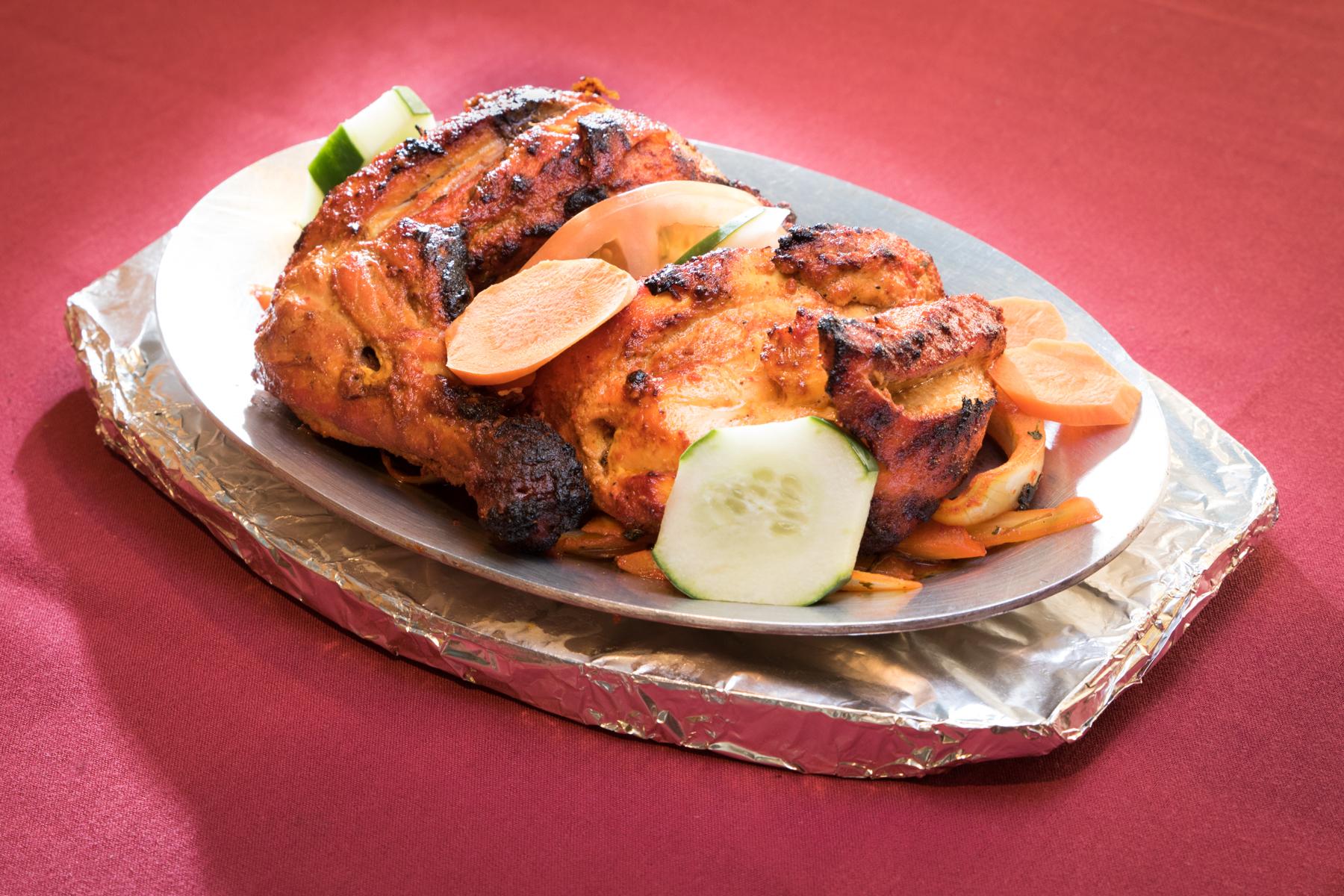
Tandoori Chicken
Tandoori chicken is another classic Indian dish that showcases the tandoor.
Chicken is marinated with spices and yogurt before being cooked at high temperature, creating a smoky exterior and juicy interior.
It is often served with lemon, onions, chutney, or other accompaniments.
Tandoori chicken is a good choice when you want something less sauce-heavy than a curry.
It also tends to travel reasonably well for takeout, although it is best eaten soon after preparation.
Chicken Tikka Masala
Chicken tikka masala is one of the most recognizable Indian restaurant dishes in the United States.
It combines grilled chicken pieces with a rich tomato-based sauce that may include cream, butter, herbs, and spices.
The dish is generally milder and creamier than many intensely spiced Indian curries, making it approachable for first-time diners.
If ordering it at a halal restaurant, confirm the chicken’s halal status.
Pair it with:
- Garlic naan
- Basmati rice
- Plain naan
- Vegetable biryani
- Raita
For a group, chicken tikka masala can work well alongside a vegetarian curry and a rice dish.
Butter Chicken
Butter chicken, also known as murgh makhani, is another popular North Indian dish.
It features chicken cooked in a smooth tomato-based sauce enriched with butter, cream, and spices.
The flavor is generally rich, mildly spiced, and slightly sweet compared with hotter curries.
Butter chicken is especially appealing if you prefer creamy curries rather than dishes dominated by chili heat.
Because the dish contains dairy, it is not vegan.
As with other chicken dishes, halal diners should confirm the meat is halal.
Lamb or Goat Curry
If you’re looking for something with a deeper, more robust flavor, consider lamb or goat curry.
Goat is particularly important in many South Asian culinary traditions and can have a more distinctive flavor than chicken.
Depending on the restaurant, you may encounter preparations involving tomato, onion, ginger, garlic, whole spices, or slow-cooked gravy.
Ask whether the restaurant serves goat curry, mutton curry, or lamb curry, since terminology can vary.
For halal diners, meat sourcing is especially important here. Confirm the meat is halal before ordering.
Chicken or Lamb Kebabs
Kebabs are another excellent choice for exploring Indian and broader South Asian cuisine.
Depending on the restaurant, you may find:
- Seekh kebab
- Chicken tikka
- Reshmi kebab
- Shami kebab
- Malai tikka
- Mixed grill preparations
Seekh kebabs are generally made from seasoned ground meat formed around skewers before grilling.
They are excellent for sharing and pair well with naan, chutneys, onions, and rice.
Kebabs can also be a good choice for diners who prefer grilled food over creamy curries.
Dal Tadka
Indian food is not all about meat.
Dal is one of the most important categories of Indian comfort food and should be on your list even if you’re primarily interested in meat dishes.
Dal tadka typically features cooked lentils finished with a tadka, or tempering, of spices and aromatics heated in oil or ghee.
The tempering can include ingredients such as cumin, garlic, dried chilies, mustard seeds, or other spices depending on the recipe.
Dal is generally hearty, comforting, and easy to pair with rice or naan.
Ask whether the dal is prepared with ghee if you are vegan.
Dal Makhani
Dal makhani is a richer lentil dish traditionally associated with North Indian and Punjabi cooking.
It is made primarily with black lentils and often includes kidney beans, butter, and cream.
The long cooking process gives it a deep, smooth texture.
Dal makhani is a particularly good option when sharing a meal because its richness balances well with grilled foods, rice, and breads.
For vegan diners, ask whether the restaurant can prepare it without butter or cream.
Chana Masala
Chana masala is a chickpea-based curry featuring tomatoes, onions, herbs, and spices.
It is one of the most useful dishes to know if you’re looking for a vegetarian or potentially vegan Indian meal.
The dish is filling without being dependent on meat, and it pairs naturally with rice, roti, or naan.
A current Brooklyn halal Indian menu lists chana masala alongside other vegetarian dishes, illustrating how common the dish is in halal-friendly Indian dining.
Saag Paneer
Saag paneer combines leafy greens with paneer, a fresh Indian cheese.
The greens may include spinach or other leafy vegetables depending on the restaurant.
It is creamy, earthy, and generally milder than fiery curries.
Saag paneer is a particularly good choice for vegetarians who want something substantial rather than simply ordering a vegetable side.
Because paneer is dairy, it is not vegan.
Palak Paneer
Palak paneer is closely related to saag paneer and is particularly associated with spinach.
The spinach is cooked with spices and combined with cubes of paneer.
The result is a smooth, savory dish that works well with naan, roti, or rice.
If you’re comparing the two, ask the restaurant whether its saag uses spinach exclusively or a broader combination of greens.
Aloo Gobi
Aloo gobi is a classic vegetarian preparation featuring potatoes and cauliflower.
It can range from relatively dry and roasted to more heavily sauced depending on the restaurant.
The combination of potato, cauliflower, turmeric, cumin, coriander, and other spices makes it a flavorful side or vegetarian main.
It is also useful for sharing because it complements richer dishes such as butter chicken or lamb curry.
Bhindi Masala
Bhindi masala features okra, known as bhindi in many Indian languages.
The okra is cooked with onions, tomatoes, and spices.
It has a very different texture from creamy curries and provides a more vegetable-forward option for the table.
If you enjoy roasted or sautéed vegetables, bhindi masala is worth trying.
A Brooklyn halal Indian menu currently lists bhindi masala among its vegetarian options.
Vegetable Biryani
Vegetable biryani is an excellent option for vegetarians who want the experience of biryani without meat.
Basmati rice is layered or cooked with vegetables, herbs, and aromatic spices.
The exact vegetables and preparation vary from restaurant to restaurant.
For a group containing both meat eaters and vegetarians, ordering one meat biryani and one vegetable biryani can be an easy way to satisfy everyone.
Samosas
Samosas are among the most recognizable Indian appetizers.
They are typically filled with spiced potatoes and peas, although meat-filled versions are also available.
Vegetable samosas are a convenient vegetarian option, while meat versions should be checked for halal status.
They work particularly well as a starter because they’re easy to share.
Order them with:
- Mint chutney
- Tamarind chutney
- Yogurt-based sauces
Pakora
Pakoras are vegetables or other ingredients coated in a seasoned batter and fried.
Common versions include:
- Onion pakora
- Potato pakora
- Vegetable pakora
- Paneer pakora
- Chicken pakora
Vegetable pakoras are particularly useful for vegetarian diners.
Because fried foods can lose their crispness during delivery, they’re best eaten soon after ordering.
Garlic Naan
No Indian meal feels complete for many diners without freshly baked naan.
Garlic naan is topped with garlic and often brushed with butter or ghee after cooking.
It is ideal for scooping up curries such as butter chicken, tikka masala, dal, and paneer dishes.
For vegans, ask whether the naan can be prepared without butter or ghee.
If you’re ordering delivery, consider adding naan separately rather than placing it underneath saucy dishes.
Roti and Paratha
If you want alternatives to naan, try roti or paratha.
Roti is generally thinner and made from whole-wheat flour.
Paratha is layered and richer, often with a flaky texture.
Some restaurants also offer stuffed versions containing potatoes, vegetables, or other fillings.
These breads provide a useful contrast to rice-based dishes and are particularly good with dry vegetable preparations and thick curries.
Dosa
For something completely different from North Indian curries, try dosa.
Dosa is a South Indian fermented crepe traditionally made from a rice-and-lentil batter.
It is typically thin and crisp and can be served with fillings such as spiced potatoes.
It is accompanied by sambar and chutneys.
Downtown Brooklyn has a strong South Indian presence through restaurants and food projects such as Brooklyn Curry Project, while Dosa Royale on Lafayette Avenue provides another nearby option for South Indian dishes.
Dosa is naturally vegetarian in many preparations, although diners should confirm ingredients such as butter or ghee if following a vegan diet.
Idli and Vada
Idli and vada are two other South Indian dishes worth exploring.
Idli is a soft steamed preparation made from fermented rice and lentil batter.
Vada is a savory fried lentil preparation with a crisp exterior and soft center.
Both are commonly served with sambar and chutneys.
They are especially useful for breakfast, lunch, or a lighter meal.
Chaat
If you want something snack-like, explore Indian chaat.
Chaat is a broad category rather than one specific dish and can include combinations of crispy components, potatoes, chickpeas, chutneys, yogurt, spices, and herbs.
Popular examples include:
- Papdi chaat
- Aloo chaat
- Samosa chaat
- Bhel puri
The combination of sweet, sour, salty, spicy, and crunchy flavors makes chaat very different from a standard curry-based meal.
Vindaloo
Vindaloo is a good choice if you enjoy stronger spice and acidity.
The dish has roots in Goa and reflects the region’s historical Portuguese influence.
Restaurant versions can feature chicken, lamb, goat, or vegetables.
The level of heat varies significantly between restaurants, so ask before ordering if you are sensitive to spice.
Vegetable vindaloo can also be a good option for vegetarians.
Korma
Korma is generally a rich, aromatic preparation featuring meat or vegetables cooked with spices and a creamy or nut-based sauce, depending on the recipe.
It is usually much milder than dishes such as vindaloo.
If you’re new to Indian cuisine or don’t enjoy very spicy food, korma can be an approachable choice.
For vegan diners, check whether the sauce contains cream, yogurt, or other dairy ingredients.
Tandoori Vegetables
Indian tandoor cooking isn’t limited to meat.
Restaurants may prepare vegetables, paneer, mushrooms, or other ingredients in the tandoor.
Tandoori vegetables can provide a smoky alternative to standard vegetable curries.
They are also useful when ordering for a mixed group where some diners want meat and others prefer vegetarian food.
Indian Thali
If you cannot decide what to order, look for a thali.
A thali is a complete meal served with multiple small portions, which can include:
- Rice
- Dal
- Vegetable curry
- Paneer
- Pickles
- Chutneys
- Roti or naan
- Dessert
The exact composition varies by restaurant and region.
A thali is particularly useful for first-time diners because it lets you sample several flavors in one meal.
However, diners with strict halal requirements should ask whether any meat is included and whether every component meets their requirements.
What Should You Order for Your First Halal Indian Meal?
If you’re visiting a halal Indian restaurant for the first time, a simple order could be:
For one person:
- Chicken or lamb biryani, after confirming halal status
- Vegetable samosa
- Garlic naan
- Raita
For two people:
- One chicken or lamb dish
- One vegetarian curry
- One biryani
- Garlic naan
- Samosas
- Chutneys
For a larger group:
- Chicken or lamb biryani
- Vegetable biryani
- One creamy curry
- One spicy curry
- Dal
- Paneer dish
- Tandoori appetizer
- Naan
- Rice
- Raita and chutneys
This approach provides a balance of meat, vegetables, rice, bread, spice levels, and textures.
How to Choose Dishes Based on Your Taste
If you like mild and creamy flavors, try:
- Butter chicken
- Korma
- Dal makhani
- Saag paneer
If you prefer smoky grilled food, try:
- Tandoori chicken
- Chicken tikka
- Seekh kebab
- Tandoori vegetables
If you enjoy spicy food, try:
- Vindaloo
- Spicy biryani
- Kebab preparations
- Regional chili-based curries
If you prefer vegetarian food, try:
- Chana masala
- Dal
- Saag paneer
- Aloo gobi
- Bhindi masala
- Vegetable biryani
- Dosa
If you want South Indian flavors, explore:
- Dosa
- Idli
- Vada
- Sambar
- Coconut-based chutneys
Final Tips for Ordering Halal Indian Food
The most important rule is simple: don’t assume the meat is halal just because the restaurant serves Indian food.
Before ordering chicken, lamb, goat, or other meat, ask the restaurant directly.
Also check:
- Whether the specific meat is halal
- Whether all meat served by the restaurant is halal
- Whether vegetarian dishes contain dairy
- Whether naan contains butter or ghee
- Whether sauces contain yogurt or cream
- Whether the restaurant uses shared cooking equipment, if that matters to you
Once those questions are answered, you can focus on the enjoyable part—exploring the enormous variety of Indian cuisine.
From fragrant biryani and smoky tandoori chicken to creamy paneer, comforting dal, crispy dosa, and flavorful vegetable curries, there is far more to discover than the familiar chicken tikka masala.
For diners exploring Downtown Brooklyn and nearby neighborhoods, the best strategy is to start with a few classic dishes and then branch into regional specialties. That approach makes it easier to understand the diversity of Indian cuisine while finding dishes that match your own taste and dietary requirements.
Vegetarian and Vegan Indian Food Options
Indian cuisine is one of the easiest cuisines to explore when you’re looking for vegetarian food, and Downtown Brooklyn is a good place to start. Indian cooking has a long tradition of vegetable-based curries, lentil dishes, rice preparations, breads, snacks, and South Indian specialties.
For vegan diners, however, there is an important distinction. Vegetarian does not automatically mean vegan. Many Indian vegetarian dishes contain paneer, butter, ghee, cream, yogurt, or other dairy products.
The good news is that there are still plenty of naturally plant-based Indian dishes to explore, especially when you know what to look for and what questions to ask.
Vegetarian Indian Food Is More Than Paneer
When people think about vegetarian Indian food, paneer dishes are often the first thing that come to mind.
Paneer is popular, but Indian vegetarian cuisine goes much further.
A typical Indian vegetarian menu can include:
- Dal
- Chana masala
- Aloo gobi
- Bhindi masala
- Baingan bharta
- Vegetable biryani
- Vegetable curry
- Samosas
- Pakoras
- Dosa
- Idli
- Vada
- Sambar
- Roti
- Rice
- Vegetable thali
This variety makes Indian restaurants particularly useful for groups where some people eat meat while others prefer vegetarian food.
Govinda’s Kitchen
For diners specifically interested in vegetarian Indian food around Downtown Brooklyn, Govinda’s Kitchen at 305 Schermerhorn Street is an especially notable option.
The restaurant describes its food as pure vegetarian and says its kitchen uses no meat, fish, eggs, onion, or garlic. Its menu includes thalis, dal or beans, vegetable preparations, paneer dishes, rice, roti, samosas, and other Indian foods.
Its current weekday menu includes an Express Thali for $8.99, a Veggie Thali for $13.99, a Paneer Thali for $14.99, and a Govinda Thali for $17.99.
The restaurant is therefore particularly interesting for diners who want a traditional vegetarian Indian meal rather than simply removing meat from a standard menu.
However, vegan diners should still check individual dishes. Paneer, raita, gulab jamun, and other items contain dairy, so a vegetarian meal at Govinda’s is not automatically vegan.
Dal
Dal should be near the top of any vegetarian Indian food list.
Made from lentils or other legumes, dal is a staple across many Indian culinary traditions.
Common versions include:
- Dal tadka
- Dal fry
- Dal makhani
- Moong dal
- Masoor dal
- Chana dal
Dal can be served with rice, roti, or naan.
For vegans, dal can be an excellent choice, but ask whether it is prepared with ghee or butter. A dish that looks completely plant-based may contain dairy fat.
Chana Masala
Chana masala is a chickpea curry cooked with spices, onions, tomatoes, herbs, and aromatics.
It is filling, flavorful, and naturally vegetarian.
Depending on the recipe, it can also be vegan, making it one of the easiest dishes to request when dining with a vegan group.
Pair chana masala with:
- Basmati rice
- Roti
- Plain naan, after confirming it contains no dairy
- Vegetable biryani
Its hearty texture also makes it a good alternative to meat-based curries.
Aloo Gobi
Aloo gobi combines potatoes and cauliflower with Indian spices.
It is one of the classic vegetarian dishes to order when you want something that is not creamy or paneer-based.
Depending on the restaurant, it may be relatively dry or prepared with a light sauce.
Ask whether the dish contains butter or ghee if you’re vegan.
Bhindi Masala
Bhindi, or okra, is another excellent vegetable option.
Bhindi masala is commonly prepared with onions, tomatoes, and spices. The dish has a completely different texture from creamy curries and can provide a nice contrast when ordering several dishes.
For a vegetarian table, bhindi masala works particularly well alongside dal, rice, naan, and a paneer dish.
For vegans, ask whether the restaurant uses ghee or butter.
Baingan Bharta
Baingan bharta is made from roasted or grilled eggplant that is mashed and cooked with aromatics and spices.
The roasting process gives the eggplant a smoky flavor.
It is a particularly good choice if you enjoy grilled vegetables and want something more complex than a basic vegetable curry.
Recipes vary considerably between restaurants, so this is one dish worth asking about when you’re exploring regional Indian food.
Saag Paneer and Palak Paneer
Paneer dishes are among the most popular vegetarian Indian entrées in the United States.
Saag paneer and palak paneer combine leafy greens with cubes of paneer.
They are generally rich, savory, and creamy.
The important point for vegan diners is obvious: paneer is dairy, so these dishes are vegetarian but not vegan.
You can ask whether the restaurant offers a tofu or vegetable alternative, but don’t assume that substitution is available.
Vegetable Biryani
Vegetable biryani is one of the best choices for a vegetarian diner who wants a substantial rice-based meal.
It combines aromatic rice with vegetables, herbs, and spices.
Some versions contain butter or ghee, while others may use vegetable oil, so vegan diners should confirm the preparation.
Vegetable biryani also works particularly well for groups because it can be shared alongside meat-based biryani and curries.
Dosa
Dosa is one of the most important South Indian dishes for vegetarian and vegan diners.
Traditional dosa is made from fermented rice and lentil batter and cooked into a thin, crisp crepe.
Popular varieties include:
- Plain dosa
- Masala dosa
- Mysore dosa
- Rava dosa
- Onion dosa
- Podi dosa
The filling in a masala dosa typically includes spiced potatoes.
Dosa is commonly served with sambar and chutneys.
The basic batter is naturally plant-based, but the cooking surface may be greased with butter or ghee, so vegan diners should ask before ordering.
DOSA ROYALE at 65 Lafayette Avenue is a nearby South Indian restaurant specializing in dosa and related cuisine. Current listings show service from 11 a.m. to 10 p.m. daily.
Idli
Idli is another excellent South Indian vegetarian choice.
These soft, steamed cakes are traditionally made from fermented rice and lentil batter.
Idli is generally served with sambar and coconut or other chutneys.
Because the basic preparation does not require meat or dairy, it can be a useful vegan option, although diners should still confirm the ingredients and preparation at the restaurant.
Idli also makes a lighter meal than a rich curry and can be especially appealing for breakfast or lunch.
Vada
Vada is a savory fried preparation generally made from lentil batter.
It has a crisp exterior and soft interior and is commonly served with sambar and chutney.
For vegan diners, the ingredients themselves are often suitable, but it is still worth checking what accompanies the dish.
Vada is also a good choice when you want something different from dosa or curry.
Samosas
Vegetable samosas are one of the easiest Indian appetizers to share.
The classic filling usually includes potatoes, peas, and spices inside a crisp pastry shell.
Most vegetable samosas are vegetarian, but vegan diners should check the pastry and preparation ingredients.
Samosas pair naturally with mint chutney and tamarind chutney.
At Govinda’s Kitchen, the current menu lists a potato-filled samosa for $3.99.
Pakoras
Pakoras are vegetables or other ingredients coated in seasoned batter and fried.
Vegetable varieties may include:
- Onion
- Potato
- Spinach
- Cauliflower
- Mixed vegetables
Pakoras can be vegetarian and sometimes vegan, but the batter and frying process should be confirmed.
They are best eaten fresh because their crisp texture declines during delivery.
Vegetable Thali
A thali is one of the best ways to explore vegetarian Indian food because it combines several small dishes into one meal.
A vegetarian thali may include:
- Rice
- Dal
- Vegetable curry
- Paneer
- Roti
- Salad
- Pickles
- Chutney
- Dessert
The exact contents depend on the restaurant.
Govinda’s Kitchen currently offers several vegetarian thali combinations, including its Veggie Thali and Govinda Thali.
For vegan diners, ask which components can be served without dairy.
Vegan Indian Food: What to Look For
If you’re vegan, some of the easiest dishes to investigate are:
- Chana masala
- Dal
- Vegetable curry
- Aloo gobi
- Bhindi masala
- Baingan bharta
- Vegetable biryani
- Plain dosa
- Idli
- Vada
- Vegetable samosas
- Vegetable pakoras
- Rice
- Roti, depending on preparation
But don’t rely solely on the dish name.
The same dish can be prepared differently at different restaurants.
Watch Out for Ghee
Ghee is clarified butter and is widely used in Indian cooking.
A dish may appear vegetarian and completely plant-based while still containing ghee.
This is especially important for:
- Dal
- Rice
- Biryani
- Dosa
- Roti
- Curries
- Vegetable preparations
If you are vegan, specifically ask:
“Is this cooked with ghee or butter?”
If the answer is yes, ask whether the restaurant can prepare it using vegetable oil instead.
Watch Out for Cream and Yogurt
Cream and yogurt are also common in Indian cooking.
They may appear in:
- Korma
- Paneer curries
- Butter chicken alternatives
- Raita
- Some sauces
- Marinades
A dish can therefore be vegetarian without being vegan.
For vegan diners, ask whether the curry contains:
- Cream
- Yogurt
- Butter
- Ghee
- Paneer
Naan Is Not Always Vegan
Naan is another common source of confusion.
Traditional naan can contain yogurt, milk, butter, or ghee, depending on the recipe.
Garlic naan is frequently finished with butter.
If you’re vegan, don’t simply order “plain naan” assuming it is dairy-free.
Ask:
“Is the naan made with dairy or brushed with butter?”
If it is, consider ordering roti or another bread that the restaurant confirms is vegan.
Rice Can Be a Good Vegan Choice
Plain basmati rice is generally one of the easiest accompaniments for vegan diners.
However, flavored rice dishes can contain butter or ghee.
Ask about:
- Jeera rice
- Biryani
- Pulao
- Coconut rice
- Vegetable rice
If you’re uncertain, plain rice is the simplest option.
Vegan-Friendly Indian Meals
If you want a simple vegan meal, consider ordering:
Option 1:
Chana masala + rice + vegetable samosa
Option 2:
Dal + aloo gobi + roti
Option 3:
Vegetable biryani + vegetable curry
Option 4:
Plain dosa + sambar + coconut chutney
Option 5:
Idli + sambar + chutney
Always confirm the ingredients before ordering.
Vegetarian and Vegan Dining for Groups
Indian restaurants are particularly useful for groups with different dietary requirements.
Imagine a table with four people:
- One person wants halal chicken.
- One person is vegetarian.
- One person is vegan.
- One person simply wants to try Indian food.
A shared Indian meal can accommodate all four.
For example:
Halal diner:
Chicken biryani or chicken tikka, after confirming halal status.
Vegetarian diner:
Saag paneer or vegetable biryani.
Vegan diner:
Chana masala, dal, vegetable curry, and rice.
Everyone:
Samosas, rice, chutneys, and vegetable dishes.
This is one of the reasons Indian food works particularly well for mixed-diet groups.
Vegetarian Does Not Automatically Mean Halal
There is another distinction worth remembering for this article.
Vegetarian food does not contain meat, but diners following halal dietary requirements may have additional concerns about ingredients and preparation.
For example, a vegetarian dish may contain alcohol-based ingredients or other components that a particular diner wants to avoid.
Similarly, a vegan dish is not automatically halal simply because it contains no animal products.
If you’re following halal dietary rules as well as a vegetarian or vegan diet, ask the restaurant about the specific ingredients and preparation methods that matter to you.
How to Find Vegan Options on a Menu
When reading an Indian menu, look for dishes described as:
- Vegan
- Plant-based
- Dairy-free
- Vegetarian
- Jain-friendly
But treat “vegetarian” and “vegan” as different categories.
You can also look for dishes built primarily around:
- Lentils
- Chickpeas
- Vegetables
- Rice
- Potatoes
- Eggplant
- Okra
- Fermented rice-and-lentil batter
These ingredients are often the starting point for plant-based Indian dishes.
Ask the Restaurant Three Simple Questions
If you’re unsure whether a dish is vegan, three questions can solve most problems:
1. “Does this contain dairy?”
2. “Is it cooked with butter or ghee?”
3. “Can you prepare it without dairy?”
If you’re also following halal requirements, add:
“Are there any ingredients I should know about for halal dietary requirements?”
Clear questions are usually more reliable than trying to interpret a menu description yourself.
Best Vegetarian and Vegan Choices by Category
| Category | Good Choices | Vegan? |
|---|---|---|
| Lentils | Dal tadka, dal fry | Often, but check ghee |
| Chickpeas | Chana masala | Often |
| Vegetables | Aloo gobi, bhindi, baingan bharta | Often |
| Rice | Plain basmati rice | Usually |
| Biryani | Vegetable biryani | Check ghee |
| South Indian | Idli, dosa, vada | Often, check cooking fat |
| Snacks | Vegetable samosa, pakora | Check ingredients |
| Paneer | Saag paneer, palak paneer | No |
| Bread | Roti | Often, check preparation |
| Naan | Plain or garlic naan | Often contains dairy |
| Thali | Vegetable thali | Depends on components |
| Desserts | Gulab jamun, kheer | Usually not vegan |
Final Tips for Vegetarian and Vegan Indian Dining
Downtown Brooklyn gives vegetarian diners plenty of choices, while vegan diners need to pay a little more attention to preparation.
The safest approach is not to assume that a dish is vegan simply because it contains vegetables.
Instead:
- Ask about ghee.
- Ask about butter.
- Ask about cream.
- Ask about yogurt.
- Check paneer.
- Confirm how naan is prepared.
- Ask whether rice contains butter or ghee.
- Confirm chutney and sauces when necessary.
For vegetarians, the process is much simpler. Indian menus commonly offer substantial meat-free meals built around lentils, vegetables, paneer, rice, breads, and South Indian specialties.
For vegans, dishes such as chana masala, dal, vegetable curries, vegetable biryani, dosa, idli, and certain vegetable preparations can provide satisfying meals when prepared without dairy.
And for diners who want the most straightforward vegetarian experience, Govinda’s Kitchen is particularly notable because its Brooklyn kitchen identifies itself as pure vegetarian and explicitly excludes meat, fish, and eggs.
Whether you’re vegetarian, vegan, halal-conscious, or simply trying to eat more plant-based meals, Indian cuisine offers enough variety that you rarely have to settle for a boring side dish.
Instead, build your meal around lentils, vegetables, rice, breads, dosa, and regional specialties and ask a few simple questions about dairy and preparation. That’s the easiest way to enjoy a flavorful Indian meal while staying within your dietary preferences.
Budget-Friendly Indian Restaurants
Indian food can be surprisingly affordable in Downtown Brooklyn, especially if you know what to order. While some Indian restaurants in the area offer upscale dining experiences, there are also casual restaurants, lunch specials, vegetarian dishes, and halal-friendly options that can provide a satisfying meal without turning dinner into a major expense.
For this guide, a budget-friendly Indian meal generally means around $10–$20 per person, while some sit-down restaurants can still offer good value in the $20–$30 range.
For halal diners, it is important to remember that affordability and halal status are separate considerations. A restaurant should be selected based on both price and whether it can confirm the halal requirements that matter to you.
Curry Heights
Curry Heights
Located at 151 Remsen Street, Curry Heights is one of the more affordable Indian restaurants in the Downtown Brooklyn area. Current business listings place the restaurant in the $10–$20 price range, with service generally running until around 9:45 p.m. most days.
The menu is useful for budget diners because you don’t necessarily need to order a large combination of dishes to have a complete meal.
Vegetarian curries, rice, naan, samosas, and other Indian staples can be combined into a relatively inexpensive meal.
For someone trying to stay around $20, a practical strategy is to order one curry with rice or bread rather than ordering several appetizers and entrées.
If halal status is important to you, confirm the current meat sourcing and preparation directly with the restaurant before ordering.
Kazi Halal Food
Kazi Halal Food
For diners whose priority is halal food at an affordable price, Kazi Halal Food at 61 Clinton Street is one of the most relevant nearby options.
The current business listing categorizes it as an Indian restaurant, halal establishment, and places it in the $10–$20 range.
Its current hours are primarily daytime and afternoon, making it more suitable for lunch than a late dinner. The restaurant’s own website also identifies its location at 61 Clinton Street and describes it as a halal restaurant.
Kazi is particularly useful when you want a quick, inexpensive halal meal rather than a formal Indian dining experience.
Masala Grill
Masala Grill
At 501B Atlantic Avenue, Masala Grill offers casual Indian dining in the broader Downtown Brooklyn/Fort Greene area.
Current listings place it around $20–$30, while its menu includes several relatively inexpensive appetizers and vegetarian dishes.
For example, its menu currently lists items such as chicken samosa for $3.95, chicken pakora for $4.95, and lamb seekh kebab for $6.95.
This makes Masala Grill particularly useful for groups because you can share a few inexpensive starters before ordering one or two larger dishes.
Current listings also identify vegetarian and halal options, although diners who require halal meat should confirm the current status directly with the restaurant.
Dastaan Indian Kitchen
Dastaan Indian Kitchen
Dastaan Indian Kitchen at 115 Smith Street is another option for diners who want a sit-down Indian meal without moving into fine-dining prices.
Current business listings place it in the $20–$30 range and show service until approximately 10:30 p.m.
The restaurant’s own website also promotes catering and describes its offerings as “Halal Flavors of India Catered.”
Because halal requirements can vary by diner and restaurant practice, it’s still worth asking about the specific meat dishes and current preparation when ordering.
For budget-conscious diners, sharing an appetizer and ordering one entrée each—or sharing several dishes across a group—can provide better value than ordering individual appetizers, entrées, and desserts.
Kashi’s Weekday Lunch Special
Kashi Indian Cuisine & Bar
Kashi at 286 Livingston Street is positioned at a higher price point for dinner, but its weekday lunch special provides a useful budget option.
The restaurant currently advertises a Monday-Friday lunch special from 11 a.m. to 3 p.m. The vegetarian option is $19.99, while the non-vegetarian option is $21.99. Each includes a starter, entrée, dal, accompaniments, and dessert.
The vegetarian lunch includes choices such as ragda chaat or samosa, paneer butter masala or saag paneer, dal makhani or dal tadka, naan, rice, raita, and dessert.
That makes the lunch special considerably more cost-effective than ordering multiple individual dishes.
However, diners looking specifically for halal meat should verify Kashi’s current halal status before ordering the non-vegetarian option.
Mint Heights
Mint Heights
Mint Heights is another Indian restaurant in the broader Downtown Brooklyn area, currently listed around $20–$30.
Its menu provides several options that can work well for budget-conscious diners, particularly if you choose one entrée and share rice or bread.
Vegetarian dishes are often a particularly good value because they can be filling without the higher cost associated with meat-based entrées.
The restaurant’s current business listing shows dinner service during the week and later weekend hours.
If you’re ordering for two people, sharing a vegetable curry, rice, naan, and one meat entrée can often provide more variety than ordering two separate meat-heavy meals.
BK JANI
BK JANI at Dekalb Market Hall
BK JANI at 445 Albee Square West is not an Indian restaurant—it is Pakistani—but it deserves a mention in a halal South Asian budget guide because it is located directly in Downtown Brooklyn and is currently listed around $10–$20.
Pakistani and North Indian cuisines share many dishes and culinary traditions, including biryani, naan, grilled meats, and richly spiced curries.
For a diner who is primarily looking for affordable halal South Asian food, BK JANI can therefore be a useful alternative.
Its current business listing shows service from noon until 10 p.m. daily.
Halima Indian Restaurant
Halima Indian Restaurant
Halima Indian Restaurant at 228 Albany Avenue is farther from Downtown Brooklyn, but it can be useful when expanding the search into Crown Heights and nearby neighborhoods.
Current business listings place it in a relatively affordable category and show service extending to around 11:30 p.m.
For diners who are willing to travel beyond Downtown Brooklyn, restaurants in surrounding neighborhoods can provide additional choices, particularly when you’re searching for later hours or a particular dietary requirement.
OMAR’S INDIAN FINE CUISINE
OMAR’S INDIAN FINE CUISINE
OMAR’S INDIAN FINE CUISINE at 568 Vanderbilt Avenue is another restaurant to consider when expanding the search into Prospect Heights.
Current listings place it around $20–$30, with hours extending to approximately 11 p.m. most days.
It isn’t the cheapest option on this list, but it can still provide reasonable value for diners who want a sit-down Indian meal rather than fast food.
The Vanderbilt Avenue location also makes it useful for people exploring Indian restaurants outside the immediate Downtown Brooklyn core.
Dosa Royale
DOSA ROYALE
For affordable vegetarian and South Indian food, Dosa Royale at 65 Lafayette Avenue is another nearby option.
Dosa, idli, vada, and other South Indian dishes can provide good value because many are based on rice, lentils, potatoes, and vegetables.
This is especially useful for vegetarians who want something different from the usual North Indian curry-and-naan combination.
Current business listings place Dosa Royale in the $20–$60 overall price category, although individual South Indian dishes can provide more affordable meal options.
How to Eat Indian Food on a $20 Budget
If you want to keep your meal around $20, the best strategy is usually not to order a full appetizer, entrée, bread, rice, drink, and dessert separately.
Instead, build your meal strategically.
Option 1: One Curry + Rice
Choose:
- Chana masala
- Dal
- Vegetable curry
- Saag paneer
Then add rice or roti.
This can be one of the simplest affordable meals.
Option 2: Biryani
A biryani can function as an entire meal because it combines rice, spices, and meat or vegetables.
For halal diners, confirm the meat is halal before ordering.
Option 3: Vegetarian Meal
Vegetarian dishes are often among the most economical choices.
Try:
- Aloo gobi
- Chana masala
- Dal
- Vegetable biryani
- Bhindi masala
Add rice or one bread rather than several sides.
Option 4: Share a Few Dishes
For two people, consider:
- One appetizer
- One curry
- One vegetable dish
- Rice or naan
Sharing gives you more variety while controlling the total bill.
Vegetarian Diners Often Get the Best Value
Indian cuisine is particularly friendly to budget-conscious vegetarians.
A meat entrée can be more expensive, while dishes based around lentils, chickpeas, potatoes, cauliflower, spinach, and other vegetables can provide a complete meal for less.
Kashi’s weekday lunch special illustrates this difference: its current vegetarian lunch is $19.99 compared with $21.99 for the non-vegetarian option.
For vegan diners, ask whether the dish contains ghee, butter, cream, or yogurt before ordering.
Lunch Is Usually Better for Your Budget
If you have flexibility about when you eat, lunch is often the easiest way to experience a more expensive Indian restaurant without paying full dinner prices.
Kashi currently offers its weekday lunch special from 11 a.m. to 3 p.m., with a multi-course vegetarian meal for $19.99 and non-vegetarian meal for $21.99.
Other restaurants may offer lunch boxes, lunch combos, thalis, or weekday specials.
When comparing restaurants, search for lunch specials rather than simply searching for cheap restaurants.
Don’t Forget Takeout
Takeout can also help keep the total cost under control.
You can skip drinks and potentially share one or two dishes at home.
Good takeout choices include:
- Biryani
- Dal
- Chana masala
- Chicken curry
- Vegetable curry
- Paneer dishes
- Rice
- Naan
If you’re ordering for two, one large rice dish plus two curries can often be more economical than ordering two complete meals.
Watch Delivery Fees
A meal that appears to cost $15 can become significantly more expensive after delivery charges, service fees, taxes, and tip.
If your goal is affordability, compare:
- Restaurant pickup
- Direct restaurant ordering
- Third-party delivery
- Dine-in lunch specials
A 2026 Brooklyn food guide notes that direct ordering can sometimes reduce the extra platform fees associated with third-party delivery services.
Pickup is particularly useful when the restaurant is close enough to walk or make a short trip.
Budget-Friendly Options by Situation
| Dining Situation | Good Strategy |
|---|---|
| Under $15 | Dal, chana, samosas, rice, roti |
| Around $20 | One entrée + rice/bread |
| $20–$25 | Lunch special or shared dishes |
| Two people | Share curry + vegetable dish + rice/naan |
| Vegetarian | Dal, chana, vegetable curry, dosa |
| Vegan | Dal, chana, vegetables, rice, dosa after checking dairy |
| Halal | Confirm meat status first, then compare prices |
| Takeout | Biryani or curry + rice |
| Group | Shared biryani + curries + naan |
| Best value lunch | Weekday lunch specials |
Budget Doesn’t Mean You Have to Skip Authenticity
Affordable Indian food does not necessarily mean sacrificing regional character.
A simple bowl of dal, a plate of dosa, a vegetable curry, or a well-prepared biryani can provide a more meaningful introduction to Indian cuisine than an expensive multi-course meal.
When choosing a budget restaurant, look beyond the price.
Ask:
- Does the restaurant specialize in a particular regional cuisine?
- Are dishes prepared fresh?
- Are vegetarian options substantial?
- Can the staff explain unfamiliar dishes?
- Is halal status clearly documented if needed?
- Are lunch specials available?
- Can you order individual portions instead of expensive combinations?
These questions can help you find value without reducing the search to the cheapest menu.
Best Budget Choices for Halal Diners
For halal diners, the options should be considered in two categories.
Clearly identified halal options:
Kazi Halal Food and Curry Spot are among the nearby establishments currently identified as halal, with Kazi listed around $10–$20.
Restaurants where halal status should be verified:
Several Indian restaurants in Downtown Brooklyn offer affordable meals, but diners should confirm the current halal status of meat before ordering.
Dastaan’s website specifically promotes halal Indian catering, which may be useful for larger orders, while Masala Grill is listed by one current directory as offering halal options.
Because halal standards and restaurant practices can vary, direct confirmation remains the safest approach.
Final Tips for Saving Money on Indian Food
If you’re exploring Indian restaurants in Downtown Brooklyn on a budget, keep these strategies in mind:
Choose lunch when possible.
Weekday specials can provide several components for one fixed price.
Order vegetarian dishes.
Dal, chana, vegetable curries, dosa, and rice are often filling and economical.
Share dishes.
Indian food is naturally suited to family-style ordering.
Skip unnecessary extras.
Rice or naan plus a curry can be enough for a satisfying meal.
Compare pickup and delivery.
Extra delivery fees can significantly increase the final bill.
Look for halal restaurants directly.
If halal is essential, verify status before choosing based on price alone.
Try regional dishes.
A budget meal can still introduce you to South Indian, North Indian, or other regional traditions.
Final Thoughts
Downtown Brooklyn has Indian restaurants across several price levels, so eating Indian food on a budget is very possible.
For a quick and inexpensive halal meal, Kazi Halal Food is one nearby option currently listed in the $10–$20 range. For casual Indian dining, Curry Heights offers another affordable choice. Masala Grill provides inexpensive appetizers and a broader menu, while Dastaan sits in a moderate price range. Kashi’s weekday lunch special is another example of how a higher-end Indian restaurant can become more accessible during lunch.
The most effective strategy is to focus on value rather than simply the lowest menu price.
Choose a filling dish, share where practical, take advantage of lunch specials, and compare pickup with delivery costs. If you’re following halal or vegan dietary requirements, verify ingredients and preparation before ordering.
With the right approach, you can enjoy biryani, curries, dal, dosa, naan, samosas, and other Indian favorites in and around Downtown Brooklyn without turning every meal into a luxury dining experience.
Fine Dining Indian Restaurants
Fine dining Indian food in and around Downtown Brooklyn offers a very different experience from a quick curry, takeout meal, or casual biryani restaurant. These restaurants tend to place greater emphasis on presentation, regional culinary traditions, service, atmosphere, cocktails or wine, and chef-driven menus.
For diners looking for halal Indian food, however, there is an important distinction: an upscale Indian restaurant is not automatically halal. If halal meat is essential to your dining choice, confirm the restaurant’s current meat sourcing and preparation directly before ordering.
Kashi Indian Cuisine & Bar
Kashi Indian Cuisine & Bar at 286 Livingston Street is one of the most prominent upscale Indian restaurants in Downtown Brooklyn.
The restaurant describes its food as a modern interpretation of North Indian cuisine, drawing inspiration from Awadhi, Mughlai, and Punjabi traditions. Its menu highlights slow-cooked biryanis, char-grilled kebabs, curries, and other dishes rooted in North Indian cooking.
Kashi’s chef, Hakikat Dhawan, has worked at several Indian restaurants in New York and previously trained at Taj Palace New Delhi. The restaurant’s concept combines traditional Indian flavors with contemporary presentation and techniques.
OpenTable currently categorizes Kashi as fine dining, with a typical price range of $31–$50. It also lists the restaurant as suitable for special occasions and business meals.
The dining room and bar make Kashi suitable for occasions such as:
- Date nights
- Business dinners
- Birthdays
- Family celebrations
- Pre-event dinners
- Special occasions
For halal diners, Kashi should currently be treated as a verify-before-ordering restaurant, rather than automatically being described as halal.
Indian Table
Indian Table at 234 Court Street is another standout for diners interested in a more specialized Indian dining experience near Downtown Brooklyn.
Rather than presenting a generic Indian menu, Indian Table focuses on Goan cuisine, incorporating Indian and Portuguese influences.
The restaurant’s official website describes it as Indian-Goan cuisine and identifies chef Eric McCarthy, while Condé Nast Traveler highlights dishes such as chicken cafreal, ros omelette, pork sorpotel, fish curry, and crab cutlets.
This regional focus makes Indian Table particularly interesting for diners who want to explore an Indian cuisine that is different from the more familiar North Indian curry-and-naan format.
Current hours are listed as lunch from noon to 2:45 p.m. and dinner from 5 p.m. to 9:45 p.m. daily.
The restaurant is especially suitable for:
- Regional Indian food enthusiasts
- Couples
- Food-focused dinners
- Special occasions
- Diners interested in Goan cuisine
However, because the menu includes pork and seafood, halal diners should verify whether the restaurant meets their individual halal requirements before dining.
Dastaan Indian Kitchen
Dastaan Indian Kitchen at 115 Smith Street is another polished Indian restaurant in the Downtown Brooklyn area.
Current business listings place it around the $20–$30 price range and show dinner service extending to approximately 10:30 p.m.
Dastaan is particularly relevant to this article because its own website promotes “Halal Flavors of India Catered.” This makes it worth investigating for diners specifically interested in halal Indian cuisine, particularly for larger meals and catered occasions.
For a special dinner, diners can explore dishes such as biryani, curries, kebabs, paneer preparations, rice, and Indian breads.
If halal status is essential, confirm which meat dishes are currently halal and whether the restaurant’s preparation practices match your requirements.
OMAR’S Indian Fine Cuisine
OMAR’S Indian Fine Cuisine at 568 Vanderbilt Avenue is located in Prospect Heights rather than Downtown Brooklyn, but it is worth including for diners willing to travel a little farther.
The restaurant is currently listed as an Indian restaurant in the $20–$30 price range and operates into the evening, generally until 11 p.m.
Its location on Vanderbilt Avenue places it within a broader Brooklyn dining corridor where visitors can explore Indian food outside the Downtown Brooklyn core.
OMAR’S can be a useful option for:
- Sit-down dinners
- Family meals
- Indian-food enthusiasts
- Diners exploring Prospect Heights
- Evening dining
If halal meat is required, verify its current halal status directly before ordering.
LORE
For diners willing to travel beyond Downtown Brooklyn, LORE at 441 7th Avenue in Brooklyn offers a more modern Indian dining experience.
Current business listings categorize LORE as a Modern Indian restaurant with a price range of approximately $40–$100.
The higher price point makes it more appropriate for special occasions rather than an everyday Indian dinner.
Modern Indian restaurants such as LORE can be particularly interesting for diners who want to experience familiar Indian ingredients presented through contemporary culinary techniques.
Possible reasons to consider this type of restaurant include:
- Creative presentations
- Contemporary Indian cooking
- Special-occasion dining
- A more polished atmosphere
- Exploring dishes beyond traditional restaurant staples
However, LORE should not be presented as a confirmed halal restaurant without current verification.
Dosa Royale
DOSA ROYALE at 65 Lafayette Avenue provides a different type of elevated Indian dining experience by focusing on South Indian cuisine.
Current business listings categorize it as a South Indian restaurant, with a price range around $20–$60 and service extending through dinner.
Instead of focusing primarily on North Indian curries and tandoori dishes, South Indian restaurants introduce diners to foods such as:
- Dosa
- Masala dosa
- Idli
- Vada
- Sambar
- Coconut chutneys
- South Indian rice dishes
This makes Dosa Royale particularly interesting for diners who want to explore a different side of Indian cuisine.
Vegetarians also have many options in South Indian cooking.
Halal diners should note that vegetarian dishes may be suitable depending on their requirements, but any meat or other ingredients should be checked directly with the restaurant.
Kashi for a Special Occasion
Among the restaurants directly in Downtown Brooklyn, Kashi is particularly suited to diners who want an upscale North Indian atmosphere.
Its official concept emphasizes modern North Indian cuisine, while OpenTable currently classifies the restaurant as fine dining and lists it as suitable for special occasions and business meals.
The restaurant also offers a full bar and a more polished dining environment, making it appropriate for an evening when the experience matters as much as the food.
For halal diners, however, the restaurant’s upscale positioning should not be confused with halal certification.
Always verify meat sourcing before ordering.
Indian Table for Regional Indian Dining
Indian Table offers a different kind of fine-dining experience.
Instead of emphasizing a broad selection of Indian classics, its identity is strongly connected to Goan cuisine and Indian-Portuguese culinary traditions.
That makes it particularly appealing for diners who have already tried standard Indian restaurant dishes and want to explore something more regional.
The restaurant’s menu can introduce diners to ingredients and preparations associated with Goa, including seafood and traditional Goan specialties.
Because its cuisine includes pork and seafood, it is not a straightforward recommendation for diners seeking halal meat. Those diners should review the menu and speak with the restaurant before visiting.
What Makes Fine Dining Indian Different?
Fine dining Indian restaurants are often distinguished by several factors.
Regional focus:
The menu may highlight a particular Indian region rather than trying to represent every part of the country.
Chef-driven cooking:
Chefs may reinterpret traditional recipes using modern techniques.
Presentation:
Dishes are often plated more carefully than at casual restaurants.
Service:
The dining experience generally includes more attentive table service.
Atmosphere:
Fine dining restaurants typically place more emphasis on lighting, furniture, music, and overall ambience.
Beverage programs:
Some upscale Indian restaurants offer cocktails, wine, or Indian-inspired drinks designed to pair with the food.
Special occasions:
These restaurants are often chosen for birthdays, anniversaries, business dinners, and date nights.
What Should You Order at a Fine Dining Indian Restaurant?
If you’re spending more on dinner, consider ordering dishes that demonstrate the restaurant’s specialty rather than choosing only familiar favorites.
For a North Indian restaurant, consider:
- Slow-cooked biryani
- Tandoori kebabs
- Regional curries
- Paneer preparations
- Dal
- Specialty breads
For a Goan restaurant, explore:
- Goan fish curry
- Chicken cafreal
- Regional seafood
- Traditional Goan preparations
For a South Indian restaurant, try:
- Masala dosa
- Regional dosa variations
- Idli
- Vada
- Sambar
- Specialty rice dishes
The idea is to use the opportunity to discover something beyond the standard butter chicken and naan combination.
Fine Dining and Halal Requirements
This is particularly important for this article.
A restaurant’s menu may contain halal-friendly vegetarian dishes even if its meat is not halal.
For example, you may be able to order:
- Dal
- Chana masala
- Vegetable curry
- Aloo gobi
- Vegetable biryani
- Dosa
- Idli
- Rice
But if you want chicken, lamb, goat, or another meat, confirm the halal status directly.
Questions to ask include:
“Is your chicken halal?”
“Is your lamb or goat halal?”
“Is all of the meat halal?”
“Do you prepare halal meat separately?”
The exact questions you need to ask depend on your own dietary standards.
Fine Dining vs. Casual Indian Restaurants
The choice between fine dining and casual dining depends largely on what you want from the evening.
| Fine Dining | Casual Dining |
|---|---|
| More polished atmosphere | More relaxed atmosphere |
| Higher average cost | Lower average cost |
| Chef-driven menus | Familiar comfort food |
| More elaborate presentation | Faster service |
| Better suited to celebrations | Better for everyday meals |
| More emphasis on service | More emphasis on convenience |
| Often full beverage programs | Usually simpler beverage options |
Neither style is inherently better for every diner.
If you’re celebrating an anniversary, a fine-dining restaurant may provide the type of atmosphere you’re looking for.
If you simply want biryani and naan after work, a casual restaurant may make more sense.
Fine Dining for Families and Groups
Indian food is naturally suited to group dining because many dishes are designed to be shared.
At an upscale restaurant, a group can order:
- One biryani
- Two or three curries
- One vegetarian dish
- A kebab appetizer
- Dal
- Several breads
- Rice
- Desserts
This approach allows everyone to taste different dishes.
For groups with halal, vegetarian, and vegan diners, explain dietary requirements to the restaurant before ordering.
That can make it easier to plan a menu everyone can enjoy.
Fine Dining for Date Night
Indian cuisine can work particularly well for date night because a shared meal allows couples to try several dishes together.
A date-night order might include:
- One grilled appetizer
- One curry
- One vegetarian dish
- Rice or biryani
- Naan
- Dessert
Kashi’s current OpenTable listing specifically identifies the restaurant as suitable for special occasions and business meals and offers a cocktail and bar program.
Indian Table offers a different atmosphere, with a smaller regional menu centered on Goan cuisine and a cozy dining room.
How Much Should You Budget?
Fine dining Indian food can vary considerably in price.
A rough planning guide is:
- $20–$30 per person: Upscale-casual Indian dining
- $30–$50 per person: More polished dinner experience
- $50+ per person: Premium modern Indian dining, depending on drinks and number of courses
Drinks, appetizers, desserts, tax, and tip can increase the final bill.
Kashi is currently listed by OpenTable at approximately $31–$50 per person before additional costs.
LORE is currently listed around $40–$100, making it a substantially more expensive option.
Best Fine Dining Choices by Experience
Modern North Indian:
Kashi Indian Cuisine & Bar
Goan and Indian-Portuguese:
Indian Table
Halal-focused Indian catering and dining:
Dastaan Indian Kitchen — verify current meat and preparation details
South Indian:
Dosa Royale
Modern Indian:
LORE
Indian dining in Prospect Heights:
OMAR’S Indian Fine Cuisine
These restaurants represent different approaches to Indian dining rather than identical experiences.
A Note About “Authentic” Fine Dining
Fine dining does not necessarily mean more authentic.
An upscale restaurant may reinterpret traditional dishes using modern techniques, while a small casual restaurant may serve a very traditional family recipe.
For diners interested in authenticity, look for:
- Regional identity
- Traditional ingredients
- Cooking techniques
- Knowledgeable staff
- Clear dish descriptions
- Culinary history
- Consistency
Kashi, for example, explicitly describes its food as rooted in Awadhi, Mughlai, and Punjabi traditions while combining those traditions with contemporary techniques.
Indian Table similarly focuses on the distinctive regional traditions of Goa.
Final Thoughts
Fine dining Indian restaurants around Downtown Brooklyn provide an opportunity to experience Indian cuisine beyond the standard neighborhood curry restaurant.
Kashi is particularly focused on modern North Indian cuisine and currently operates as a fine-dining restaurant at 286 Livingston Street.
Indian Table offers a distinctly regional Goan experience at 234 Court Street, giving diners an opportunity to explore Indian-Portuguese cuisine.
Dastaan provides another polished Indian option in the Downtown Brooklyn area and specifically promotes halal Indian catering, making it relevant to this article’s halal focus.
Beyond Downtown Brooklyn, OMAR’S, Dosa Royale, and LORE provide additional options for diners willing to travel into neighboring Brooklyn areas.
For Muslim diners, the most important takeaway is to separate fine dining quality from halal status. A restaurant can offer sophisticated Indian cuisine without necessarily serving halal meat. Always verify the restaurant’s current halal practices before ordering meat.
With that distinction in mind, fine dining can be an excellent way to explore India’s regional diversity—from North Indian Awadhi and Mughlai cooking to Goan coastal cuisine and South Indian specialties—while enjoying a more polished Brooklyn dining experience.
Takeout and Delivery Tips
Indian food is particularly well suited to takeout and delivery. Curries, biryani, dal, rice, paneer dishes, and many vegetable preparations can travel well and still taste satisfying once they reach your table.
Downtown Brooklyn also has plenty of delivery infrastructure, with restaurant-specific ordering as well as major delivery platforms offering Indian food in the area. Wonder currently lists Indian delivery options specifically for Downtown Brooklyn, while Brooklyn restaurants such as Kazi Halal Food offer both takeout and delivery.
For this guide, halal diners should remember one important rule: never assume that an Indian restaurant’s meat is halal simply because the cuisine is Indian. Confirm the current halal status of chicken, lamb, goat, or other meat before placing your order.
Choose Dishes That Travel Well
Not every Indian dish performs equally well during delivery.
The best delivery choices are generally dishes with sauces, gravies, or rice that remain flavorful after transportation.
Good choices include:
- Chicken biryani
- Lamb or goat biryani
- Vegetable biryani
- Butter chicken
- Chicken tikka masala
- Dal
- Chana masala
- Korma
- Saag paneer
- Paneer curry
- Vegetable curry
- Lamb curry
- Rice dishes
Biryani is particularly convenient because it is already designed as a complete rice-based meal.
Creamy and tomato-based curries also tend to maintain their texture during a short delivery journey.
Biryani Is One of the Best Delivery Choices
If you’re ordering Indian food for delivery and aren’t sure what to choose, biryani is often a safe starting point.
The rice, spices, herbs, and meat or vegetables are packed together, so the dish doesn’t depend on delicate presentation.
You can order:
- Chicken biryani
- Lamb biryani
- Goat biryani
- Vegetable biryani
For halal diners, confirm that the meat used in the biryani is halal before ordering.
If raita is included, keep it chilled and add it when you’re ready to eat rather than mixing it into the hot biryani during transport.
Curries Are Excellent for Delivery
Curries are another strong choice.
Dishes such as butter chicken, chicken tikka masala, korma, dal, chana masala, and paneer curries generally hold up well during transportation.
They can be paired with:
- Basmati rice
- Jeera rice
- Biryani
- Naan
- Roti
One advantage of curry delivery is that the sauce helps protect the food from drying out during transportation.
If you’re ordering for two people, consider choosing two different curries and one rice dish rather than ordering two identical entrées.
Naan Needs Special Attention
Fresh naan is one of the most enjoyable parts of an Indian meal, but it can lose some of its texture during delivery.
Garlic naan, butter naan, cheese naan, and plain naan can become softer as steam accumulates inside the packaging.
When possible:
- Order naan separately.
- Open the container when it arrives.
- Reheat briefly if necessary.
- Avoid placing naan underneath a curry container.
- Eat it soon after delivery.
If you’re vegan, remember that naan may contain butter, milk, yogurt, or ghee. Ask the restaurant whether a dairy-free bread option is available.
Dosa Is Better for Short-Distance Delivery
Dosa is delicious when fresh but is more difficult to deliver than curry or biryani.
The crisp exterior can soften quickly inside a closed delivery container.
If you’re craving dosa, pickup or a very short delivery distance is generally preferable.
Keep the dosa separate from:
- Sambar
- Coconut chutney
- Tomato chutney
- Other sauces
If the restaurant packages these separately, keep them separate until you’re ready to eat.
Fried Appetizers Are Best Eaten Quickly
Samosas, pakoras, vadas, and other fried appetizers can lose their crispness during delivery.
They’re still good options, but they are better when:
- The restaurant is nearby.
- Delivery is quick.
- You eat them immediately.
- They are packed in a way that allows some steam to escape.
If you’re ordering a large meal, don’t let fried appetizers sit underneath hot curry containers.
For maximum crispness, pickup is often the better option.
Vegetarian and Vegan Delivery
Indian food provides plenty of delivery choices for vegetarians.
Good options include:
- Chana masala
- Dal tadka
- Dal makhani
- Saag paneer
- Palak paneer
- Aloo gobi
- Bhindi masala
- Vegetable biryani
- Vegetable curry
- Dosa
- Idli
- Vegetable samosas
Vegan diners need to check more carefully.
Ask whether the dish contains:
- Butter
- Ghee
- Cream
- Yogurt
- Paneer
Even dishes that appear completely plant-based may contain dairy during preparation.
Halal Takeout and Delivery
For this particular guide, halal verification should happen before ordering rather than after the food arrives.
Kazi Halal Food at 61 Clinton Street currently offers dine-in, takeout, and delivery through its ordering system. Its current ordering page identifies the restaurant as halal and provides online ordering information.
When ordering from an Indian restaurant that isn’t clearly identified as halal, ask:
“Is the chicken halal?”
“Is the lamb or goat halal?”
“Is all of your meat halal?”
If you have additional requirements regarding preparation or shared equipment, ask those questions as well.
Order Directly When Practical
Many restaurants offer their own ordering systems in addition to third-party delivery platforms.
Before checking out, compare:
- Restaurant’s own website
- Restaurant phone ordering
- Pickup price
- Delivery-platform price
- Delivery fee
- Service fee
- Minimum order
- Estimated delivery time
For example, Vojon Bilash, a halal South Asian restaurant in Brooklyn, currently promotes direct ordering for pickup and delivery and specifically notes that direct ordering can avoid third-party app fees.
Direct ordering isn’t always cheaper, but it is worth checking.
Watch the Final Checkout Price
A restaurant menu might show a $17 biryani, but the final delivery bill can be substantially higher after:
- Delivery fees
- Service fees
- Small-order fees
- Taxes
- Tip
- Platform charges
If you’re ordering for one person, pickup can sometimes provide significantly better value.
If you’re ordering for a group, delivery fees may be easier to justify because they are spread across several meals.
Check the Delivery Radius
Not every restaurant delivers equally far.
A restaurant located a few blocks away may be a better choice for dosa, naan, kebabs, and fried appetizers.
A restaurant farther away may still be suitable for biryani or curry if its delivery service is reliable.
For example, Wonder currently offers Indian delivery specifically in Downtown Brooklyn, while larger delivery platforms such as Uber Eats and DoorDash provide broader Brooklyn coverage.
Always check the actual delivery estimate for your address rather than assuming that a restaurant’s general delivery area includes you.
Order Before the Kitchen Gets Busy
If you’re ordering around dinner time, don’t wait until the exact moment you want to eat.
Indian dishes often require preparation time, especially:
- Biryani
- Tandoori dishes
- Kebabs
- Dosa
- Large group orders
During busy Friday and Saturday evenings, preparation and delivery times can increase.
If you’re ordering for a group, place the order earlier whenever possible.
Late-Night Delivery Requires Extra Checking
Late-night delivery is particularly dependent on the restaurant and delivery platform.
A restaurant may remain open but stop accepting delivery orders earlier.
Another restaurant may accept orders through a third-party platform after its regular dining service has slowed.
Current local listings show significant variation in hours. Masala Grill is currently listed until 11 p.m. Friday and Saturday, while Dastaan is listed until 10:30 p.m. daily.
Mint Heights at 368 Myrtle Avenue is currently listed until midnight on several days, making the broader Fort Greene/Clinton Hill area useful for later Indian-food searches.
For late-night orders, check the actual delivery cutoff at the moment you place the order.
Keep the Restaurant’s Kitchen Cutoff in Mind
A restaurant’s posted closing time is not necessarily the same as its final delivery-order time.
There can be separate cutoffs for:
- Dine-in
- Pickup
- Delivery
- Online ordering
- Kitchen orders
If you’re ordering close to closing time, check the ordering platform rather than relying only on the restaurant’s general hours.
Best Dishes for a Group Delivery
Indian food is particularly convenient for group delivery.
For four people, for example, you could order:
- One chicken or lamb biryani
- One vegetable biryani
- One creamy curry
- One vegetable curry
- Dal
- Two or three orders of naan
- Samosas
- Raita
- Chutneys
This creates a variety of flavors without requiring four completely separate meals.
For halal groups, verify the meat dishes first.
For mixed groups, keep vegetarian and vegan dishes clearly identified.
A Good Order for Two People
For two diners, avoid ordering too much.
A practical combination could be:
Option 1:
- One chicken biryani
- One vegetarian curry
- Garlic naan
- Samosas
Option 2:
- One chicken curry
- One dal
- Rice
- Naan
- One appetizer
Option 3 — vegetarian:
- Chana masala
- Saag paneer
- Rice
- Naan
- Samosas
Option 4 — vegan:
- Chana masala
- Dal prepared without ghee
- Vegetable curry
- Rice
- Dairy-free bread if available
Delivery Tips for Families
If you’re ordering Indian food for a family, prioritize dishes that everyone can share.
Rice and curry are usually easier for families than individual plated meals.
Consider:
- One mild curry
- One medium-spiced curry
- One vegetarian dish
- Rice
- Naan
- Samosas
- Yogurt or raita
If children are eating, ask the restaurant to keep one curry mild.
Reheating Indian Takeout
Indian food can often be reheated successfully, but different dishes require different approaches.
Rice:
Reheat gently and add a small amount of water if necessary.
Curry:
Reheat slowly on the stovetop or in short microwave intervals.
Naan:
Use a toaster oven, skillet, or brief oven heating to restore texture.
Samosas:
An oven or air fryer can help restore crispness better than a microwave.
Dosa:
Best eaten immediately rather than stored for long periods.
Tandoori items:
Reheat briefly to avoid drying out the meat.
Avoid repeatedly reheating the same food.
Takeout Can Be Better Than Delivery
If the restaurant is nearby, pickup has several advantages.
You can:
- Avoid delivery fees.
- Reduce travel time for the food.
- Pick up food immediately after preparation.
- Reduce the chance of a long delivery delay.
- Keep fried foods and naan fresher.
This can be especially useful around Downtown Brooklyn, where many restaurants are concentrated within relatively short distances.
Best Takeout Choices
For pickup, consider:
- Chicken tikka
- Tandoori chicken
- Seekh kebab
- Samosas
- Pakoras
- Naan
- Dosa
- Biryani
- Curry
- Paneer dishes
Pickup is particularly worthwhile for foods where texture matters.
Best Delivery Choices
For delivery, prioritize:
- Biryani
- Butter chicken
- Chicken tikka masala
- Dal
- Chana masala
- Korma
- Paneer curry
- Vegetable curry
- Rice dishes
These foods are generally more forgiving of transportation time.
How to Keep Your Order Affordable
If you’re trying to keep delivery costs under control:
Choose one large rice dish.
Biryani can serve as the main part of the meal.
Share curries.
Two shared curries can provide more variety than several individual entrées.
Avoid unnecessary drinks.
Beverages can increase the total quickly.
Compare pickup and delivery.
A short walk can save delivery charges.
Check direct ordering.
The restaurant’s own ordering system may have different fees.
Order enough for the group.
A well-planned shared order can be more economical than multiple individual meals.
Delivery for Office Lunches
Indian food can work particularly well for office lunches because many dishes can be portioned easily.
For an office group, consider:
- Vegetable biryani
- Chicken biryani
- Dal
- Paneer curry
- Chicken curry
- Naan
- Raita
- Samosas
If you’re ordering for a mixed dietary group, clearly identify:
- Halal
- Vegetarian
- Vegan
- Dairy-containing dishes
- Spicy dishes
This can prevent confusion when several people are sharing one order.
What to Do If Your Order Arrives Late
If delivery takes considerably longer than expected, check the food immediately.
Look at:
- Temperature
- Packaging
- Missing items
- Spills
- Incorrect dishes
If an item is missing or incorrect, contact the restaurant or delivery platform promptly.
Current delivery listings show that delays can occasionally occur even when restaurants prepare orders quickly, because delivery-partner availability and traffic can affect the final journey.
Takeout and Delivery Checklist
Before ordering Indian food in Downtown Brooklyn, check:
- Is the restaurant currently open?
- Is delivery available to your location?
- What is the estimated delivery time?
- What is the kitchen’s final order time?
- Is the meat halal if required?
- Are vegetarian and vegan dishes clearly identified?
- Does naan contain dairy?
- Does dal contain ghee?
- Are delivery fees reasonable?
- Would pickup produce a fresher meal?
These ten questions can prevent most common takeout problems.
Final Tips for a Better Indian Takeout Experience
The best Indian takeout order isn’t necessarily the largest one. It is the order that matches your group, dietary requirements, travel time, and budget.
If you’re ordering biryani, you’re choosing something that generally travels well.
If you’re ordering naan and kebabs, pickup may give you better texture.
If you’re ordering dosa, choose the shortest practical delivery distance.
If you’re ordering curries and dal, delivery is usually an easy option.
If you’re ordering halal meat, verify the restaurant’s current halal status before checkout.
And if you’re ordering for a group, build the meal around shared dishes rather than individual entrées.
Downtown Brooklyn has a useful mix of Indian restaurants and delivery services, while nearby Fort Greene, Clinton Hill, Prospect Heights, and other Brooklyn neighborhoods expand the choices even further. Current listings show restaurants such as Kazi Halal Food offering takeout and delivery, while delivery services provide dedicated Indian-food options for Downtown Brooklyn.
The simplest rule is:
Choose the right dish, verify the dietary requirements, check the actual delivery time, and order from the closest reliable restaurant when freshness matters.
That approach makes it much easier to enjoy biryani, curries, naan, kebabs, vegetarian dishes, and other Indian favorites at home without sacrificing too much of the restaurant experience.
How to Find Authentic Indian Food
Finding authentic Indian food in Downtown Brooklyn is less about looking for one specific dish and more about understanding where the food comes from, how it is prepared, and what culinary tradition the restaurant represents.
Indian cuisine is extraordinarily diverse. North Indian, South Indian, Goan, Bengali, Gujarati, Punjabi, Hyderabadi, Rajasthani, Kerala, and other regional cuisines can have very different ingredients, cooking methods, and flavor profiles. A recent guide to Indian regional cuisines similarly emphasizes that Indian cooking varies by geography, ingredients, climate, and culinary traditions.
For diners searching specifically for halal Indian food, there is an additional step: authenticity and halal status are two separate things. A restaurant can serve traditional Indian food without serving halal meat, while a halal restaurant may serve a broad South Asian menu rather than specialize in one Indian region.
The best approach is to evaluate both separately.
Look for a Clear Regional Identity
One of the strongest clues that an Indian restaurant takes its cuisine seriously is a clearly defined regional identity.
Instead of offering a generic menu simply labeled “Indian food,” look for descriptions such as:
- North Indian
- Punjabi
- Mughlai
- Awadhi
- South Indian
- Goan
- Bengali
- Hyderabadi
- Kerala
- Gujarati
- Rajasthani
- Chettinad
This does not automatically prove that a restaurant is authentic, but it gives you useful context about the food.
For example, Kashi in Downtown Brooklyn describes its cuisine as modern North Indian and specifically references Awadhi, Mughlai, and Punjabi traditions. Its menu highlights slow-cooked biryanis and char-grilled kebabs.
That kind of regional description gives diners a better idea of what they are ordering.
Don’t Assume There Is Only One Definition of Authentic Indian Food
There is no single recipe for “authentic Indian food.”
Recipes can vary between states, communities, families, restaurants, and even generations.
A Gujarati thali, a Kerala fish curry, a Punjabi tandoori dish, a Bengali mustard-based preparation, and a Hyderabadi biryani can all be completely different while remaining deeply connected to Indian culinary traditions.
This is why it is better to ask:
“What regional cuisine does this restaurant specialize in?”
rather than simply:
“Is this authentic Indian food?”
The answer to the first question gives you something concrete to explore.
Look Beyond Butter Chicken and Naan
Butter chicken, chicken tikka masala, naan, samosas, and biryani are popular for good reason, but Indian cuisine goes far beyond these familiar dishes.
If you want to explore more traditional or regional cooking, look for dishes such as:
- Dal
- Chole
- Bhindi masala
- Baingan bharta
- Regional thalis
- Dosa
- Idli
- Vada
- Goan curries
- Hyderabadi biryani
- Regional kebabs
- Chettinad preparations
- Gujarati vegetable dishes
A restaurant with a menu that gives you opportunities to explore different preparations can be more interesting than one built almost entirely around the same few Americanized favorites.
Learn How to Read an Indian Menu
Indian menu vocabulary can initially look complicated, but learning a few words makes ordering much easier.
For example:
- Aloo = potato
- Gobi = cauliflower
- Palak = spinach
- Saag = leafy greens
- Chana = chickpeas
- Paneer = fresh Indian cheese
- Bhindi = okra
- Baingan = eggplant
- Matar = peas
- Murgh = chicken
- Gosht = meat, often lamb or goat
- Jhinga = shrimp
Then look at the preparation style.
Words such as korma, kadai, jalfrezi, bhuna, achari, methi, vindaloo, and tandoori can tell you more about how the ingredients are prepared.
Once you understand these terms, you can make much more informed choices.
Look for Traditional Cooking Techniques
Authenticity is also connected to cooking technique.
Indian cuisine uses many distinctive methods, including:
Tandoor cooking:
High-temperature cooking used for naan, kebabs, chicken tikka, and other grilled preparations.
Dum cooking:
Slow, sealed cooking associated with preparations such as certain biryanis and meat dishes.
Tempering:
Spices and aromatics are heated in oil or ghee and added to dishes such as dal.
Fermentation:
Important in foods such as dosa and idli.
Slow cooking:
Used for many curries, dals, meat dishes, and regional preparations.
A restaurant that can explain how a dish is traditionally prepared gives you a useful window into its culinary approach.
Ask About the Tandoor
If you enjoy naan, kebabs, or tandoori dishes, ask whether the restaurant uses a traditional tandoor.
A tandoor is a high-temperature clay oven traditionally used in Indian cooking. It produces characteristic blistering and charring in naan and grilled foods.
This is only one indicator—not a guarantee of authenticity—but it can help you understand how the restaurant prepares its grilled dishes.
If you’re ordering naan, ask:
“Is it cooked in a tandoor?”
You can also ask which kebab or tandoori dish the kitchen recommends.
Pay Attention to the Bread
Indian breads can tell you a surprising amount about a restaurant’s menu.
Look beyond garlic naan and check whether the restaurant offers:
- Roti
- Tandoori roti
- Butter naan
- Garlic naan
- Paratha
- Stuffed paratha
- Kulcha
- Regional breads
Different breads pair with different styles of cooking.
For example, a crisp tandoori roti can be excellent with dal, while a richer naan can work well with creamy curries.
If you’re vegan, remember that naan and some other breads may contain butter, ghee, milk, or yogurt.
Explore Vegetarian Dishes
A deep vegetarian menu is another useful clue when exploring Indian cuisine.
Indian vegetarian cooking includes much more than paneer.
Look for:
- Dal
- Chana masala
- Aloo gobi
- Bhindi masala
- Baingan bharta
- Vegetable biryani
- Regional vegetable curries
- Dosa
- Idli
- Thali meals
A restaurant that treats vegetables, lentils, grains, and legumes as central parts of the cuisine gives you more opportunities to explore India’s culinary diversity.
Vegetarian Does Not Automatically Mean Vegan
If you’re vegan, be more careful.
Indian vegetarian dishes commonly use:
- Ghee
- Butter
- Cream
- Yogurt
- Paneer
For example, saag paneer is vegetarian but not vegan. Dal may be vegan at one restaurant and contain ghee at another.
Ask:
“Is this cooked with ghee?”
“Does this contain butter or cream?”
“Is the naan dairy-free?”
These questions are particularly useful when ordering from an unfamiliar restaurant.
Ask the Server About Regional Specialties
One of the easiest ways to discover authentic Indian food is simply to ask the people who work there.
Try asking:
“What is this restaurant’s regional specialty?”
Or:
“Which dish best represents your cuisine?”
Another useful question is:
“What would you recommend if I want something traditional rather than a typical Indian-American dish?”
These questions can lead you toward dishes that aren’t necessarily the most popular items on the menu.
Don’t Judge Authenticity by Spice Level
Authentic Indian food does not have to be extremely spicy.
Spice in Indian cooking is much more complicated than simply measuring chili heat.
Flavor can come from:
- Cumin
- Coriander
- Cardamom
- Cloves
- Cinnamon
- Black pepper
- Mustard seeds
- Fenugreek
- Turmeric
- Ginger
- Garlic
- Chilies
Some Indian dishes are mild and creamy, while others are intensely spicy.
A restaurant shouldn’t be considered more authentic simply because it makes a dish extremely hot.
Instead, pay attention to the balance of spices and the character of the dish.
Look for Different Flavor Profiles
Another useful sign is whether dishes actually taste different from one another.
For example, a good menu may offer:
- Creamy korma
- Smoky tandoori dishes
- Tangy vindaloo
- Earthy dal
- Spiced vegetable dishes
- Aromatic biryani
- Fresh chutneys
- Fermented South Indian dishes
If every curry seems to have the same sauce with a different protein added, you may be getting a more generalized interpretation of Indian cuisine.
A varied menu does not guarantee authenticity, but distinct flavor profiles can indicate greater attention to individual recipes.
Explore South Indian Cuisine
If you’ve mostly eaten North Indian food, exploring South Indian cuisine is one of the easiest ways to expand your understanding of Indian food.
Look for:
- Dosa
- Idli
- Vada
- Sambar
- Rasam
- Coconut chutney
- Tomato chutney
- South Indian rice dishes
Downtown Brooklyn has South Indian options such as Brooklyn Curry Project and nearby Dosa Royale. Brooklyn Curry Project at 383 Bridge Street is currently categorized as a South Indian restaurant. Brooklyn Curry Project
Exploring South Indian food can immediately demonstrate how different Indian regional cuisines can be.
Explore Goan Cuisine
Goan food offers another regional perspective.
Indian Table at 234 Court Street focuses on Goan and Indian-Portuguese cuisine, providing dishes that differ significantly from the typical North Indian restaurant menu. Indian Table
Goan cuisine is particularly known for its use of ingredients and techniques influenced by the region’s coastal geography and Portuguese history.
However, halal diners should be especially careful here because Goan menus can include pork and seafood. Confirm whether the restaurant meets your dietary requirements before ordering.
Explore North Indian Cooking
North Indian cuisine is one of the most familiar styles to American diners.
Look for:
- Tandoori chicken
- Chicken tikka
- Kebabs
- Biryani
- Dal
- Paneer
- Naan
- Korma
- Punjabi-style curries
Kashi is a useful Downtown Brooklyn example because its current menu explicitly focuses on modern North Indian cooking and highlights biryanis and char-grilled kebabs.
Don’t Judge a Restaurant by Its Décor
An Indian restaurant doesn’t need ornate decorations, Bollywood posters, traditional music, or elaborate interiors to serve excellent Indian food.
Likewise, an attractive restaurant isn’t automatically more authentic.
Focus on:
- Regional identity
- Ingredients
- Cooking techniques
- Menu depth
- Staff knowledge
- Specific dishes
- Consistency
Food should be the primary evidence.
Read Reviews Carefully
Online reviews can be useful, but don’t rely on a review that simply says:
“Very authentic!”
That statement is subjective.
Instead, look for reviews that explain what the diner actually experienced.
For example:
- “The dosa was crisp and fermented.”
- “The biryani had distinct layers of rice and spices.”
- “The restaurant specializes in Goan cuisine.”
- “The naan was cooked in a tandoor.”
- “The staff explained the regional origin of the dish.”
Specific observations are much more useful than a generic authenticity label.
Look for Consistency Across the Menu
Authenticity isn’t just about one excellent dish.
Look for consistency.
If a restaurant claims to specialize in Punjabi cuisine, do several dishes reflect that culinary identity?
If it advertises South Indian cuisine, does the menu include dishes such as dosa, idli, vada, and sambar?
If it identifies itself as Goan, does the menu actually contain recognizable Goan preparations?
A coherent menu gives diners more confidence about what the restaurant is trying to represent.
Check Whether the Restaurant Explains Its Food
Restaurants that take their culinary identity seriously often provide information about their chefs, regional influences, ingredients, or cooking traditions.
Kashi, for example, provides information about chef Hakikat Dhawan and describes his culinary background in Delhi before explaining the restaurant’s modern North Indian approach.
This doesn’t prove that every dish is traditional, but it provides useful context for understanding the restaurant’s culinary philosophy.
Authenticity and Halal Are Separate Questions
For this particular article, this point is especially important.
When you’re looking for authentic halal Indian food, ask two different questions:
Question 1: Is the food connected to an Indian culinary tradition?
Look at regional identity, ingredients, dishes, and cooking techniques.
Question 2: Is the meat halal?
Ask the restaurant directly about its current meat sourcing and preparation.
One does not automatically answer the other.
For example, a restaurant can serve traditional North Indian food without being halal, while a halal Indian restaurant can serve a broader menu influenced by several South Asian traditions.
Questions Halal Diners Should Ask
Before ordering meat, ask:
“Is all of your meat halal?”
“Is the chicken halal?”
“Is the lamb or goat halal?”
“Do you use any non-halal meat?”
If your own dietary practice requires additional precautions, ask about preparation and shared equipment as well.
Don’t be embarrassed to ask. Restaurants that serve halal diners are accustomed to answering these questions.
Look Beyond the Word “Curry”
“Curry” is an extremely broad word in American Indian restaurant menus.
Indian cooking includes many distinct preparations that don’t fit neatly into one generic curry category.
Instead of ordering simply “chicken curry,” consider asking whether the restaurant has:
- Kadai chicken
- Chicken korma
- Chicken tikka masala
- Chicken vindaloo
- Chicken chettinad
- Butter chicken
- Regional chicken preparations
Similarly, instead of simply ordering “vegetable curry,” ask which regional vegetable dish the restaurant recommends.
The more specific the dish, the more you can learn about the restaurant’s culinary identity.
Try a Thali
A thali can be an excellent introduction to authentic Indian dining.
Rather than ordering one large entrée, a thali typically provides several smaller components, which can include:
- Dal
- Vegetable dishes
- Rice
- Bread
- Pickles
- Chutneys
- Yogurt
- Dessert
The exact contents depend on the region and restaurant.
A thali allows you to experience several flavors in one meal and can be particularly useful when you don’t know which individual dishes to choose.
For halal diners, ask whether the thali contains meat and whether the included components meet your requirements.
Don’t Expect Every Traditional Dish to Be Available
Some authentic regional dishes require specialized ingredients, lengthy preparation, or specific cooking equipment.
A restaurant may therefore have a relatively small menu but still prepare its dishes carefully.
A smaller menu is not automatically a negative sign.
In fact, a focused menu built around one regional tradition can sometimes make it easier to understand what the restaurant is trying to represent.
Consider the Restaurant’s Specialization
Specialization can be a helpful clue.
A restaurant focused specifically on South Indian food may provide a deeper exploration of dosa, idli, vada, sambar, and related dishes.
A North Indian restaurant may focus on tandoori cooking, kebabs, breads, biryani, and rich curries.
A Goan restaurant may emphasize seafood and coastal flavors.
A halal Indian restaurant may focus on dishes that work particularly well with halal meat.
None of these approaches is automatically more authentic. They simply provide different culinary experiences.
A Simple Authenticity Checklist
Before choosing an Indian restaurant in Downtown Brooklyn, ask yourself:
- Does the restaurant identify a regional cuisine?
- Does the menu contain regional specialties?
- Are cooking techniques clearly represented?
- Does the menu go beyond generic curry dishes?
- Are vegetarian dishes treated as substantial meals?
- Can staff explain unfamiliar dishes?
- Does the restaurant explain its culinary background?
- Do reviews mention specific dishes rather than just saying “authentic”?
- Are different dishes noticeably different in flavor and preparation?
- If halal meat matters, has the restaurant confirmed its current halal status?
You don’t need every answer to be “yes.” The checklist is simply a way to make your decision more informed.
A Good Way to Explore Authentic Indian Food in Brooklyn
If you’re new to Indian cuisine, don’t try to understand the entire country through one restaurant.
Instead, compare different regional experiences.
Start with a North Indian restaurant and try a tandoori dish, dal, biryani, and naan.
Then visit a South Indian restaurant and try dosa, idli, vada, and sambar.
Try a Goan restaurant to explore a coastal Indian tradition.
If halal food is essential, separately investigate restaurants that explicitly identify their meat as halal.
This approach gives you a much better understanding of Indian cuisine than searching for one restaurant that supposedly represents all of India.
Final Thoughts
Finding authentic Indian food in Downtown Brooklyn is ultimately about curiosity rather than a single authenticity test.
Look for restaurants with a clear culinary identity. Learn a few Indian food terms. Ask where dishes come from. Explore regional specialties. Pay attention to cooking techniques. Read reviews for specific observations rather than relying on generic claims.
Most importantly, remember that Indian cuisine is not one cuisine with one flavor profile. Its diversity is exactly what makes exploring it so rewarding.
For halal diners, add one additional step: verify the restaurant’s current halal meat practices rather than assuming that an Indian restaurant is automatically halal.
Downtown Brooklyn provides a useful starting point, with restaurants representing different approaches to Indian cooking. Kashi highlights modern North Indian cuisine, Brooklyn Curry Project focuses on South Indian food, and Indian Table offers a Goan perspective.
Once you stop looking for one universal definition of “authentic” and instead start exploring regional traditions, cooking methods, ingredients, and culinary stories, Indian food becomes much easier to understand—and much more exciting to discover.
Final Guide to Halal Indian Restaurants in Downtown Brooklyn
Downtown Brooklyn is an exciting place to explore Indian food because the area gives diners access to different regional styles, price points, dining formats, and nearby neighborhoods. Whether you’re looking for a quick halal meal, a traditional Indian dinner, vegetarian food, South Indian specialties, or a more polished dining experience, there are plenty of ways to explore the cuisine.
The most important thing to remember is that Indian food and halal food are not automatically the same thing. If halal meat is important to you, always confirm the restaurant’s current halal practices before ordering meat or poultry.
At the same time, don’t limit your search to familiar dishes such as butter chicken, chicken tikka masala, naan, and biryani. Indian cuisine is much broader. Exploring different regional dishes can turn a simple meal into an opportunity to discover entirely new flavors.
Start With the Type of Experience You Want
The best restaurant for you depends on what you want from your meal.
If you’re looking for a more polished North Indian dining experience, Kashi at 286 Livingston Street focuses on North Indian cuisine, with influences from Awadhi, Mughlai, and Punjabi cooking. Its menu highlights dishes such as slow-cooked biryanis and char-grilled kebabs.
For a more casual halal meal, Kazi Halal Food at 61 Clinton Street offers halal food with dine-in and takeout options, along with delivery options listed through its ordering channels.
For South Indian food, restaurants such as Brooklyn Curry Project and DOSA ROYALE provide opportunities to explore dishes such as dosa, idli, vada, and other South Indian specialties.
If Halal Is Your Priority, Verify Before Ordering
This is the single most important takeaway for halal diners.
Don’t assume that an Indian restaurant is halal simply because it serves Indian food. Instead, ask directly:
- Is all of your meat halal?
- Is the chicken halal?
- Is the lamb or goat halal?
- Are the meat dishes prepared separately?
- Do you use any non-halal meat?
- Can you recommend your halal meat dishes?
For example, Kazi Halal Food explicitly identifies itself as a halal restaurant, and its current online menu listings identify meat dishes such as chicken over rice and chicken kebab over rice as halal.
If your dietary requirements are particularly strict, ask about preparation practices as well as the source of the meat.
Explore More Than One Indian Region
One of the best ways to understand Indian food is to explore different regional traditions.
Try North Indian food for:
- Tandoori chicken
- Chicken tikka
- Kebabs
- Biryani
- Dal makhani
- Paneer dishes
- Naan
Try South Indian food for:
- Dosa
- Idli
- Vada
- Sambar
- Rasam
- Coconut chutney
Try Goan cuisine for:
- Coastal curries
- Seafood
- Regional rice dishes
- Portuguese-influenced preparations
Try vegetarian Indian cuisine for:
- Chana masala
- Dal
- Aloo gobi
- Bhindi
- Baingan bharta
- Vegetable biryani
- Thali meals
The variety is one of the biggest reasons Indian food remains interesting even after you’ve tried the most popular dishes.
Downtown Brooklyn Is Only the Starting Point
Although this guide focuses on Downtown Brooklyn, don’t feel restricted to a few blocks around Downtown Brooklyn.
Nearby areas such as Brooklyn Heights, Boerum Hill, Cobble Hill, Fort Greene, Clinton Hill, and Prospect Heights can expand your choices considerably.
Restaurants such as Curry Heights, Masala Grill, Dastaan Indian Kitchen, Mint Heights, and OMAR’S INDIAN FINE CUISINE are examples of Indian restaurants in the broader Brooklyn area worth considering when you’re willing to travel a little beyond the immediate Downtown core.
This wider search can be particularly useful when you have specific requirements such as halal meat, vegan food, late-night dining, lunch specials, or a particular regional cuisine.
Vegetarian and Vegan Diners Have Plenty of Choices
Indian cuisine can be especially convenient for vegetarian diners.
A typical Indian menu may include dozens of dishes based around vegetables, lentils, chickpeas, rice, and other plant-based ingredients.
However, vegetarian and vegan are different.
If you’re vegan, ask whether a dish contains:
- Ghee
- Butter
- Cream
- Milk
- Yogurt
- Paneer
Even something that appears to be a simple vegetable dish may contain ghee or butter.
For completely plant-based meals, confirm the ingredients before ordering.
Choose Your Dishes Based on the Occasion
Your ideal Indian meal can also depend on the occasion.
Quick lunch:
Choose a thali, rice bowl, lunch combination, or a simple curry with rice.
Casual dinner:
Try a curry, biryani, naan, and one vegetable or lentil dish to share.
Date night:
Look for a restaurant with a more polished dining room, regional specialties, and a broader beverage menu.
Family meal:
Order several dishes and share them rather than giving every person a separate entrée.
Vegetarian gathering:
Choose several vegetable curries, dal, rice, breads, dosa, and appetizers.
Halal group meal:
Confirm the halal requirements first, then choose dishes that everyone can share.
Takeout night:
Biryani, curry, dal, rice, and many grilled dishes tend to travel well.
Biryani Remains One of the Best Dishes to Explore
If you are visiting an Indian restaurant for the first time, biryani can be a useful starting point.
But remember that biryani isn’t one single recipe.
Different regions and restaurants prepare it differently. You may encounter variations in:
- Rice
- Spices
- Meat
- Cooking method
- Aromatics
- Garnishes
- Heat level
When ordering halal biryani, confirm the meat source before ordering.
If you are dining with vegetarians, vegetable biryani can provide a flavorful alternative without requiring a separate meal.
Don’t Forget the Sides
A good Indian meal is often about the combination of dishes rather than one entrée.
Consider adding:
- Samosas
- Pakoras
- Chutneys
- Pickles
- Raita
- Papad
- Naan
- Roti
- Rice
If you’re vegan, check whether raita contains yogurt and whether the breads contain dairy.
For groups, ordering several smaller items can create a more interesting meal because everyone gets to taste different flavors.
Lunch Can Be a Smart Way to Try Indian Food
If you want to explore a restaurant without committing to a large dinner, lunch can be a practical option.
Kashi currently lists weekday lunch specials from Monday through Friday, 11:00 AM to 3:00 PM, with separate vegetarian and non-vegetarian pricing.
Lunch can also be useful for first-time diners because many restaurants offer combination meals or smaller portions during the daytime.
Before visiting, check the restaurant’s current menu and hours because lunch offerings can change.
Takeout and Delivery Can Work Extremely Well
Indian food is particularly suitable for takeout because many curries, biryanis, dals, and rice dishes maintain their flavor during transportation.
For the best results:
- Order biryani when you want something filling.
- Choose curry with rice or bread.
- Order naan as close to mealtime as possible.
- Choose dosa when you’re close enough for it to arrive quickly.
- Keep fried appetizers separate if possible.
- Check delivery fees before completing the order.
- Compare pickup and delivery prices.
- Confirm the restaurant’s kitchen cutoff time.
For halal diners, also verify that the exact meat dish you’re ordering is halal rather than relying solely on the restaurant category.
Authenticity Matters, But So Does Your Own Preference
The word “authentic” can sometimes make Indian food sound more complicated than it needs to be.
You don’t have to know every Indian regional cuisine before enjoying the food.
Start with dishes you recognize and gradually try something new.
For example:
First visit:
Chicken tikka + naan + dal.
Second visit:
Biryani + kebab + vegetable dish.
Third visit:
Try dosa, idli, or another regional specialty.
Next visit:
Choose something you’ve never heard of and ask the server to explain it.
This is one of the easiest ways to develop an understanding of Indian cuisine.
What Makes a Good Indian Dining Experience?
A satisfying Indian restaurant experience usually combines several things:
Good food:
Dishes should have their own distinct flavors rather than tasting like variations of the same sauce.
Clear culinary identity:
The restaurant should give diners some idea of its regional or culinary approach.
Fresh preparation:
Breads, grilled dishes, fried appetizers, and other items benefit greatly from being prepared close to serving time.
Helpful staff:
Staff members who can explain unfamiliar dishes make the experience much easier for first-time diners.
Dietary transparency:
Halal, vegetarian, vegan, gluten-free, and other dietary requirements should be addressed clearly.
Good value:
Portion size, quality, service, and price should make sense together.
A Simple Downtown Brooklyn Indian Food Strategy
If you’re visiting Downtown Brooklyn and don’t know where to begin, use this simple strategy:
Step 1: Decide your dietary requirements.
Halal? Vegetarian? Vegan? No dairy?
Step 2: Choose your budget.
Quick and inexpensive, moderate, or a more upscale meal?
Step 3: Pick a cuisine style.
North Indian, South Indian, Goan, or another regional approach?
Step 4: Choose your dining format.
Lunch, dinner, takeout, delivery, or a group meal?
Step 5: Pick one familiar dish.
Biryani, tikka, dosa, dal, or another favorite.
Step 6: Add one unfamiliar dish.
Ask the staff for a regional recommendation.
Step 7: Verify dietary details.
Especially halal meat and vegan ingredients.
This simple approach can turn restaurant hunting into a much more enjoyable experience.
Final Takeaway
Downtown Brooklyn offers a diverse setting for exploring Indian food, but the best experience comes from knowing what you’re looking for.
If halal food is your priority, verify the restaurant’s current halal practices before ordering meat.
If authenticity matters, look for regional identity, traditional cooking methods, specific dishes, and staff who can explain the food.
If value matters, compare lunch specials, vegetarian options, combination meals, pickup prices, and portion sizes.
If variety matters, don’t stop with butter chicken and naan. Explore biryani, kebabs, dal, dosa, idli, regional curries, thalis, and vegetable dishes.
And if you’re completely new to Indian cuisine, don’t worry about knowing everything before your first meal. Indian food is best explored gradually—one restaurant, one region, and one new dish at a time.
For current restaurant information, always check the restaurant’s own website or ordering page before visiting, especially for hours, menu availability, halal status, delivery options, and prices, as these details can change.
Downtown Brooklyn can be the beginning of a much larger Brooklyn Indian food journey. Once you start exploring beyond familiar dishes and discover the regional diversity behind Indian cuisine, you’ll find that there is always another flavor, preparation, and culinary tradition waiting to try.