
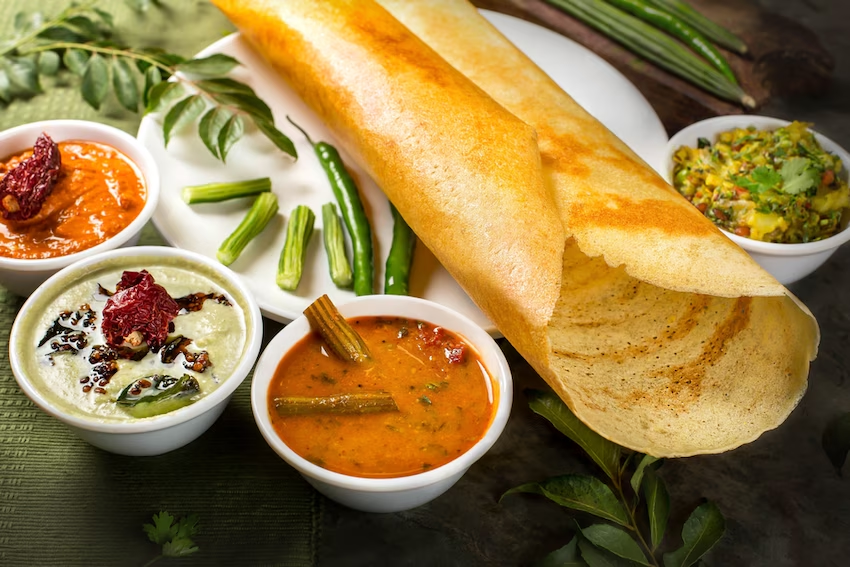
If you’re searching for the best dosa in SoHo, you’re looking for much more than an ordinary Indian restaurant dish. Dosa is one of South India’s most recognizable foods—a thin, crisp, fermented rice-and-lentil crepe traditionally served with flavorful sambar and chutneys.
The appeal is in the contrast. A properly prepared dosa should be crisp around the edges, delicate enough to break easily, and flavorful without becoming heavy. Depending on the style, it may be filled with spiced potatoes, coated with podi, enriched with ghee, or served plain so that the fermented batter and accompanying sauces take center stage.
SoHo is an interesting place to begin this search because some of the most relevant dosa destinations are technically in or around nearby downtown neighborhoods rather than within SoHo’s exact boundaries. One notable example is Hampton Chutney Co. on Grand Street, which has long been associated with dosa in SoHo and is specifically included in current dosa guides.
At the same time, expanding your search into Greenwich Village, the West Village, East Village, and other nearby Manhattan neighborhoods can open up restaurants specializing more directly in South Indian cooking.
What Makes Dosa Different?
Unlike many familiar North Indian restaurant dishes, dosa is built around a fermented rice-and-lentil batter.
The batter is spread thinly over a hot cooking surface, producing a crepe-like dish that can range from soft and flexible to extremely thin and crisp.
The classic masala dosa is usually filled with seasoned potatoes and onions and served with sambar and chutneys.
But there are many other styles worth exploring, including:
- Plain dosa
- Masala dosa
- Mysore dosa
- Podi dosa
- Ghee dosa
- Rava dosa
- Onion dosa
- Paper dosa
- Cheese dosa
- Paneer dosa
- Vegetable dosa
That variety means you can visit the same South Indian restaurant several times and order something different each time.
Why SoHo Is a Good Starting Point
SoHo is primarily known for shopping, architecture, galleries, and its broader downtown restaurant scene. Its location makes it easy to combine a meal with a day exploring Lower Manhattan.
More importantly, SoHo borders several neighborhoods with diverse Indian food options.
You can start with dosa in SoHo and then continue your food exploration through:
- Greenwich Village
- West Village
- Nolita
- East Village
- Lower East Side
- Tribeca
This wider search is particularly valuable because dosa specialists aren’t distributed in exactly the same way as restaurants serving North Indian favorites such as butter chicken or chicken tikka masala.
What This Guide Covers
This guide will explore the best dosa in and near SoHo, including where to find authentic South Indian preparations, which neighborhoods are worth visiting, what different dosa styles taste like, and how to choose a restaurant based on your budget and dining preferences.
We’ll cover:
- Why SoHo has access to excellent Indian food
- Top dosa restaurants in and around SoHo
- Best nearby neighborhoods for South Indian food
- Popular dosa varieties
- Vegetarian and vegan dosa options
- Budget-friendly dosa restaurants
- Fine-dining South Indian experiences
- Takeout and delivery tips
- How to identify authentic dosa
- How to order dosa like a local
- What to eat alongside dosa
- A final guide for finding your favorite dosa
A Dish That’s Naturally Vegetarian
One of dosa’s biggest advantages is that many traditional preparations are vegetarian.
A classic dosa batter is based on rice and lentils, while popular fillings may include potatoes, onions, chilies, curry leaves, and spices.
This makes dosa an excellent option for vegetarian diners.
However, vegan diners should check whether the dosa is cooked with ghee or butter. Some varieties may also contain cheese, paneer, or other dairy ingredients.
The Importance of Sambar and Chutney
A dosa isn’t complete without its accompaniments.
A crisp dosa can be excellent by itself, but sambar and chutneys provide much of the meal’s variety.
Look for combinations such as:
- Coconut chutney
- Tomato chutney
- Mint chutney
- Coriander chutney
- Peanut chutney
- Sambar
The balance between the dosa and its accompaniments is one of the best ways to judge a South Indian restaurant.
Current dosa guides emphasize that the sambar and accompanying chutneys are almost as important to the overall experience as the dosa itself.
Why Authenticity Matters
The best dosa isn’t simply the biggest one.
Some restaurants serve enormous dosas that stretch across the table, while others focus on thinner, more delicate preparations.
Current reporting on Semma in Greenwich Village, for example, highlights its gunpowder dosa as exceptionally thin and crisp, served with coconut and tomato chutneys and sambar.
That illustrates an important point: authenticity can be about texture, fermentation, cooking technique, accompaniments, and regional character—not just size.
The Best Dosa May Be Outside SoHo
If your goal is simply to eat dosa while you’re visiting SoHo, you have convenient choices.
But if your goal is to discover the best dosa near SoHo, expanding your search is worthwhile.
Greenwich Village, especially, can be an important stop for South Indian food lovers. Semma is one of the area’s notable restaurants, and its dosa has received significant attention from New York food critics.
For a more casual experience, you can also explore nearby Indian restaurants and dedicated dosa-focused establishments.
What You’ll Learn in This Guide
Whether you’re a first-time dosa diner or someone who already knows the difference between a masala dosa and a rava dosa, this guide is designed to help you navigate the downtown Indian food scene.
We’ll look beyond simple restaurant ratings and consider:
Texture: Is the dosa crisp, light, and properly cooked?
Batter: Does it have the subtle tang associated with fermentation?
Filling: Is the masala flavorful without overpowering the dosa?
Sambar: Is it aromatic, balanced, and satisfying?
Chutneys: Are there multiple fresh accompaniments?
Technique: Does the restaurant demonstrate genuine South Indian cooking?
Value: Is the portion and overall meal worth the price?
By the end, you’ll have a better understanding of where to look and what to order when you’re craving an authentic South Indian dosa in SoHo or nearby downtown Manhattan.
Whether you’re shopping along Broadway, exploring SoHo’s cast-iron architecture, meeting friends for lunch, or simply looking for a vegetarian-friendly Indian meal, dosa is an excellent way to experience a completely different side of Indian cuisine.
And the best part is that you don’t have to stop with one.
Start with a classic masala dosa.
Try a podi dosa next.
Then experiment with rava dosa, ghee dosa, or a regional specialty.
That’s how a search for the best dosa in SoHo can become an introduction to the enormous and delicious world of South Indian food.
Why SoHo Has Great Indian Restaurants
SoHo is one of the most convenient places in downtown Manhattan to begin an Indian food adventure. The neighborhood is surrounded by Greenwich Village, Nolita, Tribeca, the West Village, and the Lower East Side, giving diners access to a remarkably broad range of Indian cooking within a relatively small area.
That variety is especially valuable when you’re searching for the best dosa in SoHo. Unlike popular North Indian dishes such as butter chicken or chicken tikka masala, dosa belongs to the diverse culinary traditions of South India. Finding an excellent version may therefore require looking beyond restaurants that simply advertise themselves as general Indian restaurants.
Current New York dining guides emphasize just how broad the city’s Indian food scene has become, with restaurants representing regional cuisines and specialties ranging from South Indian stews and dosas to biryani and tandoori cooking.
SoHo’s Downtown Location Gives Diners More Choice
One of SoHo’s biggest advantages is its location.
A visitor can easily spend the afternoon exploring SoHo and then walk toward another downtown neighborhood for dinner. That means your search doesn’t have to stop at the restaurant closest to your current location.
For dosa lovers, nearby areas can be particularly valuable.
Greenwich Village and the West Village have notable South Indian options.
Nolita sits immediately alongside SoHo.
Tribeca provides more upscale Indian dining.
Lower East Side and East Village offer additional opportunities to explore regional Indian cuisine.
This makes downtown Manhattan feel like one connected Indian dining destination rather than a collection of isolated neighborhoods.
Dosa Adds a Different Dimension to SoHo’s Indian Food Scene
Many diners first encounter Indian cuisine through dishes such as chicken tikka masala, butter chicken, naan, or biryani.
Dosa introduces an entirely different experience.
A traditional dosa is made from a fermented rice-and-lentil batter that is spread thinly over a hot cooking surface. The result can be crisp, delicate, slightly tangy, and surprisingly light.
Popular versions include:
- Masala dosa
- Plain dosa
- Podi dosa
- Mysore dosa
- Ghee dosa
- Rava dosa
- Onion dosa
- Paper dosa
Each preparation can provide a different combination of texture and flavor.
South Indian Food Has a Strong Presence in New York City
New York’s Indian food scene isn’t limited to one region of India.
Current citywide restaurant guides specifically highlight South Indian specialties and dosa among the city’s important Indian food experiences.
That gives SoHo visitors an opportunity to explore beyond the familiar North Indian curry-house menu.
Instead of ordering another creamy curry, you can try a crisp dosa served with sambar and several chutneys.
It’s a completely different style of Indian dining.
Greenwich Village Is Especially Important for Dosa Lovers
When looking for authentic South Indian dosa near SoHo, Greenwich Village and the surrounding downtown area deserve particular attention.
Semma, located on Greenwich Avenue, has received significant attention for its South Indian cooking. Eater’s coverage of the restaurant specifically praised its thin, crisp “gunpowder” dosa, served with potato filling, chutneys, and sambar.
The Infatuation’s NYC dosa guide also highlights Semma’s dosa, describing its podi-dusted rice-and-lentil dosa with masala potatoes, black mustard seeds, mint and coconut-cilantro sauces, and lentil sambar.
That makes the broader Greenwich Village area an important stop for anyone serious about finding excellent dosa near SoHo.
SoHo Itself Has a Notable Dosa Destination
Hampton Chutney Co. at 143 Grand Street is another reason dosa belongs on a SoHo food guide.
The Infatuation specifically includes Hampton Chutney Co. in its NYC dosa guide and describes its dosas as large, crisp preparations with fillings ranging from eggs and potatoes to curry chicken.
This is particularly useful for visitors who want to eat dosa without leaving the SoHo area.
Its approach is also different from a traditional South Indian restaurant, which makes it an interesting comparison point.
Casual and Upscale Indian Dining Coexist Nearby
Another reason the area works well for Indian food lovers is the range of dining styles.
You can find casual restaurants for a quick lunch, neighborhood restaurants for relaxed dinners, and upscale Indian restaurants for special occasions.
For example, current local listings show Indian restaurants around the broader SoHo area ranging from casual options such as Mint Masala and Masala Times to upscale destinations such as Musaafer in Tribeca. Mint Masala Masala Times Musaafer
That variety means your Indian food experience can match your occasion and budget.
Vegetarian Diners Have Plenty of Choices
Dosa is also particularly appealing because many traditional preparations are vegetarian.
The basic rice-and-lentil dosa batter is naturally plant-based, although the cooking fat and fillings can introduce dairy.
Popular vegetarian choices include:
- Masala dosa
- Plain dosa
- Podi dosa
- Onion dosa
- Vegetable dosa
- Idli
- Vada
- Sambar
- Coconut chutney
For vegan diners, it’s important to ask whether the dosa is cooked with ghee or butter.
Sambar and Chutney Matter Just as Much
A great dosa isn’t only about the crepe.
The accompaniments are an important part of the experience.
Sambar adds a warm, aromatic lentil-and-vegetable component, while chutneys provide contrasting flavors and textures.
You might receive:
- Coconut chutney
- Tomato chutney
- Mint chutney
- Coriander chutney
- Peanut chutney
- Sambar
The Infatuation’s dosa guide specifically emphasizes that the quality of the sambar is an important part of judging a good dosa experience.
New York Makes It Easy to Compare Different Dosa Styles
Another advantage of the city’s Indian food scene is that you don’t have to settle on one definition of dosa.
One restaurant may specialize in enormous, paper-thin dosas.
Another may serve a smaller, crisp dosa with a carefully prepared potato filling.
Another may emphasize podi, ghee, or regional South Indian flavors.
That diversity is useful because the best dosa is ultimately a matter of personal preference.
You may prefer an ultra-crisp paper dosa.
Someone else may prefer a softer masala dosa.
Another diner may love a spicy podi dosa.
The Best Search Strategy Is Broader Than “SoHo”
If you’re simply hungry while shopping in SoHo, staying nearby makes sense.
But if you’re specifically searching for the best dosa near SoHo, expand your search radius.
Start with SoHo.
Then consider Greenwich Village and the West Village.
After that, explore Nolita, Tribeca, the Lower East Side, and East Village depending on how far you’re willing to travel.
This approach gives you access to more regional Indian cooking and a wider variety of dosa preparations.
Why Dosa Is Worth Seeking Out
Dosa offers something that many Indian restaurant dishes don’t.
It’s:
Crisp rather than creamy.
Light rather than heavy.
Fermented rather than simply spiced.
South Indian rather than primarily North Indian.
Naturally vegetarian in many traditional preparations.
And when paired with hot sambar and fresh chutneys, it becomes a complete meal rather than simply a side dish.
That’s why the search for the best dosa in SoHo is worth approaching as a broader exploration of downtown Manhattan’s Indian food scene.
Whether you choose a casual dosa-focused restaurant in SoHo or walk toward Greenwich Village for a more regional South Indian experience, you’ll have the opportunity to discover one of India’s most distinctive and satisfying foods.
And once you find a dosa with the right combination of crisp texture, fermented flavor, flavorful masala, aromatic sambar, and fresh chutneys, you may never look at Indian food in SoHo the same way again.
Top Indian Restaurants in and Near SoHo for Authentic Dosa
When searching for the best dosa in SoHo, it’s important to distinguish between restaurants that are actually in SoHo and excellent South Indian restaurants in nearby downtown neighborhoods. SoHo itself has a notable dosa destination, while Greenwich Village and the West Village offer additional options for diners willing to walk a little farther.
The following restaurants are particularly useful starting points based on their current menus, location, and relevance to dosa.
Hampton Chutney Co. — SoHo
Hampton Chutney Co. is one of the most convenient choices if you specifically want to eat dosa without leaving SoHo. The restaurant is located at 143 Grand Street, and current restaurant guides specifically identify it as a SoHo dosa destination.
Its current menu has an extensive dosa section. The Sada dosa is listed at $5.95, while the classic potato-filled dosa is $11.95. Other options include dosas with roasted tomato, spinach, avocado, cheese, grilled chicken, curried chicken, and other fillings.
Hampton Chutney Co. also says its dosas are made from scratch using fermented rice-and-lentil batter and cooked to develop a crisp, golden exterior.
Best for: Casual lunch, first-time dosa diners, affordable meals
Popular choice: Potato masala dosa
Price range: Approximately $6–$18 for many dosa options
Location: SoHo
Style: Casual, modern dosa-focused restaurant
Mint Masala — Greenwich Village
Mint Masala is located at 95 MacDougal Street in Greenwich Village, making it an easy option to combine with a SoHo food itinerary. Its broader Indian menu makes it useful for groups where not everyone wants dosa.
For dosa lovers, however, it should be treated as a nearby Indian restaurant rather than a dedicated dosa specialist. Its current menu is particularly broad, covering Indian curries, biryani, tandoori dishes, paneer, dal, naan, and vegetarian preparations.
The advantage here is variety. Someone can explore South Indian-style dishes while another diner orders chicken tikka masala, biryani, or another Indian favorite.
Best for: Mixed groups and casual Indian dining
Popular choices: Dosa and broader Indian specialties
Price range: Approximately $20–$30 per person
Location: Greenwich Village
Style: Casual neighborhood Indian restaurant
Masala Times — Greenwich Village
Masala Times on Bleecker Street is another convenient downtown option when you’re exploring Indian food between SoHo and Greenwich Village.
It is better suited to diners who want a broader Indian menu rather than a restaurant focused exclusively on traditional dosa. Its location makes it convenient for visitors exploring the Village after spending time in SoHo.
For a dedicated dosa experience, compare it with Hampton Chutney Co. or a specialist South Indian restaurant farther afield.
Best for: Casual Indian meals and groups
Location: Greenwich Village
Style: Casual Indian restaurant
Price range: Approximately $20–$30 per person
Ananda — Greenwich Village
Ananda at 210 Thompson Street is another nearby Indian restaurant worth considering when you’re exploring downtown Manhattan.
Its Greenwich Village location makes it convenient for diners who want to combine Indian food with an afternoon or evening around Washington Square Park and the surrounding Village streets.
For a dosa-specific visit, check the current menu before going, since its broader Indian offering is more important than treating it as a dedicated dosa restaurant.
Best for: Casual neighborhood dining
Location: Greenwich Village
Style: Indian restaurant
Price range: Approximately $20–$30 per person
Ambo — East Village
Ambo is farther from SoHo than the Greenwich Village options, but it can be worth considering if you’re willing to expand your downtown Indian food search.
The East Village has a broader Indian restaurant scene and is particularly useful for diners who want to explore beyond the most familiar North Indian curry dishes.
For this article’s primary purpose, however, verify the current dosa menu before making a trip specifically for dosa.
Best for: Exploring downtown Indian cuisine
Location: East Village
Price range: Approximately $10–$20 per person
Madras Dosa Co. — Chelsea / Flatiron Area
Madras Dosa Co. at 668 Sixth Avenue is farther from SoHo, but it is much more directly relevant to diners who want South Indian dosa rather than simply an Indian restaurant that happens to offer dosa.
Its current business listing identifies it specifically as a South Indian restaurant, with a relatively affordable price range of approximately $10–$20 per person.
This makes it an attractive destination if dosa quality is more important to you than staying strictly within SoHo.
Best for: South Indian food and dosa enthusiasts
Location: Sixth Avenue, downtown Manhattan
Price range: Approximately $10–$20 per person
Style: South Indian
NY Dosas — Washington Square Area
NY Dosas is another interesting option for serious dosa enthusiasts. Its location at Washington Square South places it close to Greenwich Village and makes it a natural extension of a SoHo food itinerary.
Unlike a conventional full-service restaurant, NY Dosas is an Indian takeaway operation, making it particularly interesting for diners who want a focused dosa experience rather than a formal restaurant meal.
Best for: Quick dosa meals and food enthusiasts
Location: Washington Square area
Price range: Approximately $10–$20
Style: Indian takeaway
Saravanaa Bhavan — Midtown East
For diners willing to travel farther, Saravanaa Bhavan is a major name in South Indian vegetarian dining.
Its Manhattan location is significantly farther from SoHo, so it shouldn’t be presented as a nearby SoHo restaurant. Instead, consider it a destination option if you’re particularly interested in South Indian cuisine.
The restaurant’s current listing identifies it as an Indian restaurant with a substantial customer base and a $20–$30 approximate price range.
Best for: Traditional South Indian vegetarian cuisine
Location: Lexington Avenue, Midtown East
Style: South Indian vegetarian restaurant
Semma — Greenwich Village
Semma deserves special attention even though it isn’t returned in the local business results above.
Located at 60 Greenwich Avenue, Semma’s current official menu lists its Gunpowder Dosa at $21, made with a rice-and-lentil crepe, potato masala, and sambar.
The restaurant is particularly interesting for diners seeking regional South Indian cooking rather than a generic Indian restaurant experience. Its dosa has also received significant attention from New York food critics and restaurant guides.
Best for: Serious South Indian food exploration
Signature dosa: Gunpowder Dosa
Price: $21
Location: Greenwich Village
Style: Upscale South Indian/regional Indian
Which Restaurant Should You Choose?
If your priority is staying in SoHo, start with Hampton Chutney Co. Its current menu has a substantial dosa selection and specifically centers the restaurant around the dish.
If your priority is regional South Indian cooking, Semma is a particularly interesting nearby destination, with its current Gunpowder Dosa providing a more specialized interpretation.
If you’re looking for a quick and affordable dosa, NY Dosas or a casual South Indian restaurant can be a better fit.
And if you’re dining with a group that has different tastes, a broader Indian restaurant such as Mint Masala may be more convenient.
A Note About “Best Dosa in SoHo”
It’s worth emphasizing that not every restaurant listed above is physically inside SoHo.
That’s intentional.
When people search Google for “best dosa in SoHo,” restaurant results often extend into neighboring downtown areas. For someone actually visiting SoHo, these neighborhoods are close enough that they can reasonably be part of the same food itinerary.
The distinction is important for SEO and for readers: Hampton Chutney Co. is the clearest SoHo-specific dosa destination, while Semma, NY Dosas, and other South Indian restaurants provide nearby alternatives for diners willing to walk or travel a little farther.
Ultimately, the best choice depends on what you’re looking for—convenience, authenticity, price, regional South Indian cooking, or a more elevated dining experience.
Best Neighborhoods and Areas for Indian Food Near SoHo
If you’re searching for the best dosa in SoHo, it helps to think beyond SoHo’s exact neighborhood boundaries. Downtown Manhattan is compact, and several nearby areas offer excellent Indian restaurants, including places specializing in South Indian cuisine and dosa.
The biggest advantage is variety. Within a relatively short walk or subway ride, you can move from a casual dosa counter to a regional South Indian restaurant or an upscale Indian dining room.
SoHo
SoHo should be your first stop because it offers one of the most convenient dosa options in the neighborhood: Hampton Chutney Co., at 143 Grand Street. The Infatuation specifically includes it in its NYC dosa guide and describes its large, crisp dosas with fillings ranging from potatoes to curry chicken.
SoHo is particularly convenient if you’re combining lunch with shopping, galleries, architecture, and downtown sightseeing.
Best for: Convenience, casual dosa, lunch, first-time diners
Greenwich Village
Greenwich Village is arguably one of the most important nearby areas for anyone serious about South Indian food near SoHo.
The neighborhood has several Indian restaurants, and it is particularly notable for NY Dosas and Semma.
NY Dosas is a Washington Square-area destination associated with Thiru “Dosa Man” Kumar. Current reviews continue to highlight its South Indian dosa and reasonable pricing.
For a more formal experience, Semma at 60 Greenwich Avenue focuses on regional South Indian cuisine. Eater specifically highlighted its thin, crisp gunpowder dosa with potato filling, chutneys, and sambar.
Best for: Authentic South Indian food, dosa specialists, regional cuisine
West Village
The West Village overlaps naturally with the broader Greenwich Village food scene and is another excellent area to consider when searching for Indian food near SoHo.
Semma is particularly relevant here because current NYC restaurant guides identify it as a destination for dosa and regional South Indian cooking.
This area works especially well if you’re planning a relaxed dinner after spending the afternoon in SoHo.
Best for: Dinner, regional South Indian cuisine, date nights
Nolita
Nolita sits immediately east of SoHo, making it one of the easiest neighborhoods to include in a downtown Indian food search.
Its location makes it useful for visitors who don’t want to travel far from SoHo but are willing to expand their restaurant search beyond the neighborhood’s exact boundaries.
When searching specifically for dosa, check current menus because restaurants can change their South Indian offerings.
Best for: Nearby alternatives and downtown food exploration
Tribeca
Tribeca is particularly useful if you’re interested in upscale Indian dining rather than a casual dosa meal.
For example, Musaafer on Duane Street is currently listed as an upscale Indian restaurant, while Paisley on Greenwich Street offers another polished Indian dining option.
These restaurants are better suited to diners who want an elevated Indian experience. If dosa is your specific priority, however, verify the current menu before making the trip.
Best for: Fine dining, celebrations, upscale Indian cuisine
East Village
The East Village is farther from SoHo, but it’s worthwhile for diners who want to explore more of New York’s Indian food scene.
The neighborhood includes restaurants such as Ambo, while current restaurant guides also highlight the East Village as an important part of the city’s broader Indian dining landscape.
For dosa specifically, look for restaurants with a clearly identified South Indian focus rather than assuming every Indian restaurant will specialize in dosa.
Best for: Regional exploration, casual Indian food
Lower East Side
The Lower East Side provides another useful extension to your downtown Indian food search.
Mughlai Grill on Clinton Street is more relevant to North Indian and Mughlai-style food than to dosa, but that’s exactly why the neighborhood can be useful for a broader Indian food itinerary.
If you’re traveling with a group, you can explore different styles of Indian cooking rather than focusing exclusively on South Indian food.
Best for: Broader Indian cuisine and Mughlai flavors
Sixth Avenue and the Flatiron Area
If dosa quality matters more to you than staying close to SoHo, consider traveling toward Sixth Avenue.
Madras Dosa Co. at 668 Sixth Avenue is specifically identified as a South Indian restaurant, making it more directly relevant to a dosa-focused search than many general Indian restaurants.
Its current business listing places it in the approximately $10–$20 price range, making it an appealing option for diners looking for South Indian food without a fine-dining price tag.
Best for: Dedicated South Indian food, affordable dosa
Midtown East
Midtown East is considerably farther from SoHo, but it becomes relevant if you’re willing to make dosa the main purpose of your trip.
SARAVANAA BHAVAN on Lexington Avenue is a well-known South Indian vegetarian restaurant and is currently listed in the approximately $20–$30 price range.
For someone exploring South Indian cuisine beyond downtown Manhattan, it can be worth considering.
Best for: Traditional South Indian vegetarian cuisine
Washington Square Park Area
For a truly casual dosa experience, the Washington Square Park area deserves special mention.
NY Dosas has long been associated with this part of Greenwich Village. Time Out describes the operation as a vegan stand serving South Indian crepes stuffed with curried potatoes and vegetables.
It’s a completely different experience from sitting down at a polished restaurant such as Semma.
That’s part of the appeal.
You can experience dosa as an affordable, quick street-food-style meal rather than a formal restaurant dish.
Best for: Street food, quick lunches, vegan-friendly dosa
Which Neighborhood Is Best for Dosa?
If dosa is your main priority, here’s a simple way to think about the downtown area:
| Area | Best For |
|---|---|
| SoHo | Convenient dosa and casual lunch |
| Greenwich Village | South Indian specialists and dosa |
| West Village | Regional South Indian dining |
| Nolita | Convenient nearby alternatives |
| Tribeca | Upscale Indian dining |
| East Village | Broader Indian exploration |
| Lower East Side | Mughlai and North Indian food |
| Sixth Avenue / Flatiron | Dedicated South Indian restaurants |
| Washington Square Park | Casual street-style dosa |
Why Greenwich Village Deserves Extra Attention
For this particular article, Greenwich Village is arguably the most important neighborhood beyond SoHo.
It gives you access to both extremes of the dosa experience.
You can grab an affordable dosa from NY Dosas around Washington Square Park, or enjoy a more refined regional South Indian meal at Semma.
Current NYC food coverage continues to recognize the neighborhood’s importance for Indian dining, while Semma’s dosa has received particular praise for its crisp texture, potato filling, chutneys, and sambar.
Create a Downtown Dosa Food Tour
If you’re visiting New York specifically to explore Indian food, you can turn your SoHo visit into a small food tour.
Start: Shopping and sightseeing in SoHo
Lunch: Dosa at a SoHo restaurant
Afternoon: Walk toward Greenwich Village
Snack: Explore Washington Square Park and consider NY Dosas
Dinner: Experience regional South Indian cooking at Semma
This gives you two very different interpretations of dosa in one downtown itinerary.
Don’t Limit Your Search to Restaurant Ratings
When choosing a neighborhood, consider what type of dosa experience you actually want.
If you want affordable and casual, look toward SoHo and Washington Square Park.
If you want regional South Indian cuisine, Greenwich Village is a stronger choice.
If you want fine dining, consider Tribeca.
If you want a dedicated South Indian restaurant, expanding toward Sixth Avenue or Midtown can make sense.
The “best” neighborhood depends on the experience you’re after.
For most visitors searching for the best dosa in SoHo, start in SoHo itself, then expand toward Greenwich Village if you’re serious about authentic South Indian cooking.
SoHo gives you convenience.
Greenwich Village gives you depth.
Washington Square Park provides a casual dosa experience.
Semma provides a more refined regional interpretation.
And if you’re willing to travel farther, dedicated South Indian restaurants such as Madras Dosa Co. and Saravanaa Bhavan give you even more opportunities to compare styles.
That broader approach is the best way to explore Indian food around SoHo—because sometimes the perfect dosa isn’t on the exact street where you started looking.
Popular Indian Dishes People Should Try Besides Dosa
If you’re searching for the best dosa in SoHo, don’t stop at the dosa itself. South Indian cuisine offers a wide range of dishes with different textures, spices, and cooking techniques. Exploring a few of these specialties can make your visit much more rewarding.
Dosa is often the perfect introduction because it is crisp, flavorful, and naturally vegetarian in many traditional preparations. But once you’ve tried a classic masala dosa, there are plenty of other Indian dishes worth adding to your list.
1. Masala Dosa
The masala dosa is the classic choice for first-time diners.
A thin, crisp dosa is filled with spiced potatoes and onions, then served with sambar and chutneys.
A good masala dosa should offer several contrasting flavors:
- Crisp dosa
- Soft potato filling
- Aromatic spices
- Tangy sambar
- Fresh chutney
If you’re ordering dosa for the first time, this is usually the safest place to start.
2. Plain Dosa
Plain dosa lets you focus on the batter itself.
Without a substantial filling, you can better appreciate:
- Fermentation
- Crispness
- Rice flavor
- Lentil flavor
- Light tanginess
- Char from the cooking surface
This is an excellent choice if you’re comparing dosa between restaurants.
3. Mysore Dosa
Mysore dosa adds a layer of spicy chutney or podi-like seasoning inside the dosa before the filling is added.
The result is more intense than a standard masala dosa.
If you enjoy chili and bold flavors, Mysore dosa is worth trying.
4. Podi Dosa
Podi is a flavorful South Indian spice mixture often made using roasted lentils, chilies, and other spices.
A podi dosa combines the crisp dosa with this aromatic powder, creating a savory, spicy, slightly nutty flavor.
Semma’s current menu, for example, features a gunpowder dosa made with a rice-and-lentil crepe, potato masala, and sambar.
This style is especially appealing to diners who want something more adventurous than a basic masala dosa.
5. Rava Dosa
Rava dosa is made using semolina, giving it a different texture from traditional fermented rice-and-lentil dosa.
It tends to be:
- Thin
- Crisp
- Lacy
- Light
- Full of small crunchy edges
Because of its texture, rava dosa is one of the best dishes to order when you want something dramatically different from a standard masala dosa.
6. Ghee Dosa
Ghee dosa is cooked with clarified butter, giving the dosa a richer aroma and deeper flavor.
The exterior can become beautifully crisp while retaining a delicate interior.
Because ghee is dairy, it isn’t vegan.
If you’re looking for a richer South Indian experience, this is an excellent choice.
7. Paper Dosa
Paper dosa is known for its extremely thin and crisp texture.
It can be dramatically larger than a regular dosa and is often rolled or folded into a long, delicate shape.
For many diners, the presentation is part of the experience.
However, don’t choose a restaurant simply because its dosa is enormous.
Texture and flavor matter more than size.
8. Onion Dosa
Onion dosa incorporates sliced onions and spices into the preparation.
The onions can become lightly caramelized and add sweetness and texture to the crisp dosa.
It’s a good choice for diners who want something more flavorful than plain dosa without moving into an extremely spicy preparation.
9. Idli
Idli is another classic South Indian dish made from fermented rice-and-lentil batter.
Instead of being cooked on a flat surface like dosa, the batter is steamed in molds.
The result is:
- Soft
- Light
- Spongy
- Mildly tangy
Idli is commonly served with sambar and chutneys.
If you enjoy dosa but want something lighter, idli is an excellent next choice.
10. Medu Vada
Medu vada is a savory, fried South Indian lentil fritter.
It has a crisp exterior and soft center.
It’s commonly served alongside idli and dosa with sambar and chutney.
The combination of vada + sambar + chutney makes an excellent breakfast or lunch.
11. Sambar
Sambar is more than an accompaniment.
It’s a major part of South Indian cuisine.
This lentil-based stew generally combines vegetables, tamarind, and spices to create a savory, tangy, aromatic flavor.
The exact recipe varies from restaurant to restaurant.
A good sambar should complement the dosa without completely overwhelming it.
12. Coconut Chutney
Coconut chutney provides a cool, creamy contrast to crisp dosa and spicy sambar.
It may contain:
- Fresh coconut
- Green chili
- Ginger
- Cilantro
- Tempered spices
The freshness of the chutney can be particularly noticeable when paired with a hot dosa straight from the griddle.
13. Tomato Chutney
Tomato chutney offers a more tangy and savory flavor.
Compared with coconut chutney, it usually has a stronger acidity and deeper spice character.
Try alternating between coconut and tomato chutney with different bites of dosa.
14. Vada Pav
If you want to explore Indian street food beyond South Indian cuisine, try vada pav.
It consists of a spiced potato fritter served inside a bun with chutneys and other accompaniments.
It’s inexpensive, filling, and dramatically different from dosa.
15. Samosas
Samosas are one of the most recognizable Indian appetizers.
A crisp pastry shell surrounds a spiced filling, commonly potato and peas.
They’re ideal for sharing before a dosa or another Indian main course.
16. Chicken Tikka
Chicken tikka provides an opportunity to explore tandoor cooking.
The chicken is marinated in spices and typically cooked at high heat.
The result can be smoky, charred, and tender.
Although chicken tikka comes from a different culinary tradition than dosa, trying both demonstrates the enormous regional diversity of Indian cuisine.
17. Chicken Tikka Masala
Chicken tikka masala is one of the most popular Indian restaurant dishes in the United States.
It combines grilled chicken with a rich tomato-based sauce.
If you’re visiting with someone who isn’t interested in dosa, this can be an easy shared main dish alongside your South Indian order.
18. Butter Chicken
Butter chicken is another familiar North Indian favorite.
Compared with many dosa preparations, it is:
- Richer
- Creamier
- More buttery
- More sauce-focused
It makes an interesting comparison if you’re dining with someone who prefers North Indian curries.
19. Biryani
Biryani is an aromatic rice dish prepared with spices, herbs, and ingredients such as chicken, lamb, vegetables, or other proteins.
It can be quite different from restaurant-style curries.
If you’re dining with a group, biryani is particularly useful as a shared dish.
20. Chana Masala
Chana masala features chickpeas cooked with tomatoes, onions, herbs, and spices.
It’s filling, flavorful, and commonly vegetarian.
It also gives dosa lovers another way to experience Indian spices without ordering meat.
21. Saag Paneer
Saag paneer combines leafy greens with cubes of paneer.
The earthy greens and mild cheese make it a good contrast to crisp dosa.
It is vegetarian but contains dairy.
22. Dal Tadka
Dal tadka is a lentil dish finished with a tempering of spices, often including cumin, garlic, chilies, or other aromatics.
It is comforting and flavorful without needing to be extremely spicy.
It also works well as a shared dish.
23. Gulab Jamun
Don’t forget dessert.
Gulab jamun consists of soft fried milk-based dumplings served in sweet syrup.
It’s rich and sweet, making it an excellent finish to a spicy Indian meal.
24. Kulfi
Kulfi is a traditional Indian frozen dessert.
Popular flavors include:
- Pistachio
- Cardamom
- Saffron
- Mango
Its dense texture makes it different from conventional ice cream.
25. Kheer
Kheer is an Indian rice pudding traditionally flavored with ingredients such as cardamom, saffron, nuts, or raisins.
It’s a comforting dessert after a meal of dosa, sambar, and chutney.
Vegetarian and Vegan Indian Food Options in SoHo
One of the biggest advantages of exploring Indian food around SoHo is the enormous variety of vegetarian and vegan-friendly dishes available. For diners searching for the best dosa in SoHo, this is especially exciting because many traditional South Indian dishes are naturally vegetarian, while several can be made vegan depending on the cooking method.
From crispy masala dosa and idli to sambar, chutneys, vegetable curries, and lentil dishes, you can create a complete Indian meal without ordering meat.
Dosa Is an Excellent Vegetarian Choice
Traditional dosa is made primarily from fermented rice-and-lentil batter, making many basic varieties vegetarian.
Popular choices include:
- Plain dosa
- Masala dosa
- Mysore dosa
- Podi dosa
- Onion dosa
- Rava dosa
- Paper dosa
- Vegetable dosa
The main ingredient to check is the cooking fat.
Some restaurants use ghee or butter, which means the dosa may be vegetarian but not vegan.
Masala Dosa
Masala dosa is one of the best choices for vegetarian diners.
The crisp dosa is typically filled with spiced potatoes and onions and served with sambar and chutneys.
The potato filling can include ingredients such as:
- Potatoes
- Onion
- Mustard seeds
- Curry leaves
- Turmeric
- Green chili
- Ginger
It’s filling enough to serve as a complete meal.
Plain Dosa for Vegan Diners
Plain dosa can be a good vegan choice when prepared with oil instead of ghee or butter.
Because recipes vary, ask:
“Is the dosa cooked with oil or ghee?”
That simple question can determine whether the dish fits a vegan diet.
Podi Dosa
Podi dosa is another flavorful vegetarian option.
Podi is a South Indian spice mixture commonly made with roasted lentils, chilies, and spices.
The combination of crisp dosa and spicy podi creates a more intense flavor than plain dosa.
If you’re vegan, confirm that the dosa is cooked without ghee.
Rava Dosa
Rava dosa is made using semolina and is known for its thin, crispy, lacy texture.
It can be a particularly enjoyable choice for diners who want something different from the traditional fermented dosa.
Ask about ghee or butter if you’re following a vegan diet.
Idli
Idli is a steamed South Indian preparation made from fermented rice-and-lentil batter.
It’s naturally vegetarian and often vegan when prepared traditionally.
The soft texture provides a wonderful contrast to crisp dosa.
Idli is commonly served with:
- Sambar
- Coconut chutney
- Tomato chutney
Sambar
Sambar is an important vegetarian staple in South Indian cuisine.
It’s typically made with lentils, vegetables, tamarind, and spices.
Common vegetables can include:
- Carrot
- Eggplant
- Drumstick
- Pumpkin
- Okra
- Tomato
- Onion
However, recipes vary.
If you’re vegan, ask whether the sambar contains any dairy or animal-derived ingredients.
Coconut Chutney
Coconut chutney is one of the most natural accompaniments for vegan dosa.
Fresh coconut provides richness while green chili, ginger, herbs, and tempered spices add flavor.
It pairs particularly well with:
- Masala dosa
- Plain dosa
- Idli
- Vada
Tomato Chutney
Tomato chutney provides acidity and spice.
It is often a good alternative when you want something stronger and more savory than coconut chutney.
As always, confirm ingredients if you’re following a strict vegan diet.
Medu Vada
Medu vada is a fried lentil preparation with a crisp exterior and soft center.
It’s generally vegetarian and can be vegan depending on the cooking oil.
Ask whether the restaurant uses vegetable oil rather than ghee.
Chana Masala
If you’re exploring beyond South Indian food, chana masala is another excellent vegetarian option.
The dish features chickpeas cooked with onions, tomatoes, herbs, and spices.
It’s hearty enough to serve as a main dish and pairs well with rice or roti.
Dal Tadka
Dal tadka is a flavorful lentil dish finished with a tempering of spices.
The tempering can include:
- Cumin
- Garlic
- Chili
- Mustard seeds
- Curry leaves
Some restaurants use ghee.
For vegan diners, ask for an oil-based preparation.
Dal Makhani
Dal makhani is vegetarian but usually not vegan.
The dish commonly includes butter or cream in addition to black lentils and beans.
It’s delicious but should be avoided by strict vegans unless the restaurant specifically offers a dairy-free version.
Vegetable Biryani
Vegetable biryani is another substantial vegetarian meal.
Fragrant rice is combined with vegetables and aromatic spices.
It can be a great choice for groups because everyone can share it.
For vegan diners, confirm whether ghee was used.
Aloo Gobi
Aloo gobi combines potatoes and cauliflower with Indian spices.
It is a simple but satisfying vegetarian dish that works particularly well alongside rice or roti.
Ask whether the restaurant prepares it with oil or ghee.
Baingan Bharta
Baingan bharta is made with roasted eggplant.
The smoky eggplant can be particularly appealing if you enjoy the charred flavor of dosa.
It’s generally vegetarian and can often be prepared vegan, although the cooking fat should be confirmed.
Bhindi Masala
Bhindi masala features okra cooked with onions, tomatoes, and spices.
The dish provides a completely different texture from dosa and creamy curries.
It’s a good choice for diners who want more vegetables in their meal.
Saag Paneer
Saag paneer is a vegetarian favorite made with leafy greens and paneer.
The paneer gives the dish a rich, mild flavor.
It is not vegan because paneer is dairy.
If you’re vegan, look for a vegetable-based alternative.
Paneer Tikka
Paneer tikka is a grilled vegetarian preparation featuring marinated cubes of paneer.
It can be smoky and charred, making it a good choice for diners who enjoy grilled foods but don’t eat meat.
Again, it contains dairy.
Vegan Indian Food Requires Careful Questions
Indian food contains many naturally plant-based ingredients, but dairy is widely used.
Watch for:
- Ghee
- Butter
- Cream
- Milk
- Yogurt
- Paneer
Even a vegetable dish may contain ghee.
And naan can contain milk, yogurt, butter, or ghee depending on the recipe.
Vegan-Friendly Bread Options
Roti may be easier to adapt to a vegan meal than naan, but preparation varies.
Ask:
“Is the roti made without ghee or butter?”
Never assume based only on the name.
Vegan Rice Options
Plain basmati rice is often an easy option, but some restaurants finish rice with ghee.
Jeera rice and vegetable biryani may also contain butter or ghee.
Confirm before ordering.
A Great Vegetarian Dosa Meal
For a vegetarian diner, try:
Masala dosa + idli + sambar + coconut chutney + tomato chutney
This gives you:
- Crisp texture
- Soft texture
- Tangy flavors
- Spicy flavors
- Fresh coconut
- Fermented rice-and-lentil flavors
A Vegan-Friendly Meal
After confirming ingredients, consider:
Plain dosa or masala dosa + idli + sambar + coconut chutney + tomato chutney + roti
Ask the restaurant to prepare the dosa and other items with vegetable oil instead of ghee or butter where possible.
Vegetarian Meal for Two
A good shared order could include:
- Masala dosa
- Podi dosa
- Idli
- Medu vada
- Sambar
- Coconut chutney
- Tomato chutney
This lets both diners experience several textures without ordering meat.
Vegan Meal for Two
After confirming ingredients:
- Plain dosa
- Vegetable dosa
- Idli
- Sambar
- Chutneys
- Vegetable biryani
- Roti
This creates a substantial meal with plenty of variety.
Don’t Assume Every “Vegetable” Dish Is Vegan
This is one of the most important tips.
A dish containing only vegetables can still contain ghee or butter.
Similarly, a dosa may look completely plant-based while being cooked with ghee.
If you have a strict dietary requirement, communicate it clearly to your server.
Check for Cross-Contact
For serious allergies or strict dietary requirements, ask about shared:
- Griddles
- Fryers
- Cooking utensils
- Sauces
- Preparation surfaces
A restaurant may be able to accommodate your needs, but it’s important to communicate them before ordering.
Why SoHo Is Great for Vegetarian Diners
The broader downtown Indian food scene gives vegetarian diners a lot of flexibility.
You can enjoy a casual dosa in SoHo, explore South Indian specialties around Greenwich Village, or visit a restaurant specializing in regional Indian cuisine.
You don’t have to feel like you’re choosing a “second-best” option.
Vegetarian dishes are an important part of Indian culinary traditions.
If you’re searching for the best dosa in SoHo, vegetarian diners have an advantage: many of the most interesting South Indian dishes are already meat-free.
Start with a masala dosa.
Try podi dosa next.
Add idli or vada.
Experiment with different chutneys.
Then explore sambar, vegetable biryani, dal, and regional vegetarian specialties.
For vegans, the key is simply to ask about ghee, butter, dairy, and cooking methods before ordering.
With a little communication, a SoHo Indian food adventure can offer an impressive range of vegetarian and vegan dishes—and the humble dosa can be the perfect place to begin.
Budget-Friendly Indian Restaurants in and Around SoHo
You don’t need a large budget to enjoy excellent Indian food around SoHo. One of the biggest advantages of Indian cuisine is that many dishes are naturally filling, shareable, and reasonably priced. This is especially true for dosa, idli, vada, chana masala, dal, and other vegetarian specialties.
For visitors searching for the best dosa in SoHo, budget-friendly dining can also be one of the best ways to explore South Indian food. A simple dosa with sambar and chutneys can make a satisfying meal without the price of an upscale dinner.
Because restaurant prices and menus change, it’s always worth checking the current menu before visiting.
Hampton Chutney Co. — SoHo
Hampton Chutney Co. is one of the most convenient options if you want an affordable dosa experience without leaving SoHo.
Its dosa-focused menu includes options ranging from simple dosa preparations to more elaborate versions with different fillings. This makes it particularly useful for diners who want to try dosa without committing to a full-service, expensive restaurant.
For a budget-conscious diner, a plain or classic potato dosa can be enough for lunch, while a more elaborate dosa can be shared or paired with another inexpensive dish.
The restaurant’s focus on dosa also makes it a natural choice for this guide.
Best for: Affordable dosa, casual lunch, quick meals
Ideal order: Masala dosa + chutneys + sambar
NY Dosas — Washington Square Area
If you’re willing to walk from SoHo toward Washington Square Park, NY Dosas is another interesting budget-friendly destination.
NYC’s current Indian restaurant guides continue to highlight the Washington Square dosa operation as a casual and inexpensive way to experience South Indian food.
The experience is very different from a traditional sit-down restaurant. It’s particularly appealing if you want:
- Quick food
- Vegetarian options
- Vegan-friendly choices
- Dosa at an approachable price
- A casual downtown experience
The limited format can actually be part of the attraction.
Madras Dosa Co.
Madras Dosa Co. is farther from SoHo, but it’s worth mentioning when price and South Indian food are more important than staying inside the neighborhood.
Its current business listing places it in the $10–$20 price range and identifies it specifically as a South Indian restaurant. That makes it a strong option for diners who want a dedicated South Indian meal without moving into fine-dining prices.
Best for: South Indian food, dosa lovers, affordable meals
Price range: Approximately $10–$20
Style: Casual South Indian
Ananda — Greenwich Village
Ananda is another nearby option for diners who want both affordability and a broad selection of dosa.
Its current menu lists Sada Dosa at $14.50 and Masala Dosa at $16.50, while several other dosa preparations are also available. The restaurant specifically identifies its plain and masala dosas as vegan and gluten-free.
That makes Ananda particularly useful for groups with different dietary preferences.
You can order a classic masala dosa, while vegan diners can choose from several clearly identified vegan preparations.
Best for: Vegetarian and vegan diners, casual meals
Dosa prices: Approximately $14.50–$20.50
Location: Greenwich Village/East Village area
Tiffin Wallah
For diners willing to travel farther, Tiffin Wallah is another affordable South Indian option.
Its current menu lists:
- Sada dosa — $8
- Masala dosa — $10
- Paper dosa — $10
- Onion dosa — $11
- Gun Powder Masala dosa — $11
- Mysore Masala — $11
- Rava dosa — $10
- Rava Masala — $11
Those prices make it particularly attractive for diners who want to sample multiple dosa styles without spending a great deal.
Best for: Budget-conscious dosa enthusiasts
Style: Casual South Indian
Ideal for: Trying several dosa varieties
Saravanaas
Saravanaas is another useful choice for affordable South Indian food.
Its current menu lists plain dosa at $10.49, masala dosa at $11.49, onion dosa at $11.49, and several other preparations in the roughly $11–$13 range.
For someone who wants to compare different dosa styles, this type of menu offers plenty of choice without requiring a premium budget.
Best for: Variety and affordable South Indian meals
Price range for dosa: Approximately $10–$13
Why Dosa Is So Good for Budget Dining
Dosa is naturally suited to affordable dining.
A single dosa can include:
- Fermented rice-and-lentil crepe
- Potato masala
- Sambar
- Coconut chutney
- Tomato chutney
That can create a complete and satisfying meal.
You don’t necessarily need an appetizer, separate rice, or several side dishes.
Choose Vegetarian Dishes for Better Value
Indian vegetarian dishes can also offer excellent value.
Consider:
- Chana masala
- Dal tadka
- Aloo gobi
- Vegetable biryani
- Idli
- Vada
- Masala dosa
- Plain dosa
These dishes can be filling without the higher prices that sometimes accompany premium meat or seafood preparations.
Lunch Is Often the Best Time to Save
If you’re exploring SoHo during the day, look for lunch specials and combination meals.
A lunch combination may include:
- Dosa or curry
- Rice
- Vegetable
- Bread
- Sambar
- Chutney
Before ordering, compare the combination price with the cost of ordering individual dishes.
Share Dishes With Friends
Indian food is naturally designed for sharing.
For two people, instead of ordering two large meals, consider:
Masala dosa + another dosa + idli or vada
For four people:
Two dosa varieties + idli + vada + additional South Indian dish
This allows everyone to taste more without dramatically increasing the bill.
Don’t Overorder
Budget dining isn’t only about finding the cheapest menu item.
It’s also about avoiding unnecessary food.
If you’re ordering dosa, you already have a substantial meal.
You may not need:
- Rice
- Multiple curries
- Several appetizers
- Multiple breads
Start small and add another dish if you’re still hungry.
Best Budget Order for One Person
For a solo diner, try:
Masala dosa + sambar + chutneys
If you’re particularly hungry, add idli or vada.
Best Budget Order for Two
For two diners:
Masala dosa + podi/Mysore dosa + shared idli or vada
This gives you multiple textures and flavors at a reasonable overall cost.
Best Budget Order for a Family
For a family, consider:
- Two masala dosas
- One plain or paper dosa
- Idli
- Vada
- Sambar
- Multiple chutneys
Children can start with plain dosa, while adults can explore spicier preparations.
Budget-Friendly Vegan Dining
Vegan diners can often build an inexpensive meal from:
Plain dosa + vegetable dosa + sambar + coconut chutney
But always confirm whether ghee, butter, or other dairy ingredients are used.
For example, Ananda currently labels several dosa preparations as vegan, including its plain, paper, gunpowder, Mysore, Pondicherry, and moong dosa options.
Don’t Confuse Cheap With Low Quality
A low-priced dosa isn’t automatically inferior.
South Indian food has many naturally affordable dishes because rice, lentils, potatoes, and vegetables form the foundation of numerous traditional preparations.
Instead of judging a restaurant by price alone, look for:
- Freshly cooked dosa
- Crisp texture
- Properly fermented batter
- Flavorful potato masala
- Fresh chutneys
- Good sambar
- Appropriate portion size
Budget vs. Fine Dining
The difference between a $10–$20 dosa meal and a $50+ Indian dinner isn’t necessarily that the cheaper meal is less authentic.
You may simply be paying for different things.
Budget restaurant: Quick service, simple surroundings, generous portions.
Fine dining: Premium ingredients, presentation, service, atmosphere, and a broader culinary experience.
For dosa specifically, a casual restaurant can actually be the more appropriate choice if your goal is to experience the dish itself.
If you’re specifically searching for the best affordable dosa in SoHo, start with a casual dosa-focused restaurant rather than an upscale Indian dining room.
For the closest SoHo experience, look at Hampton Chutney Co.
If you’re willing to walk toward Greenwich Village, explore NY Dosas or Ananda.
If you’re willing to travel farther specifically for South Indian food, Madras Dosa Co., Tiffin Wallah, and Saravanaas provide additional affordable options.
The best strategy is simple: choose a classic masala dosa, enjoy it with sambar and chutneys, and only add more dishes if you’re still hungry.
That way, you can experience authentic South Indian flavors without turning a simple dosa lunch into an expensive downtown Manhattan meal.
Fine-Dining Indian Restaurants in and Around SoHo
If you’re looking for a more sophisticated Indian dining experience after exploring SoHo, downtown Manhattan has several excellent options. While SoHo itself has more casual Indian choices, nearby Tribeca, Greenwich Village, and the East Village offer restaurants where Indian cuisine is presented with premium ingredients, polished service, creative techniques, and elegant surroundings.
For someone researching the best dosa in SoHo, fine dining can also be an opportunity to experience South Indian flavors in a more refined setting rather than limiting the search to casual dosa restaurants.
Tamarind Tribeca
Tamarind Tribeca is one of the most established upscale Indian choices near SoHo.
Located in Tribeca, it offers a polished dining room and a menu that covers a broad range of Indian flavors. OpenTable currently lists it as a four-dollar-sign Indian restaurant with a 4.7 rating from thousands of diners.
Tamarind is particularly suitable for:
- Business dinners
- Anniversaries
- Date nights
- Celebrations
- Client entertaining
- Special occasions
It is also a good example of why expanding your search beyond SoHo can improve your Indian dining options.
Best for: Classic upscale Indian dining
Area: Tribeca
Style: Fine dining
Ideal occasion: Special celebrations and business dinners
Musaafer — Tribeca
Musaafer offers a very different type of upscale Indian experience.
The restaurant describes itself as a journey through India’s regional cuisines, with its design and menu inspired by the country’s different states and culinary traditions. OpenTable currently lists Musaafer as a four-dollar-sign Indian restaurant in Tribeca.
The elaborate interior is part of the experience, making Musaafer particularly appropriate when atmosphere is important.
Best for: Luxury atmosphere and contemporary Indian cuisine
Area: Tribeca
Ideal occasion: Date nights, celebrations, upscale dinners
If you’re specifically visiting for dosa, check the current menu before going, as Musaafer is better viewed as a broader contemporary Indian destination than a dedicated dosa restaurant.
Paisley — Tribeca
Paisley is another polished Indian restaurant near SoHo.
Its Greenwich Street location puts it within the broader Tribeca dining area, making it convenient after spending time in SoHo.
The restaurant is listed in the approximately $50–$100 price range, placing it firmly above casual Indian dining. Its menu combines familiar Indian dishes with a more contemporary restaurant presentation.
Best for: Upscale Indian dinner
Area: Tribeca
Price level: Approximately $50–$100
Ideal occasion: Date nights and celebrations
Semma — Greenwich Village
Semma is especially relevant to this article because it focuses on regional South Indian cuisine rather than simply offering a generic Indian menu.
The Infatuation’s current dosa guide highlights Semma’s dosa, while Eater has previously praised its gunpowder dosa for its extremely thin and crisp texture, potato filling, chutneys, and sambar.
That makes Semma one of the most interesting choices if your idea of fine dining includes regional authenticity and South Indian cooking.
For a dosa-focused visitor, this is potentially more relevant than a general upscale Indian restaurant.
Best for: Regional South Indian cuisine
Signature: Gunpowder dosa
Area: Greenwich Village
Ideal occasion: Date nights, birthdays, food-focused dinners
Dravida — East Village
Dravida is a newer upscale option that takes a broader approach to South Asian and Indian diaspora cuisine.
OpenTable describes Drāvida as a restaurant exploring food and stories from communities connected to India, Sri Lanka, Pakistan, Bangladesh, Trinidad, Guyana, South Africa, Malaysia, and other parts of the diaspora.
That makes it particularly interesting for diners who have already explored classic Indian restaurant dishes and want something more contemporary and unconventional.
Best for: Modern Indian and South Asian cuisine
Area: East Village
Price level: $100+
Ideal occasion: Culinary experiences and special occasions
Kanyakumari — Flatiron / Union Square Area
Kanyakumari is another South Indian-focused option worth considering if you’re willing to travel beyond SoHo.
Its current business listing categorizes it specifically as a South Indian restaurant, with a price range of approximately $40–$100.
This makes it more relevant to dosa and South Indian cuisine enthusiasts than many general Indian restaurants.
Best for: Elevated South Indian cuisine
Area: Union Square / Flatiron
Price level: Approximately $40–$100
Dhamaka — Lower East Side
Dhamaka is farther from SoHo but deserves consideration for diners who want to explore regional Indian cooking.
It is located on Delancey Street in the Lower East Side and is currently listed around the $50–$100 range.
Dhamaka is particularly useful for diners who want to move beyond familiar dishes such as chicken tikka masala and butter chicken and explore less commonly represented Indian regional foods.
Best for: Regional Indian cuisine
Area: Lower East Side
Price level: Approximately $50–$100
Ideal occasion: Food-focused dinners and celebrations
Adda — East Village
Adda is another respected option for diners interested in regional Indian cooking.
The restaurant is located at 107 First Avenue and is currently listed at approximately the upscale-casual level.
It can be a useful stop if your Indian food exploration continues east from SoHo toward the East Village.
Best for: Regional Indian cooking
Area: East Village
Ideal occasion: Casual upscale dinners
Fine Dining vs. Casual Dosa Restaurants
If your primary goal is simply to eat a great dosa, a specialized casual restaurant may actually be the better choice.
Restaurants such as Hampton Chutney Co. and dedicated South Indian establishments focus more directly on the dosa itself.
Fine dining is better when you want:
- A sophisticated atmosphere
- Full-service dining
- Creative presentations
- Regional tasting experiences
- Premium ingredients
- Cocktails and wine
- A special-occasion experience
So don’t assume that the most expensive Indian restaurant automatically serves the best dosa.
Best Fine-Dining Choice for Dosa Lovers
For this particular article, Semma deserves special attention.
The restaurant’s focus on regional South Indian cuisine makes it more closely aligned with the history and traditions behind dosa than a general contemporary Indian restaurant.
Its gunpowder dosa has also received notable attention from New York food critics. Eater described the dosa as exceptionally thin and crisp, with potato filling, chutneys, and sambar.
That’s exactly the type of preparation serious dosa enthusiasts should seek.
Best Fine Dining for a Special Occasion
If you’re celebrating something important, Tamarind Tribeca or Musaafer may be stronger choices.
Tamarind offers a classic upscale Indian experience, while Musaafer emphasizes a more theatrical, contemporary interpretation of Indian cuisine. Both are currently listed among the higher-end Indian restaurants near the SoHo area.
Best for Regional Indian Cuisine
If your priority is discovering less familiar Indian food rather than simply enjoying a luxurious dining room, consider:
Semma — South Indian
Dhamaka — regional Indian
Dravida — Indian and South Asian diaspora cuisine
Adda — regional Indian
These restaurants can be particularly rewarding for diners who have already tried the standard Indian restaurant favorites.
Fine-Dining Lunch Can Offer Better Value
If you want the upscale experience without spending as much as a full dinner, check whether the restaurant offers a lunch menu.
Tamarind, for example, has been highlighted for an executive lunch special that includes multiple courses, rice, naan, and a vegetable preparation.
Lunch can therefore be a smart way to experience a fine-dining Indian restaurant while keeping the overall cost more manageable.
What to Order at a Fine-Dining Indian Restaurant
Rather than ordering only one entrée, consider sharing several dishes.
A good upscale Indian meal could include:
- One tandoori appetizer
- One South Indian or regional specialty
- One meat or seafood dish
- One vegetarian dish
- Fresh naan or roti
- Rice or biryani
- Indian dessert
For a South Indian-focused restaurant, prioritize regional specialties rather than automatically ordering butter chicken.
A Fine-Dining Meal for Two
A good order might be:
One shared appetizer
One signature dosa or regional dish
One meat or seafood entrée
One vegetarian dish
One bread
One dessert
This gives you a much broader experience than ordering two identical entrées.
A Note About Dosa and Fine Dining
Dosa doesn’t have to be casual.
A carefully prepared dosa can become a sophisticated dish when the restaurant pays attention to:
- Fermentation
- Texture
- Spice blends
- Potato masala
- Ghee
- Chutneys
- Sambar
- Presentation
Semma’s gunpowder dosa is a good example of how a traditional South Indian preparation can become a centerpiece of a higher-end dining experience.
If you’re searching for fine-dining Indian food near SoHo, don’t restrict yourself to the neighborhood itself.
For a classic upscale experience, consider Tamarind Tribeca.
For a dramatic contemporary setting, choose Musaafer.
For an elevated South Indian experience—and especially if dosa is the reason you’re reading this guide—Semma is one of the most relevant choices.
For more adventurous regional Indian cuisine, explore Dhamaka, Adda, or Dravida.
The important distinction is that fine dining and authentic dosa are not necessarily the same thing. A casual dosa specialist may produce the crispest dosa, while an upscale restaurant may offer the most elaborate overall dining experience.
For the best of both worlds, explore the casual dosa scene in SoHo and Greenwich Village first, then reserve a fine-dining Indian dinner to discover how regional Indian cuisine can be transformed into a sophisticated New York dining experience
Takeout and Delivery Tips for Dosa in SoHo
Dosa can be an excellent takeout meal, but it behaves differently from a curry, biryani, or other Indian dishes during transportation. A dosa that is perfectly crisp when it leaves the kitchen can become softer as steam builds inside a sealed container.
If you’re searching for the best dosa in SoHo for takeout or delivery, choosing the right restaurant is only part of the experience. How you order, package, transport, and reheat the dosa can make a significant difference.
Choose a Restaurant That Specializes in Dosa
When ordering dosa for delivery, prioritize restaurants that prepare South Indian food regularly.
A restaurant that specializes in dosa is more likely to understand how to package it so that the crisp texture survives transportation.
Hampton Chutney Co., for example, specifically focuses on dosa and describes its preparations as being made from scratch with fermented rice-and-lentil batter and cooked to a crisp, golden texture.
That kind of specialization can be an advantage when ordering to go.
Pickup Is Often Better Than Delivery
If you’re already in SoHo, pickup can be one of the best options.
Why?
Because dosa is at its best shortly after cooking.
A short pickup trip means:
- Less steam buildup
- Less time in a container
- Crispier edges
- Hotter food
- Fresher chutneys
If the restaurant is within walking distance, ordering ahead and collecting it yourself can provide a noticeably better experience than waiting for a delivery driver.
Order Dosa Close to Your Mealtime
Don’t order dosa an hour before you’re ready to eat.
Ideally, place the order shortly before you plan to eat it.
The longer the dosa sits in a closed container, the more moisture it absorbs.
This is especially important for:
- Paper dosa
- Plain dosa
- Rava dosa
- Podi dosa
- Ghee roast dosa
Thin, crispy varieties tend to lose their texture more quickly.
Ask the Restaurant About Packaging
When ordering, you can politely ask:
“Can you package the dosa so it stays as crisp as possible?”
Some restaurants may already have a packaging method designed to reduce condensation.
If chutneys and sambar are packed separately, that’s even better.
Keep Sambar Separate
Sambar should ideally be packed separately from the dosa.
If liquid touches the dosa during transportation, the crisp surface can quickly become soft.
Separate containers allow you to dip each bite when you’re ready to eat.
Keep Chutneys Separate
The same principle applies to chutneys.
Coconut, tomato, mint, and other chutneys should stay in their own containers.
This allows the dosa to remain relatively dry until you’re ready to eat.
Don’t Pour Sambar Over the Dosa
At the restaurant, dipping dosa into sambar is part of the experience.
For takeout, avoid pouring the entire container of sambar over the dosa.
Instead:
- Break off a piece.
- Dip it into sambar.
- Add a little chutney.
- Eat immediately.
That preserves more of the dosa’s texture.
Masala Dosa Is Better for Delivery
If you’re ordering dosa to your hotel, office, or apartment, masala dosa can be a practical choice.
The potato filling gives the dish more substance even if some of the exterior crispness is lost.
Extremely thin paper dosa may be more sensitive to transportation.
Rava Dosa Needs Extra Care
Rava dosa is prized for its thin, lacy, crispy texture.
That makes it delicious—but also more vulnerable to steam.
If you’re ordering rava dosa for delivery, try to minimize transportation time.
Pickup is often preferable.
Podi Dosa Can Travel Well
Podi dosa has an advantage because the spice powder provides strong flavor even if the dosa loses some crispness.
It’s a good option when you want a more intensely seasoned takeout meal.
Idli Is Excellent for Delivery
If you’re concerned about dosa losing its crispness, consider adding idli.
Unlike dosa, idli is supposed to be soft and steamed.
That makes it naturally well suited to takeout and delivery.
You can order:
Masala dosa + idli + sambar + chutneys
This gives you both crisp and soft textures.
Medu Vada Can Also Work
Medu vada is another good takeout addition.
It’s crisp when freshly fried but can soften during transportation.
Ask for it to be packaged separately from sambar.
If you have the option, reheat it briefly before eating.
Check the Delivery Radius
Before ordering, make sure the restaurant delivers to your exact location.
This is particularly important if you’re staying outside SoHo.
Delivery availability can vary depending on:
- Restaurant
- Time of day
- Delivery platform
- Distance
- Minimum order
- Weather
- Restaurant capacity
Don’t assume that a restaurant listed online will deliver to every downtown address.
Compare the Final Price
A $12 dosa can become considerably more expensive after:
- Delivery fee
- Service fee
- Taxes
- Tip
- Small-order fee
Before completing the order, compare the final total with the restaurant’s direct pickup option.
Consider Ordering Directly
If the restaurant offers online ordering through its own website, compare that option with third-party delivery services.
Direct ordering may provide:
- Restaurant-specific specials
- Better customization
- Pickup discounts
- More accurate menu information
Third-party platforms may offer convenience, so choose whichever provides the best combination of price and service.
Hotel Delivery Tips
SoHo attracts many visitors staying in nearby hotels.
If you’re ordering dosa to a hotel, check the hotel’s delivery policy first.
Some hotels require delivery drivers to meet guests in the lobby.
When ordering, provide:
- Hotel name
- Guest name
- Correct phone number
- Room number if permitted
- Clear delivery instructions
Meet the driver promptly so the dosa doesn’t sit outside.
Office Delivery Tips
Dosa can be a fun office lunch, especially for vegetarian teams.
For an office group, consider ordering:
- Masala dosa
- Plain dosa
- Podi dosa
- Idli
- Medu vada
- Sambar
- Coconut chutney
- Tomato chutney
Order multiple varieties so coworkers can compare them.
Best Takeout Order for One
For one person:
Masala dosa + sambar + two chutneys
If you want more food:
Add idli or vada
This is usually enough without overordering.
Best Takeout Order for Two
For two people:
Masala dosa + podi dosa + idli + sambar + chutneys
This gives you different textures and flavors.
Best Takeout Order for a Group
For four or more people, order several varieties:
- Masala dosa
- Plain dosa
- Podi dosa
- Rava dosa
- Idli
- Vada
- Sambar
- Multiple chutneys
This creates a South Indian tasting experience rather than everyone eating the same dish.
Vegetarian and Vegan Takeout
Dosa is naturally vegetarian in many preparations, but vegan diners need to check ingredients.
Ask whether the restaurant uses:
- Ghee
- Butter
- Milk
- Yogurt
Also check whether the chutneys or sambar contain dairy.
A plain dosa cooked with oil may be vegan, while the same dosa cooked with ghee is not.
Reheat Dosa Carefully
If your dosa arrives softer than expected, avoid microwaving it for a long time.
Microwaving can make the dosa chewy.
Instead, if appropriate, reheat it briefly on a dry skillet or griddle to restore some crispness.
For safety, make sure the food is heated thoroughly and follow standard food-storage practices.
Reheat Sambar Separately
Warm sambar in its own container or saucepan.
Don’t pour hot sambar onto the dosa until you’re ready to eat.
This preserves the contrast between crisp dosa and warm, flavorful sambar.
Eat Dosa First
If your order includes several dishes, eat the dosa first.
Save dishes such as:
- Idli
- Curry
- Biryani
- Dal
for later.
Dosa benefits most from being eaten immediately.
What About Delivery for Fine-Dining Dosa?
If you’re ordering from a more upscale South Indian restaurant, don’t expect delivery to reproduce the restaurant experience perfectly.
The dining room may offer:
- Fresh plating
- Immediate service
- Crisp dosa
- Freshly prepared chutneys
- Hot sambar
Delivery inevitably introduces travel time.
For a special occasion, dining in is generally preferable.
If you’re searching for the best dosa in SoHo for takeout, remember one simple rule:
Minimize the time between the griddle and your plate.
Choose a nearby restaurant.
Order close to mealtime.
Pick up the food if practical.
Keep dosa, sambar, and chutneys separate.
Eat the dosa first.
That combination gives you the best chance of experiencing the crisp, delicate texture that makes South Indian dosa so special.
And if you’re already exploring SoHo, consider eating dosa at the restaurant at least once. Dosa is one of those Indian dishes where the difference between “good” and “great” can often be felt in the first crispy bite.
How to Find Authentic Indian Food in SoHo
Finding authentic Indian food in SoHo requires looking beyond restaurant ratings, attractive interiors, or the number of dishes on a menu. Indian cuisine represents many different regions, cooking traditions, ingredients, and techniques, so there isn’t one universal definition of what makes an Indian restaurant “authentic.”
If you’re searching specifically for the best dosa in SoHo, authenticity becomes even more important. Dosa belongs to the diverse culinary traditions of South India, and a great version depends on fermented batter, cooking technique, texture, fillings, sambar, and chutneys.
Understand That Indian Food Is Regional
The first step is understanding that India doesn’t have one single cuisine.
Different regions have developed their own traditions.
For example:
- South India: Dosa, idli, vada, sambar, uttapam
- Punjab: Tandoori dishes, naan, rich curries
- Gujarat: Vegetarian specialties, dhokla, thali
- Bengal: Fish, mustard-based dishes, sweets
- Rajasthan: Dal baati churma and vegetarian dishes
- Kerala: Coconut-based curries, appam, seafood
- Maharashtra: Regional snacks and spicy preparations
- Hyderabad: Biryani and rich meat dishes
Therefore, a restaurant specializing in South Indian dosa can be just as authentic as a Punjabi restaurant specializing in tandoori cooking.
Look for Regional Specialization
One of the strongest indicators of authenticity is a clear culinary identity.
A restaurant that explains its regional focus can be more informative than one that simply labels everything “Indian.”
For dosa, look for restaurants that specifically mention:
South Indian cuisine
Tamil cuisine
Andhra cuisine
Kerala cuisine
Karnataka cuisine
or other South Indian traditions.
Restaurants such as Semma have attracted attention partly because of their focus on regional South Indian cooking rather than a generic pan-Indian menu. Eater has specifically highlighted the restaurant’s South Indian dishes and dosa.
Examine the Dosa Batter
For a serious dosa search, the batter is one of the most important elements.
Traditional dosa batter is generally made from rice and lentils and fermented before cooking.
Proper fermentation can create:
- Subtle tanginess
- Aroma
- Lightness
- Crispness
- Complex flavor
A dosa that tastes like a plain, flavorless crepe may not deliver the same experience.
Look for a Crisp Exterior
A well-prepared dosa should generally have a satisfying texture.
Depending on the style, it can be:
- Delicately crisp
- Thin and lacy
- Golden around the edges
- Slightly chewy in the center
- Very crisp throughout
The exact texture depends on the variety.
A rava dosa, for example, should not necessarily have the same texture as a masala dosa.
Check the Potato Masala
If you order masala dosa, don’t focus only on the dosa shell.
The potato filling matters too.
A flavorful masala may include:
- Potatoes
- Onions
- Mustard seeds
- Curry leaves
- Turmeric
- Green chilies
- Ginger
- Lentils
The filling should complement the dosa rather than completely overpowering it.
Pay Attention to Sambar
Sambar is an important part of the dosa experience.
It is generally a lentil-based vegetable stew with tamarind and spices.
A good sambar should provide:
- Tanginess
- Aromatic spices
- Savory depth
- Vegetable flavor
- Moderate heat
If the sambar tastes like an afterthought, the overall dosa experience may feel incomplete.
Don’t Ignore the Chutneys
Fresh chutneys are another important indicator.
You may receive:
- Coconut chutney
- Tomato chutney
- Mint chutney
- Coriander chutney
- Peanut chutney
Each should offer a distinct flavor.
Coconut chutney is usually creamy and cooling.
Tomato chutney can be tangy and savory.
Mint or coriander chutney can provide a fresh herbal character.
Ask Whether the Dosa Is Made Fresh
When ordering, you can ask:
“Is the dosa made fresh to order?”
Freshly cooked dosa should arrive hot and crisp.
If it has been sitting for a long time, the texture can deteriorate.
This is particularly important when ordering delivery.
Look for a Tandoor or Griddle-Focused Kitchen
For dosa specifically, you don’t need a tandoor.
Instead, look for evidence that the restaurant takes its griddle cooking seriously.
Dosa requires skill to:
- Spread the batter evenly
- Control thickness
- Manage heat
- Create crisp edges
- Avoid burning
- Fold or roll the dosa correctly
This technique can make a significant difference.
Explore the Menu Beyond Butter Chicken
If you’re trying to determine whether a restaurant offers a broad Indian experience, examine the menu.
A restaurant doesn’t have to offer every regional dish, but a thoughtful menu may include less familiar preparations.
For a South Indian restaurant, look for dishes such as:
- Dosa
- Idli
- Vada
- Uttapam
- Sambar
- Rasam
- Pongal
- South Indian thali
For a broader Indian restaurant, you might see regional specialties alongside familiar favorites.
Don’t Judge Authenticity by Spice Level
This is one of the biggest misconceptions about Indian food.
Authentic Indian food doesn’t have to be extremely spicy.
Spices such as:
- Cumin
- Coriander
- Cardamom
- Cinnamon
- Cloves
- Turmeric
- Mustard seeds
contribute aroma and complexity without necessarily creating intense heat.
A mild dosa or curry can still be deeply authentic.
Don’t Judge by Restaurant Appearance
A beautiful dining room doesn’t guarantee authentic cooking.
Likewise, a small casual restaurant can serve outstanding food.
Look at the food itself:
- Is it freshly prepared?
- Are flavors balanced?
- Are textures correct?
- Are regional dishes represented thoughtfully?
- Are the accompaniments fresh?
Those factors matter much more than expensive furniture.
Read Recent Reviews Carefully
Online reviews can be useful, but don’t rely on a single person’s opinion.
Look for recurring comments about:
- Fresh dosa
- Crisp texture
- Fermented batter
- Authentic flavors
- Fresh chutneys
- Good sambar
- Regional specialties
- Vegetarian options
Recent reviews are particularly valuable because restaurants can change chefs, menus, prices, and recipes over time.
Check the Current Menu
This is especially important for SEO-driven restaurant searches.
A restaurant may have been famous for dosa several years ago but no longer serve it.
Before visiting, verify:
- Dosa availability
- Current varieties
- Prices
- Hours
- Vegetarian options
- Vegan options
- Lunch specials
Restaurant menus change frequently.
Ask the Staff About Regional Dishes
A knowledgeable server can help you explore beyond the obvious choices.
Ask:
“Which dishes are traditionally South Indian?”
“What dosa do you recommend?”
“Which chutney is homemade?”
“Is the batter fermented in-house?”
“What is your most regional specialty?”
The answers can tell you a lot about the restaurant.
Look for Traditional Ingredients
Authentic South Indian cooking often relies on ingredients such as:
- Curry leaves
- Mustard seeds
- Urad dal
- Chana dal
- Tamarind
- Coconut
- Rice
- Lentils
- Asafoetida
- Fresh chilies
You don’t need to see every ingredient on the menu.
But the presence of these ingredients across multiple dishes can indicate a serious South Indian cooking program.
Try More Than One Dish
Don’t judge an entire restaurant based on one dosa.
Order a small selection.
For example:
Masala dosa
Idli
Medu vada
Sambar
Coconut chutney
If all five are carefully prepared, you have a much better indication of the restaurant’s quality.
Compare Dosa Styles
A useful way to understand authenticity is to compare different preparations.
Try:
Masala dosa for the classic experience.
Plain dosa to evaluate the batter.
Podi dosa for spice and roasted lentil flavor.
Rava dosa for a different texture.
Mysore dosa for a more intense chutney-based flavor.
This lets you understand the restaurant’s technique rather than judging it by one dish.
Explore Vegetarian Food
Vegetarian cuisine is central to many Indian culinary traditions.
If you’re exploring an Indian restaurant, don’t limit yourself to meat dishes.
Try:
- Chana masala
- Dal
- Aloo gobi
- Baingan bharta
- Paneer dishes
- Vegetable biryani
- Idli
- Dosa
A restaurant with strong vegetarian cooking can offer a much deeper representation of Indian cuisine.
Be Careful With the Word “Authentic”
Authenticity isn’t binary.
A restaurant can make a contemporary interpretation of Indian food while still respecting Indian ingredients and culinary traditions.
Similarly, a traditional-looking restaurant can serve poorly executed food.
Instead of asking only:
“Is this authentic?”
ask:
“Does this restaurant demonstrate knowledge and respect for the cuisine it is serving?”
That’s a much more useful question.
Best Way to Find Authentic Dosa Near SoHo
If dosa is your priority, use this checklist:
1. Look for South Indian specialization.
2. Check whether dosa is made fresh to order.
3. Look for fermented rice-and-lentil batter.
4. Examine the dosa texture.
5. Taste the sambar.
6. Try multiple chutneys.
7. Ask about ghee if you’re vegan.
8. Read recent reviews.
9. Check the current menu.
10. Explore nearby Greenwich Village and downtown neighborhoods.
This approach will usually produce better results than simply searching for the highest-rated Indian restaurant.
SoHo vs. Nearby Neighborhoods
For convenience, SoHo is an excellent starting point.
For a deeper South Indian experience, expand your search into Greenwich Village, where restaurants such as Semma have received attention for regional South Indian cuisine and dosa.
You can also explore the Washington Square area for casual dosa and nearby downtown neighborhoods for additional regional Indian restaurants.
The best way to discover authentic Indian food in SoHo is to stay curious.
Don’t assume that the hottest curry is the most authentic.
Don’t assume that the most expensive restaurant is the best.
Don’t assume that one famous dish represents an entire cuisine.
Instead, look for fresh ingredients, regional identity, traditional techniques, balanced flavors, proper fermentation, and knowledgeable preparation.
For dosa specifically, start with a classic masala dosa.
Pay attention to the crispness of the crepe, the flavor of the potato masala, the quality of the sambar, and the freshness of the chutneys.
Then try another South Indian specialty.
That’s when your search for the best dosa in SoHo becomes more than finding a good meal—it becomes a way to discover the remarkable regional diversity of Indian cuisine in downtown New York City.
Final Guide: Finding the Best Dosa in SoHo
Finding the best dosa in SoHo is really an invitation to explore one of the most distinctive parts of Indian cuisine. While SoHo itself offers convenient choices, the surrounding downtown neighborhoods make the search even more exciting, especially for diners interested in authentic South Indian food.
From a simple masala dosa with sambar and coconut chutney to a crisp podi dosa or an elaborate regional South Indian preparation, there are plenty of ways to discover what makes dosa special.
Start With a Classic Masala Dosa
If you’re trying dosa for the first time, begin with the classic.
A good masala dosa should offer:
- A crisp, golden exterior
- A flavorful potato filling
- Aromatic spices
- Fresh sambar
- Complementary chutneys
It’s familiar enough for first-time Indian food diners while still showcasing the fundamentals of South Indian cooking.
Explore Different Dosa Styles
Once you’ve tried masala dosa, don’t stop there.
Try:
Plain dosa — ideal for appreciating the fermented batter.
Podi dosa — excellent for spice lovers.
Mysore dosa — richer and more intensely flavored.
Rava dosa — thin, lacy, and especially crisp.
Paper dosa — extremely thin and dramatic.
Ghee dosa — richer and more aromatic.
Comparing these styles is one of the best ways to understand the diversity of dosa.
Look Beyond SoHo
If you’re serious about finding excellent South Indian food, don’t limit your search to SoHo’s exact boundaries.
Greenwich Village is especially important, with restaurants such as Semma offering regional South Indian cuisine and dosa.
Washington Square Park is associated with the casual NY Dosas experience.
Tribeca is useful for upscale Indian dining.
East Village and Lower East Side provide additional opportunities to explore Indian regional cuisines.
This broader approach gives you a much better chance of finding a dosa that matches your personal preferences.
Choose According to Your Budget
You don’t need to spend a lot to enjoy excellent dosa.
For an affordable meal, look for:
- Plain dosa
- Masala dosa
- Idli
- Vada
- Sambar
- Chutneys
A simple dosa meal can be filling without requiring several expensive entrées.
If you’re celebrating a special occasion, consider a higher-end Indian restaurant and explore regional dishes beyond the standard restaurant menu.
Vegetarian and Vegan Diners Have Plenty of Choices
Dosa is particularly friendly to vegetarian diners.
Traditional options include:
- Masala dosa
- Plain dosa
- Podi dosa
- Idli
- Vada
- Sambar
- Coconut chutney
- Tomato chutney
Vegan diners should ask about ghee, butter, yogurt, cream, and other dairy ingredients.
A dish that appears vegan isn’t necessarily dairy-free.
Know What Makes a Great Dosa
The best dosa isn’t necessarily the largest one.
Look for:
Texture: Crisp without being burnt.
Batter: Properly fermented with subtle tanginess.
Masala: Flavorful and well-seasoned.
Sambar: Aromatic, savory, and balanced.
Chutneys: Fresh and distinctive.
Cooking: Evenly browned with good control of heat.
These details are more important than presentation or portion size.
Don’t Judge Authenticity by Spice
Authentic Indian food doesn’t need to be extremely hot.
A well-made dosa can have layers of flavor from:
- Mustard seeds
- Curry leaves
- Cumin
- Lentils
- Chilies
- Ginger
- Coconut
- Tamarind
These ingredients create complexity without requiring excessive chili heat.
Best Choice for First-Time Diners
Order:
Masala dosa + sambar + coconut chutney
If you’re hungry, add idli or vada.
This gives you a straightforward introduction to South Indian food.
Best Choice for Food Enthusiasts
If you already enjoy Indian cuisine, try:
Podi or gunpowder dosa + regional South Indian appetizer + sambar + multiple chutneys
Then explore other regional dishes on the menu.
Restaurants such as Semma are particularly interesting for diners who want to explore regional South Indian cooking rather than a generic Indian restaurant menu.
Best Choice for Families
For families, order several dishes to share:
- Masala dosa
- Plain dosa
- Idli
- Vada
- Sambar
- Coconut chutney
- Tomato chutney
Children can start with plain dosa or idli, while adults can explore more strongly spiced preparations.
Best Choice for Takeout
If you’re ordering dosa to your hotel, office, or home:
- Choose a nearby restaurant.
- Order close to mealtime.
- Keep sambar separate.
- Keep chutneys separate.
- Eat dosa first.
- Reheat gently if necessary.
Pickup is often preferable to delivery because dosa is at its best shortly after cooking.
Best Choice for a Special Occasion
If you’re celebrating an anniversary, birthday, business event, or date night, consider expanding your search beyond casual dosa restaurants.
An upscale Indian restaurant can provide:
- More elaborate presentation
- Regional specialties
- Premium ingredients
- Full table service
- A sophisticated atmosphere
But remember that fine dining doesn’t automatically mean better dosa.
A dedicated dosa restaurant may still offer the superior version of the dish.
The Ultimate SoHo Dosa Food Experience
If you want to turn your search into a food adventure, try this approach:
First stop: A casual dosa restaurant in SoHo.
Order: Masala dosa.
Next: Explore Greenwich Village.
Try: A regional South Indian dosa such as podi or gunpowder dosa.
Then: Add idli, vada, sambar, and different chutneys.
Finally: Explore another regional Indian restaurant for dinner.
This lets you experience both casual and upscale interpretations of Indian food.
The search for the best dosa in SoHo isn’t simply about finding the biggest dosa, the cheapest dosa, or the restaurant with the highest online rating.
It’s about discovering the combination of fermented batter, crisp texture, flavorful fillings, aromatic sambar, fresh chutneys, and authentic South Indian cooking techniques that makes dosa so memorable.
Start in SoHo if convenience matters.
Explore Greenwich Village if you’re looking for deeper South Indian cuisine.
Try casual restaurants for affordable meals.
Choose fine dining for special occasions.
And don’t be afraid to move beyond masala dosa once you’ve found your favorite style.
Whether you’re a tourist visiting SoHo for the first time, a local searching for a new vegetarian lunch, a vegan diner exploring South Indian cuisine, or an Indian food enthusiast looking for authentic flavors, downtown Manhattan offers plenty of opportunities to discover something new.
The perfect dosa should be crisp, flavorful, freshly prepared, and balanced by excellent sambar and chutneys.
Once you find a restaurant that gets those details right, you’ve found more than just a good dosa—you’ve found a place worth returning to.
So the next time you’re searching for the best dosa in SoHo, follow the flavor, explore beyond the neighborhood boundaries, and let one crispy dosa lead you into the much larger world of authentic Indian cuisine.