If you’re searching for vegetarian Indian restaurants in Downtown Brooklyn, you’re in a great place to explore a cuisine where vegetables, lentils, beans, rice, breads, and spices are not simply side dishes—they can be the heart of the meal.
Indian cuisine has one of the world’s richest traditions of vegetarian cooking. From creamy paneer curries and flavorful dals to crispy dosa, vegetable biryani, chana masala, samosas, thalis, and regional vegetable specialties, there is an enormous variety for people who don’t eat meat.
Downtown Brooklyn is particularly convenient for vegetarian diners because Indian restaurants in and around the neighborhood represent different culinary styles. You can find traditional North Indian dishes, South Indian specialties, vegetarian-focused kitchens, and restaurants with substantial plant-based choices. Govinda’s Kitchen, for example, describes itself as a pure vegetarian kitchen and currently serves dishes ranging from thalis and dosa to samosas, chaat, dal, and vegetable preparations.
For diners who are vegan, however, there is an important distinction: vegetarian does not automatically mean vegan. Many Indian dishes use ghee, butter, cream, yogurt, milk, or paneer. Knowing what ingredients are used can help you enjoy Indian food while staying within your dietary preferences.
Why Downtown Brooklyn Is Great for Vegetarian Indian Food
Downtown Brooklyn has developed into a diverse dining destination with restaurants serving food from many cultures. Indian food fits naturally into this environment because of the extraordinary range of vegetarian dishes found across India’s different regions.
What makes the area particularly interesting is that you don’t have to settle for one type of Indian cuisine.
You can explore North Indian food, with dishes such as paneer, dal, chana masala, aloo gobi, naan, and vegetable curries.
You can explore South Indian food, with dosa, idli, vada, sambar, coconut chutney, and other rice- and lentil-based specialties.
You can also find restaurants that focus on vegetarian cooking itself rather than simply offering a few meat-free dishes alongside their regular menu.
Indian Cuisine Has a Natural Advantage for Vegetarian Diners
Many cuisines offer vegetarian alternatives, but vegetarian cooking is deeply integrated into Indian culinary traditions.
Lentils and beans provide protein and substance. Vegetables are prepared using different combinations of spices and cooking techniques. Rice and breads provide filling foundations for a meal. Yogurt, paneer, nuts, coconut, and other ingredients add richness and texture.
That means a vegetarian Indian meal doesn’t have to feel like a modified version of a meat-based meal.
A diner can order a complete meal built around:
- Dal
- Chana masala
- Aloo gobi
- Bhindi masala
- Baingan bharta
- Paneer dishes
- Vegetable biryani
- Dosa
- Idli
- Vada
- Samosas
- Pakoras
- Naan or roti
- Thali meals
This variety is one of the biggest reasons Indian restaurants are so popular with vegetarian diners.
Downtown Brooklyn Offers More Than One Indian Food Tradition
One of the biggest advantages of dining around Downtown Brooklyn is the opportunity to compare different Indian culinary traditions.
Kashi, located at 286 Livingston Street, focuses on North Indian cuisine and describes its food as drawing from Awadhi, Mughlai, and Punjabi traditions. Its current menu includes vegetarian choices alongside its broader North Indian menu.
On the other hand, restaurants such as DOSA ROYALE provide a South Indian direction, giving diners the opportunity to explore dosa and other vegetarian-friendly dishes. The current local listing identifies DOSA ROYALE at 65 Lafayette Avenue as a South Indian restaurant. DOSA ROYALE
This regional variety matters because vegetarian Indian food isn’t one single style.
A North Indian paneer curry can taste completely different from a South Indian dosa served with sambar and chutney.
Vegetarian Food Is Not Limited to One or Two Menu Items
At some Indian restaurants, vegetarian diners may have only a handful of options. Indian cuisine is different.
Even at restaurants that serve meat, vegetarian sections can include substantial meals rather than just salads or side dishes.
For example, a typical Indian menu might allow you to build a meal around:
A starter:
Samosa, pakora, papad, or chaat.
A main dish:
Paneer curry, chana masala, dal, vegetable curry, or biryani.
A bread:
Naan, roti, or paratha.
A rice dish:
Basmati rice or vegetable biryani.
A side:
Raita, chutney, or pickle.
This makes Indian restaurants particularly convenient for groups where some people eat meat and others don’t.
Dedicated Vegetarian Restaurants Make the Experience Even Easier
For strict vegetarians, a dedicated vegetarian restaurant can remove much of the uncertainty involved in ordering.
Govinda’s Kitchen at 305 Schermerhorn Street is one notable example near Downtown Brooklyn. Its current website states that its kitchen is pure vegetarian and does not use meat, fish, or eggs. It also describes its cooking as rooted in a Vedic tradition and lists dishes including dosa, thali, samosa, chaat, dal, and vegetable preparations.
Its current menu includes options such as an Express Thali, Paneer Thali, Protein Thali, and Govinda Thali, giving vegetarian diners several ways to build a complete meal.
For someone who wants to avoid meat completely without having to ask about every individual dish, a dedicated vegetarian kitchen can be especially convenient.
Vegan Diners Can Also Find Plenty to Explore
Indian cuisine can be very friendly to vegan diners, but you’ll need to understand the ingredients.
Some naturally vegan-friendly dishes may include:
- Chana masala
- Dal
- Aloo gobi
- Vegetable curries
- Bhindi masala
- Some vegetable biryanis
- Samosas
- Pakoras
- Dosa
- Idli
- Sambar
- Certain chutneys
But recipes vary between restaurants.
A dal that looks vegan may be finished with ghee. A vegetable curry may contain cream. Naan may contain butter or yogurt.
When ordering, ask:
“Is this cooked with ghee or butter?”
“Does this contain dairy?”
“Can you prepare this without cream or yogurt?”
Those simple questions can make a big difference.
South Indian Food Is Especially Interesting for Vegetarians
If you’ve never explored South Indian cuisine, Downtown Brooklyn is a good place to start.
Dosa is one of the most recognizable vegetarian South Indian dishes. Made from a fermented rice-and-lentil batter, dosa can be thin and crisp or thicker and softer depending on the style.
It is commonly served with:
- Sambar
- Coconut chutney
- Tomato chutney
- Potato filling
- Other vegetable preparations
Idli and vada provide additional options for diners who want something different from the typical curry-and-naan combination.
South Indian cuisine demonstrates how broad vegetarian Indian food can be. Instead of relying primarily on paneer or creamy curries, it uses fermented grains, lentils, vegetables, coconut, spices, and chutneys to create completely different flavor combinations.
North Indian Vegetarian Food Is Equally Diverse
North Indian cuisine offers another huge range of vegetarian dishes.
Some popular choices include:
Paneer tikka:
Indian cheese marinated with spices and grilled.
Palak paneer:
Paneer cooked with spinach and spices.
Dal makhani:
Slow-cooked black lentils traditionally prepared with a rich texture.
Chana masala:
Chickpeas cooked with tomatoes, onions, and spices.
Aloo gobi:
Potatoes and cauliflower cooked with aromatic spices.
Baingan bharta:
Roasted eggplant cooked with spices and aromatics.
Bhindi masala:
Okra prepared with an aromatic spice mixture.
Vegetable biryani:
Fragrant rice cooked with vegetables and spices.
These dishes can provide a satisfying meal even when meat is completely off the table.
Indian Food Works Well for Mixed Groups
Another reason Downtown Brooklyn Indian restaurants are useful for groups is the flexibility of the cuisine.
Imagine a table where:
- One person is vegetarian.
- One person is vegan.
- Another wants chicken.
- Someone else wants lamb.
- Another person prefers mild food.
Indian cuisine can accommodate that kind of table surprisingly well.
The group can order several shared dishes rather than forcing everyone to choose the same type of entrée.
A table might include:
- Chicken tikka
- Paneer
- Dal
- Chana masala
- Vegetable biryani
- Garlic naan
- Roti
- Chutneys
Everyone can build their own combination.
For vegan diners, simply verify which dishes contain dairy before sharing.
Thalis Offer an Easy Way to Try Multiple Dishes
A thali can be particularly appealing to vegetarian diners.
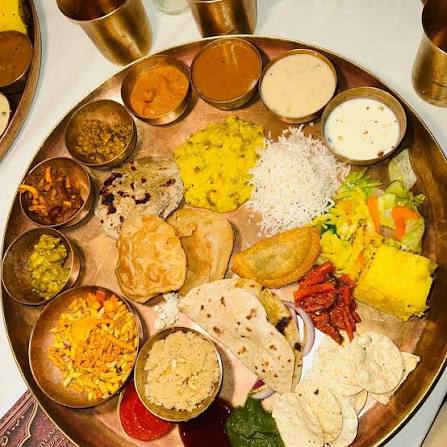
Instead of choosing one large entrée, a thali typically brings several components together on one platter.
Depending on the restaurant, a vegetarian thali may include:
- Rice
- Roti
- Dal
- Vegetable curry
- Paneer
- Beans
- Salad
- Pickles
- Chutneys
- Dessert
Govinda’s Kitchen currently offers several vegetarian thali options, including its Express Thali, Paneer Thali, Protein Thali, and Govinda Thali.
This makes a thali a useful choice for anyone who wants to sample several flavors in one meal.
Vegetarian Indian Food Can Be Affordable
Indian food can also provide good value for vegetarian diners.
Many of the cuisine’s core ingredients—lentils, chickpeas, potatoes, rice, vegetables, and grains—can create filling meals without requiring expensive proteins.
At Govinda’s Kitchen, for example, the current menu lists an Express Thali at $8.99 and a Paneer Thali at $14.99, although menu prices can change.
For budget-conscious diners, look for:
- Lunch specials
- Thalis
- Dosa combinations
- Dal with rice
- Chana masala with bread
- Vegetarian lunch combos
- Shared appetizers
- Direct pickup options
Always check the current menu before visiting because prices and specials can change.
Vegetarian Doesn’t Mean Boring
One misconception about vegetarian dining is that removing meat automatically means sacrificing flavor.
Indian cuisine makes that idea particularly easy to challenge.
Vegetarian Indian cooking can be:
- Spicy
- Smoky
- Tangy
- Creamy
- Earthy
- Aromatic
- Crispy
- Rich
- Fresh
- Light
A crispy dosa with chutney provides a completely different experience from a rich paneer curry. A smoky baingan bharta tastes different again, while a bowl of dal can be comforting and deeply flavorful.
The variety comes from ingredients and technique rather than simply the presence of meat.
Why This Guide Is Useful for Vegetarians and Vegans
The goal of this guide is not simply to list Indian restaurants with a vegetarian item on the menu.
Instead, it will help you understand which types of restaurants and dishes work best for different vegetarian and vegan dining needs.
We’ll look at dedicated vegetarian restaurants, restaurants with extensive vegetarian menus, South Indian options, affordable choices, lunch and dinner options, takeout and delivery, and practical tips for identifying vegan dishes.
Because restaurant menus and dietary policies can change, it’s still smart to confirm ingredients and preparation methods directly with the restaurant before ordering—especially for strict vegan diets.
Final Thought Before Exploring the Restaurants
Downtown Brooklyn’s Indian food scene gives vegetarian diners an opportunity to go far beyond the usual “vegetarian curry.”
You can explore thalis, dosa, chaat, paneer, lentils, chickpeas, regional vegetable dishes, rice preparations, breads, and many other foods that demonstrate the depth of Indian vegetarian cooking.
Whether you’re a lifelong vegetarian, a vegan exploring Brooklyn, someone trying to eat less meat, or simply a diner who loves flavorful plant-forward food, Indian cuisine offers an enormous range of possibilities.
And that’s what makes exploring the best vegetarian Indian restaurants in Downtown Brooklyn so interesting: you aren’t simply replacing meat with vegetables. You’re discovering an entire culinary tradition where vegetarian food has been developed, celebrated, and perfected across generations.
Top Vegetarian Indian Restaurants in Downtown Brooklyn
Downtown Brooklyn and the surrounding neighborhoods offer several Indian restaurants where vegetarian diners can enjoy much more than a basic vegetable curry. From dedicated vegetarian kitchens and South Indian dosa specialists to North Indian restaurants with substantial vegetarian menus, there are plenty of choices for meat-free dining.
For this guide, the restaurants below are selected based on their relevance to vegetarian and vegan-friendly Indian dining, rather than presented as a strict ranking. Restaurant menus, hours, and prices can change, so checking the current menu before visiting is always recommended.
Govinda’s Kitchen — Vegetarian-Focused Indian Food
Location: 305 Schermerhorn St, Brooklyn, NY 11217
Best for: Pure vegetarian Indian food, thalis, dosa, chaat, casual meals
Price: Generally budget-friendly to moderate
If your priority is finding an Indian restaurant where you don’t have to navigate a meat-heavy menu, Govinda’s Kitchen is one of the most distinctive options near Downtown Brooklyn.
The restaurant describes itself as a pure vegetarian kitchen and states that it does not use meat, fish, or eggs. Its food is connected to a Vedic culinary tradition, and the menu includes a wide variety of Indian vegetarian dishes.
Current menu highlights include:
- Govinda Thali
- Veggie Thali
- Express Thali
- Paneer Thali
- Dosa
- Samosa
- Samosa chaat
- Pani puri
- Kachori chaat
- Dal
- Gobi
- Idli
- Puri
- Indian sweets
The restaurant is especially useful for diners who want to experience Indian food as a vegetarian cuisine rather than simply choosing vegetarian alternatives at a regular Indian restaurant.
Its thalis are particularly appealing because they allow you to sample several components in one meal.
For vegan diners, however, it is still important to ask about dairy ingredients because vegetarian food can contain ghee, butter, paneer, yogurt, or other dairy products.
Govinda’s Kitchen also currently offers a tiffin service, making it an interesting option for people who want home-style vegetarian Indian food beyond a single restaurant visit.
Kadamba Kafe — Dedicated Vegetarian Option
Location: 305 Schermerhorn St, Brooklyn, NY 11217
Best for: Vegetarian Indian meals and casual daytime dining
Kadamba Kafe is another vegetarian-focused option associated with the same Schermerhorn Street location as Govinda’s Kitchen. Current local listings categorize Kadamba Kafe as a vegetarian restaurant, with daytime service. Kadamba Kafe
For vegetarian diners, this type of focused operation can make ordering simpler because the restaurant’s identity is centered around meat-free food.
It can be particularly useful for:
- Vegetarian lunches
- Indian snacks
- Light meals
- Rice and vegetable dishes
- Traditional Indian preparations
Because restaurant operations and menus can change, check the current menu and hours before making a dedicated trip.
Brooklyn Curry Project — South Indian Vegetarian Food
Location: 383 Bridge St, Brooklyn, NY 11201
Best for: South Indian cuisine, dosa, vegetarian meals
If you’re looking to move beyond North Indian curries and paneer, Brooklyn Curry Project is worth exploring.
The current local listing identifies Brooklyn Curry Project as a South Indian restaurant at 383 Bridge Street. Brooklyn Curry Project
South Indian cuisine is particularly interesting for vegetarian diners because many of its most recognizable dishes are naturally vegetarian.
Depending on the current menu, diners can look for dishes such as:
- Dosa
- Idli
- Vada
- Sambar
- Coconut chutney
- Vegetable preparations
- Rice-based dishes
Dosa is especially worth trying if you’re new to South Indian food. The crisp fermented crepe provides a completely different experience from naan and North Indian curries.
For vegan diners, South Indian food can also provide good possibilities, but ask whether butter, ghee, yogurt, or other dairy products are included in the specific dish.
Filter Kaapi — South Indian Breakfast and Vegetarian Specialties
Location: 383 Bridge St, Brooklyn, NY 11201
Best for: South Indian breakfast, dosa, coffee, casual vegetarian dining
Filter Kaapi is another Indian restaurant at 383 Bridge Street and is particularly relevant if you’re interested in South Indian food.
Filter Kaapi
The restaurant is especially suitable for diners who want to explore the breakfast and café side of Indian cuisine rather than focusing exclusively on dinner curries.
South Indian vegetarian dishes can include:
- Dosa
- Idli
- Vada
- Sambar
- Chutneys
- Upma
- Other regional breakfast preparations
A South Indian meal can be an excellent option for vegetarian diners because lentils, rice, vegetables, and fermented foods form such an important part of the cuisine.
Filter Kaapi’s current local listing shows daytime hours, making it more relevant for breakfast and lunch rather than a late dinner.
Kashi Indian Cuisine & Bar — Modern North Indian Vegetarian Dining
Location: 286 Livingston St, Brooklyn, NY 11217
Best for: Modern North Indian cuisine, business meals, upscale vegetarian dining
Kashi Indian Cuisine & Bar
Kashi offers a different experience from a dedicated vegetarian restaurant.
Its focus is modern North Indian cuisine, with the restaurant describing its menu as an interpretation of North India’s culinary traditions. Its current website highlights influences from North Indian cooking and dishes including slow-cooked biryanis and char-grilled preparations.
Vegetarian diners can explore dishes based around:
- Paneer
- Vegetables
- Lentils
- Rice
- Indian breads
- Vegetarian appetizers
Kashi can be particularly useful when you’re dining with a mixed group. One person can order vegetarian dishes while others explore the restaurant’s non-vegetarian menu.
The restaurant also currently lists a weekday lunch special from Monday through Friday, 11 AM to 3 PM, with a separate vegetarian option priced at $19.99 at the time of checking.
Because Kashi serves a broader menu that includes meat and dairy, strict vegetarians and vegans should confirm ingredients and preparation details.
Curry Heights — Casual Indian Dining Near Downtown Brooklyn
Location: 151 Remsen St, Brooklyn, NY 11201
Best for: Casual Indian meals, vegetarian curries, affordable dining
Curry Heights
Curry Heights is a convenient option for diners around Downtown Brooklyn and Brooklyn Heights who want a casual Indian meal.
Its broader Indian menu provides vegetarian diners with options such as:
- Dal
- Chickpea dishes
- Vegetable curries
- Paneer
- Rice
- Indian breads
- Vegetarian appetizers
The advantage here is flexibility. You don’t necessarily need to visit a dedicated vegetarian restaurant to enjoy a satisfying vegetarian Indian meal.
For groups, Curry Heights can also work well when some diners want meat while others prefer vegetarian dishes.
If you’re vegan, ask about ghee, butter, cream, and yogurt before ordering.
Mint Heights — Indian Dining With Vegetarian Choices
Location: 368 Myrtle Ave, Brooklyn, NY 11205
Best for: Contemporary Indian dining, vegetarian-friendly group meals
Mint Heights
Mint Heights is located in the broader Brooklyn area and can be worth considering when you’re willing to travel beyond the immediate Downtown Brooklyn core.
The restaurant offers a broader Indian menu rather than operating exclusively as a vegetarian restaurant.
Vegetarian diners can look for dishes featuring:
- Paneer
- Lentils
- Chickpeas
- Vegetables
- Rice
- Indian breads
- Vegetarian appetizers
Its broader menu makes it useful for groups with different dietary preferences.
Current local listings show lunch and dinner service, with later evening hours on several days.
Dastaan Indian Kitchen — Broad Indian Menu With Vegetarian Options
Location: 115 Smith St, Brooklyn, NY 11201
Best for: Indian curries, group dining, vegetarian-friendly meals
Dastaan Indian Kitchen
Dastaan Indian Kitchen is another nearby restaurant worth considering if you’re looking for a broader Indian menu with vegetarian choices.
The restaurant serves a range of Indian preparations, allowing vegetarian diners to build meals around vegetable curries, lentils, rice, breads, and other meat-free dishes.
It can be particularly convenient for groups because the menu isn’t limited to one specific regional style.
For vegan diners, however, individual dishes should be checked carefully. A vegetable curry may contain cream, butter, or ghee even when no meat is involved.
Indian Table — Goan and Indian Vegetarian Options
Location: 234 Court St, Brooklyn, NY 11201
Best for: Goan cuisine, regional Indian food, vegetarian dining
Indian Table
Indian Table provides an opportunity to explore a different side of Indian cuisine, with a focus that includes Goan food.
This can be an interesting choice for vegetarian diners who have already tried the familiar North Indian restaurant staples and want to explore another regional tradition.
Depending on the current menu, vegetarian diners can look for vegetable preparations, rice dishes, breads, and other meat-free options.
However, Goan cuisine can also include seafood and meat, so strict vegetarians should make their requirements clear when ordering.
For vegan diners, ask about dairy ingredients and preparation methods as well.
DOSA ROYALE — South Indian Dosa and Vegetarian Dining
Location: 65 Lafayette Ave, Brooklyn, NY 11217
Best for: Dosa, South Indian cuisine, casual vegetarian meals
DOSA ROYALE
DOSA ROYALE is another useful option when the goal is specifically to explore South Indian vegetarian food.
The current local listing identifies it as a South Indian restaurant, with service from late morning through evening.
Dosa is naturally one of the biggest attractions for vegetarian diners.
You may find varieties such as:
- Plain dosa
- Masala dosa
- Set dosa
- Vegetable dosa
- Other South Indian specialties
Pairing dosa with sambar and chutneys creates a complete vegetarian meal without needing a meat substitute.
As always, vegan diners should ask whether the dosa or accompanying chutneys contain butter, ghee, yogurt, or other dairy ingredients.
OMAR’S INDIAN FINE CUISINE — Vegetarian Options in Prospect Heights
Location: 568 Vanderbilt Ave, Brooklyn, NY 11238
Best for: Broader Indian dining, vegetarian-friendly meals
OMAR’S INDIAN FINE CUISINE
For diners willing to travel farther from Downtown Brooklyn, OMAR’S Indian Fine Cuisine in Prospect Heights provides another option.
The restaurant serves a broad Indian menu rather than specializing exclusively in vegetarian food.
Vegetarian diners can build a meal around:
- Paneer
- Dal
- Vegetable curries
- Rice
- Breads
- Vegetarian appetizers
Its location on Vanderbilt Avenue also makes it convenient for diners combining Indian food with an exploration of the surrounding Prospect Heights neighborhood.
How to Choose Between These Restaurants
Rather than asking which restaurant is universally “best,” consider what kind of vegetarian meal you want.
For a dedicated vegetarian experience:
Govinda’s Kitchen or Kadamba Kafe.
For South Indian food:
Brooklyn Curry Project, Filter Kaapi, or DOSA ROYALE.
For modern North Indian dining:
Kashi.
For a casual Indian meal:
Curry Heights.
For a broader Indian menu with a group:
Dastaan Indian Kitchen or Mint Heights.
For regional Goan cuisine:
Indian Table.
For a wider Brooklyn food trip:
OMAR’S Indian Fine Cuisine.
A Note About Vegan Dining
Vegetarian restaurants are not automatically vegan restaurants.
This distinction is especially important when ordering:
- Paneer
- Naan
- Butter naan
- Dal
- Creamy curries
- Korma
- Malai dishes
- Raita
- Desserts
Ingredients such as ghee, butter, cream, milk, yogurt, and paneer are common in Indian cooking.
If you are vegan, ask specifically whether your food contains dairy and whether it can be prepared without dairy.
Final Takeaway
Downtown Brooklyn and its surrounding neighborhoods give vegetarian diners several ways to explore Indian cuisine. Dedicated vegetarian kitchens provide the simplest experience, while South Indian restaurants offer dosa and other naturally vegetarian specialties. Broader Indian restaurants provide flexibility for groups with mixed dietary preferences.
The most enjoyable approach is to avoid limiting yourself to one type of dish. Try a thali one day, dosa the next, and then explore paneer, dal, chana masala, vegetable biryani, or regional specialties.
That variety is what makes vegetarian Indian dining in Brooklyn so much more than simply ordering a meat-free entrée.
Best Neighborhoods or Areas for Vegetarian Indian Food
When searching for the best vegetarian Indian restaurants in Downtown Brooklyn, it helps to look beyond a single street or neighborhood. Downtown Brooklyn sits close to several areas with Indian restaurants, and each neighborhood offers a slightly different dining experience.
For vegetarian and vegan diners, this is particularly useful. One area may be better for casual curry-based meals, another for South Indian dosa, another for upscale dining, and another for dedicated vegetarian food.
Here are some of the best areas to explore.
1. Downtown Brooklyn
Best for: Convenience, South Indian food, vegetarian-friendly restaurants, and easy access
Downtown Brooklyn should be the natural starting point for anyone searching for vegetarian Indian food in the area.
The neighborhood offers convenient access to several Indian restaurants and is particularly useful for diners who want to combine different styles of Indian cuisine.
One notable address is 383 Bridge Street, where both Filter Kaapi and Brooklyn Curry Project are located. Filter Kaapi is an Indian restaurant with daytime service, while Brooklyn Curry Project is specifically categorized as a South Indian restaurant.
South Indian cuisine is especially valuable for vegetarian diners because dishes such as dosa, idli, vada, and sambar are central to the cuisine.
Downtown Brooklyn is also convenient for office workers, students, residents, and visitors who want a vegetarian Indian lunch without traveling far.
Why visit: It combines convenience with access to South Indian and broader Indian dining.
2. Brooklyn Heights
Best for: Neighborhood dining, classic Indian dishes, and convenient vegetarian meals
Brooklyn Heights is immediately adjacent to Downtown Brooklyn and provides another useful area for vegetarian Indian food.
Curry Heights at 151 Remsen Street is a casual Indian restaurant with a relatively affordable price range, while Mint Heights has a location at 46 Henry Street with a broader Indian menu.
Vegetarian diners can look for dishes such as:
- Dal
- Chana masala
- Paneer
- Vegetable curries
- Vegetable biryani
- Indian breads
- Vegetarian appetizers
This neighborhood is particularly convenient if you’re already exploring Brooklyn Heights, the waterfront, or the Brooklyn Heights Promenade.
Why visit: A practical choice when you want Indian food without going far from the Downtown Brooklyn area.
3. Boerum Hill and Atlantic Avenue
Best for: Casual Indian dining, lunch, dinner, and group meals
The Atlantic Avenue and Boerum Hill area gives vegetarian diners another cluster of Indian food options.
Masala Grill at 501B Atlantic Avenue is currently listed as an Indian restaurant with lunch and dinner service and a moderate price range.
The area works well for groups because Indian cuisine makes it easy to order several vegetarian dishes for sharing.
A group might choose:
- Paneer
- Dal
- Chana masala
- Vegetable biryani
- Naan
- Roti
- Samosas
- Vegetable appetizers
Vegetarian diners can therefore participate in a shared meal rather than ordering one isolated meat-free dish.
Why visit: Good for casual meals and groups with mixed dietary preferences.
4. Livingston Street and the Downtown Brooklyn–Boerum Hill Border
Best for: Modern Indian dining and more polished vegetarian meals
The area around Livingston Street is useful when you want something more refined than a quick Indian lunch.
Kashi Indian Cuisine & Bar is located at 286 Livingston Street and focuses on modern North Indian cuisine. Its current listing places it in a higher price category than many casual Indian restaurants nearby.
Kashi’s cuisine draws from North Indian traditions, making it a useful choice for vegetarian diners who want dishes such as paneer, dal, vegetable preparations, rice, and Indian breads in a more polished restaurant environment.
The restaurant can also work well for mixed groups because its menu extends beyond vegetarian food.
Why visit: A good option for dinner, business meals, date nights, and occasions where atmosphere matters.
5. Cobble Hill and Court Street
Best for: Regional Indian cuisine and a more destination-style meal
Court Street and the Cobble Hill area are worth considering if you’re interested in exploring Indian cuisine beyond the most familiar North Indian dishes.
Indian Table at 234 Court Street offers Indian food with a Goan influence, providing an opportunity to explore a different regional tradition.
For vegetarian diners, regional Indian cuisine can open up an entirely different range of flavors.
Instead of focusing only on paneer and naan, look for:
- Vegetable preparations
- Rice dishes
- Regional curries
- Lentil dishes
- Vegetarian appetizers
- Coconut-based preparations
Goan cuisine also includes seafood and meat, so vegetarians should clearly communicate their dietary requirements when ordering.
Why visit: Ideal for diners who want to explore regional Indian cooking rather than only standard Indian restaurant favorites.
6. Fort Greene
Best for: South Indian food, dosa, and vegetarian-friendly meals
Fort Greene is one of the most interesting nearby areas for diners who specifically want South Indian cuisine.
DOSA ROYALE at 65 Lafayette Avenue is currently categorized as a South Indian restaurant and offers service throughout the day into the evening.
For vegetarian diners, this is particularly appealing because South Indian cuisine has a huge selection of naturally vegetarian foods.
Consider trying:
- Masala dosa
- Plain dosa
- Idli
- Vada
- Sambar
- Coconut chutney
- Tomato chutney
- Vegetable rice dishes
Dosa is also a great choice for diners who want something completely different from a traditional curry-and-naan meal.
Vegan diners should still ask about ghee, butter, yogurt, and other dairy ingredients.
Why visit: One of the better nearby areas for exploring South Indian vegetarian cuisine.
7. Myrtle Avenue and Clinton Hill
Best for: Broader Indian dining, evening meals, and neighborhood exploration
Myrtle Avenue and the surrounding Clinton Hill area provide additional Indian dining choices.
Mint Heights currently has a location at 368 Myrtle Avenue, with lunch and dinner service and later evening hours on several days. Spice & Grill Indian Kitchen and Bar is also located on Myrtle Avenue.
This area can be useful for diners who want to combine an Indian meal with an evening exploring Brooklyn’s neighborhood restaurants and shops.
Vegetarian diners can look for:
- Paneer dishes
- Dal
- Vegetable curries
- Biryani
- Rice
- Indian breads
- Vegetarian appetizers
The broader Indian menu also makes this area suitable for groups where some people want vegetarian food and others prefer meat.
Why visit: Useful for evening dining and exploring Indian food outside the immediate Downtown core.
8. Prospect Heights
Best for: Broader Indian dining and a neighborhood food experience
Prospect Heights gives vegetarian diners another reason to expand their search.
OMAR’S INDIAN FINE CUISINE at 568 Vanderbilt Avenue is currently listed as an Indian restaurant with a moderate price range and service extending into the evening.
A broader Indian restaurant such as this can work well when a group has different preferences.
Vegetarian diners can build meals around:
- Dal
- Paneer
- Chickpeas
- Vegetable curries
- Rice
- Breads
- Vegetarian appetizers
Because this is farther from the Downtown Brooklyn core, it makes more sense as part of a broader Brooklyn food outing rather than a quick stop during a Downtown visit.
Why visit: Good for expanding your Indian food exploration beyond Downtown Brooklyn.
9. Schermerhorn Street
Best for: Dedicated vegetarian Indian food
Schermerhorn Street is particularly important for vegetarian diners because it is home to Govinda’s Kitchen and Kadamba Kafe at 305 Schermerhorn Street.
Govinda’s Kitchen is a dedicated vegetarian Indian restaurant, while Kadamba Kafe is currently categorized as a vegetarian restaurant.
This makes the area especially convenient for people who want to avoid meat without having to navigate a large mixed menu.
Govinda’s Kitchen is particularly notable for its vegetarian thalis, dosa, Indian snacks, dal, vegetable dishes, and other meat-free preparations.
For strict vegan diners, individual ingredients still need to be checked because vegetarian restaurants can use dairy products.
Why visit: One of the most useful areas for diners specifically seeking vegetarian-focused Indian food.
10. Atlantic Avenue and the Broader Downtown Brooklyn Area
Best for: Comparing restaurants and building a vegetarian Indian food tour
If you’re not looking for just one restaurant, the broader Downtown Brooklyn area can be treated as a small Indian food tour.
You can start with a vegetarian-focused meal near Schermerhorn Street, explore South Indian food around Bridge Street, visit Livingston Street for modern North Indian cuisine, and then continue toward Atlantic Avenue or Court Street for additional options.
This approach is particularly useful for vegetarian diners because each restaurant can introduce a different side of Indian cooking.
For example:
Meal 1: Try a vegetarian thali.
Meal 2: Explore dosa and South Indian chutneys.
Meal 3: Try paneer and North Indian curries.
Meal 4: Explore Goan or another regional Indian style.
Instead of searching for one restaurant that represents all Indian food, you get to experience the diversity of Indian cuisine across several neighborhoods.
Which Area Should You Choose?
Your ideal neighborhood depends on the kind of vegetarian Indian meal you’re looking for.
For dedicated vegetarian food:
Schermerhorn Street and the Govinda’s Kitchen area.
For South Indian food:
Downtown Brooklyn and Fort Greene.
For classic Indian food close to Downtown:
Downtown Brooklyn and Brooklyn Heights.
For modern North Indian dining:
Livingston Street and the Kashi area.
For regional Indian cuisine:
Court Street and Cobble Hill.
For casual group dining:
Atlantic Avenue and Boerum Hill.
For a broader Brooklyn food trip:
Prospect Heights and Myrtle Avenue.
Vegetarian and Vegan Diners Should Look Beyond Restaurant Labels
One important lesson when exploring these neighborhoods is that a restaurant doesn’t have to be labeled “vegetarian” to offer excellent vegetarian food.
Many Indian restaurants have substantial vegetarian sections.
At the same time, a vegetarian restaurant isn’t automatically vegan.
If you’re vegan, always ask about:
- Ghee
- Butter
- Cream
- Milk
- Yogurt
- Paneer
A dish containing vegetables can still contain dairy.
The same applies to breads. Naan, for example, may contain butter, milk, or yogurt depending on the recipe.
Final Thoughts
Downtown Brooklyn is a strong starting point for vegetarian Indian food, but the surrounding neighborhoods make the experience much more interesting.
From Schermerhorn Street’s vegetarian-focused options to Downtown Brooklyn’s South Indian restaurants, Brooklyn Heights’ casual Indian dining, Livingston Street’s modern North Indian experience, and Fort Greene’s dosa-focused choices, each area offers something different.
For vegetarian diners, this neighborhood-by-neighborhood approach makes it easier to discover Indian cuisine on its own terms. Rather than treating vegetarian food as a substitute for meat, you can explore the lentils, vegetables, rice, breads, fermented foods, spices, and regional cooking techniques that make Indian vegetarian cuisine so diverse.
If you’re vegan, take the same approach but add one extra step: verify dairy ingredients before ordering.
The best part is that you don’t have to travel across New York City to experience this variety. A relatively compact area around Downtown Brooklyn gives you access to multiple Indian culinary traditions, making it easy to turn a simple vegetarian meal into a much broader exploration of Indian food.
Popular Vegetarian Indian Dishes People Should Try
One of the best things about exploring vegetarian Indian food in Downtown Brooklyn is the sheer variety available. Indian cuisine has developed thousands of vegetarian recipes across different regions, communities, and cooking traditions. That means vegetarian diners can enjoy everything from crispy South Indian dosa and spicy chaat to creamy paneer dishes, fragrant biryani, hearty dals, and complete thali meals.
If you’re new to Indian food, the menu can initially feel overwhelming. There may be dozens of unfamiliar names, different spice levels, and several variations of dishes that look similar.
The easiest approach is to start with a few well-known favorites and then gradually explore regional specialties.
Here are some of the vegetarian Indian dishes worth trying around Downtown Brooklyn and the surrounding neighborhoods.
1. Masala Dosa
Masala dosa is one of the most popular South Indian vegetarian dishes and an excellent choice if you want something different from traditional curry and naan.
A dosa is a thin, crisp crepe made from fermented rice and lentil batter. A masala dosa typically contains a spiced potato filling and is served with sambar and chutneys.
The combination gives you several textures and flavors in one meal:
- Crispy dosa
- Soft spiced potatoes
- Tangy sambar
- Coconut chutney
- Spicy or tomato-based chutney
Restaurants such as DOSA ROYALE and South Indian-focused establishments around Brooklyn provide opportunities to explore dosa and related dishes.
For vegan diners, ask whether the dosa is prepared with oil or ghee and check the ingredients in the chutneys and potato filling.
2. Idli
Idli is another classic South Indian vegetarian dish.
These soft, steamed cakes are traditionally made from fermented rice and lentil batter. Unlike crispy dosa, idli has a soft and fluffy texture.
Idli is commonly served with:
- Sambar
- Coconut chutney
- Tomato chutney
- Other regional chutneys
It makes an excellent breakfast or light meal.
Because the basic idli itself is generally plant-based, it can be a useful option for vegan diners, although the accompanying dishes should still be checked.
3. Vada
Vada is a savory fried South Indian snack or breakfast dish.
One common variety is made from urad dal, giving it a crisp exterior and soft interior.
It is often served with sambar and chutney.
The contrast between crispy vada, warm sambar, and fresh chutney makes it an excellent introduction to South Indian flavors.
Vegetarian diners can order vada as an appetizer or combine it with dosa or idli for a larger meal.
4. Chole Bhature
Chole bhature is a North Indian favorite consisting of spicy chickpea curry paired with large, fluffy fried bread called bhature.
The chickpeas are generally cooked with tomatoes, onions, and a blend of spices.
The bhature is rich, crispy on the outside, and soft inside, making the dish particularly filling.
Because it is a substantial meal based around chickpeas rather than meat, it is a great option for vegetarian diners who want something hearty.
It can be quite rich, so it is especially popular as a filling lunch.
5. Chana Masala
Chana masala is one of the most versatile vegetarian Indian dishes.
The main ingredient is chickpeas cooked with aromatics and spices, often including tomato, onion, ginger, garlic, cumin, coriander, and chili.
The exact recipe varies considerably between restaurants.
You can enjoy chana masala with:
- Naan
- Roti
- Paratha
- Rice
- Bhatura
Because recipes vary, vegan diners should still ask whether the particular preparation contains ghee or butter.
6. Dal Tadka
Dal is one of the foundations of Indian vegetarian cooking.
Dal tadka typically features lentils cooked until soft and finished with a tempering of spices and aromatics.
The tempering may include ingredients such as:
- Cumin
- Garlic
- Dried chili
- Mustard seeds
- Curry leaves
- Ghee or oil
The result is comforting, aromatic, and flavorful without needing meat.
Dal works especially well with rice or roti and is an excellent dish to share with other curries.
If you’re vegan, ask whether the tempering uses ghee or vegetable oil.
7. Dal Makhani
Dal makhani is a richer North Indian lentil dish traditionally made with black lentils and kidney beans.
It is slow-cooked to create a creamy texture and is commonly enriched with butter or cream.
The dish is particularly good with:
- Naan
- Roti
- Jeera rice
- Plain basmati rice
Vegetarians can enjoy it as a main dish rather than treating it as a side.
For vegan diners, dal makhani requires extra attention because butter and cream are common ingredients.
Ask whether the kitchen can prepare it without dairy.
8. Palak Paneer
Palak paneer combines paneer, a fresh Indian cheese, with spinach and spices.
The spinach creates a rich green sauce while paneer provides a soft, mild contrast.
It is one of the most recognizable vegetarian North Indian dishes and is particularly good with naan, roti, or rice.
Because paneer is dairy, it is vegetarian but not vegan.
If you’re vegan, look for a restaurant that offers a tofu or vegetable alternative or choose another plant-based curry.
9. Paneer Tikka
Paneer tikka is the vegetarian counterpart to many popular tandoori preparations.
Chunks of paneer are marinated with spices and often yogurt before being grilled in a tandoor with vegetables such as:
- Onion
- Bell pepper
- Tomato
The high heat creates smoky edges while keeping the paneer relatively soft inside.
It makes an excellent appetizer for a group because it can be shared easily.
Again, vegan diners should avoid traditional paneer tikka because paneer and the marinade contain dairy.
10. Shahi Paneer
Shahi paneer is another North Indian paneer preparation.
The word “shahi” refers to a rich, royal-style preparation. The sauce is often creamy and may contain nuts, dairy, spices, and aromatics.
The result is richer and milder than some spicy Indian curries.
It pairs well with:
- Naan
- Roti
- Paratha
- Basmati rice
This is a good option for diners who prefer creamy Indian dishes rather than very spicy curries.
11. Aloo Gobi
Aloo gobi is a classic vegetarian combination of potatoes and cauliflower.
The vegetables are cooked with spices that can include turmeric, cumin, coriander, ginger, and chili.
Unlike creamy curries, aloo gobi is generally a drier preparation, making it an excellent side dish to combine with dal, rice, or another curry.
It is also a good example of how Indian cooking can turn simple vegetables into a flavorful centerpiece.
Ask about the preparation if you’re vegan, particularly if you want to avoid ghee.
12. Bhindi Masala
Bhindi masala is an Indian okra dish cooked with spices and aromatics.
Okra develops a distinctive texture when cooked properly, and the spice mixture adds plenty of flavor.
It is usually served as a vegetable side or main dish with:
- Roti
- Naan
- Rice
- Dal
For diners who have never tried Indian-style okra, this can be a particularly interesting dish to explore.
13. Baingan Bharta
Baingan bharta is made from roasted or grilled eggplant that is mashed and cooked with aromatics and spices.
The roasting process gives the eggplant a smoky flavor.
It pairs beautifully with roti or naan and can provide a very different experience from paneer-based dishes.
If you enjoy smoky vegetables, baingan bharta is worth trying.
14. Vegetable Biryani
Biryani isn’t limited to meat.
Vegetable biryani uses fragrant basmati rice, vegetables, spices, and aromatics to create a substantial vegetarian rice dish.
Depending on the restaurant and regional style, the preparation may include:
- Carrots
- Peas
- Potatoes
- Beans
- Cauliflower
- Bell peppers
- Herbs
- Fried onions
- Nuts or raisins
Biryani is particularly convenient for groups because it can be ordered as a shared centerpiece.
Vegetarian diners can pair it with raita, but vegan diners should choose a dairy-free accompaniment if necessary.
15. Jeera Rice
Jeera rice is a simpler rice preparation flavored with cumin.
It may sound basic compared with biryani, but it is an excellent accompaniment for strongly flavored curries.
Try it with:
- Dal
- Chana masala
- Paneer curry
- Vegetable curry
The cumin adds fragrance without overwhelming the main dish.
16. Samosa
Samosas are among India’s most recognizable snacks.
The classic vegetarian samosa contains a spiced filling, often based around potatoes and peas, enclosed in a crisp pastry shell.
They are commonly served with chutneys such as:
- Tamarind chutney
- Mint chutney
- Coriander chutney
Samosas are excellent as an appetizer, snack, or part of a larger Indian meal.
They are also easy to share.
For vegan diners, ask whether the pastry contains dairy and whether the samosa is fried in shared oil.
17. Pakora
Pakoras are vegetables coated in a seasoned gram-flour batter and fried until crisp.
Common versions include:
- Onion pakora
- Potato pakora
- Spinach pakora
- Cauliflower pakora
- Mixed vegetable pakora
They are particularly enjoyable when served hot with chutney.
Pakoras can make a good vegetarian appetizer for a group.
18. Chaat
Chaat is less a single dish than a broad family of Indian street-food preparations.
Depending on the style, chaat may combine:
- Crispy components
- Potatoes
- Chickpeas
- Yogurt
- Chutneys
- Spices
- Sev
- Fresh herbs
Popular examples include:
- Samosa chaat
- Aloo chaat
- Papdi chaat
- Bhel puri
- Pani puri
Chaat is ideal for diners who enjoy contrasting flavors and textures.
However, vegan diners need to watch for yogurt and other dairy ingredients.
19. Aloo Tikki
Aloo tikki is a spiced potato patty that is crisp on the outside and soft inside.
It can be served on its own or incorporated into chaat preparations.
The potato base makes it naturally appealing to vegetarian diners, while spices, chutneys, and toppings add complexity.
It is a good choice when you want a snack rather than a full curry-based meal.
20. Naan
Naan is perhaps the most recognizable Indian bread in American restaurants.
Traditional naan is baked in a tandoor and can be served plain or flavored with ingredients such as:
- Garlic
- Butter
- Herbs
- Cheese
- Chili
For vegetarians, naan can accompany almost any curry.
For vegans, however, naan needs to be checked carefully because butter, ghee, milk, or yogurt may be used.
Ask whether the restaurant can prepare naan without dairy.
21. Roti
Roti is another Indian flatbread and is generally simpler than naan.
It pairs particularly well with:
- Dal
- Chana masala
- Vegetable curries
- Dry vegetable dishes
For vegan diners, roti can sometimes be easier to fit into a plant-based meal, but preparation varies, so it is still worth asking about ingredients.
22. Paratha
Paratha is a layered Indian flatbread that can be plain or stuffed.
Popular vegetarian versions may include:
- Aloo paratha
- Gobi paratha
- Paneer paratha
- Methi paratha
Aloo paratha, stuffed with spiced potatoes, can be a satisfying meal on its own when served with yogurt, pickle, or chutney.
Vegan diners should check whether the paratha is cooked with ghee or butter.
23. Thali
A vegetarian thali is one of the best ways to experience several Indian dishes in a single meal.
A typical thali may include:
- Rice
- Dal
- Vegetable curry
- Paneer
- Roti
- Pickles
- Chutneys
- Dessert
The exact selection varies by restaurant and regional tradition.
Govinda’s Kitchen is particularly notable for its vegetarian thali selection, including its Express Thali, Veggie Thali, Paneer Thali, and other thali combinations. (govindaskitchen.us)
If you’re visiting an Indian restaurant for the first time, a thali can be a convenient way to sample multiple flavors without having to choose several separate dishes.
24. Pani Puri
Pani puri is one of India’s best-known street foods.
Small crispy shells are filled with ingredients such as potato, chickpeas, chutneys, and spiced flavored water.
The experience is highly interactive and combines:
- Crunch
- Spice
- Sweetness
- Tanginess
- Fresh herbs
It is a fun choice when you’re looking for something casual rather than a traditional entrée.
Vegan diners should confirm whether the particular fillings and chutneys contain dairy.
25. Dahi Puri
Dahi puri builds on the same street-food concept but adds yogurt.
That creamy yogurt balances the spicy and tangy components.
It can be an excellent vegetarian snack, but because yogurt is a central ingredient, it is not vegan.
26. Pav Bhaji
Pav bhaji is a popular Indian street-food dish consisting of a spiced vegetable mixture served with buttered bread rolls called pav.
The vegetable mixture can contain potatoes, cauliflower, peas, tomatoes, and other vegetables.
The dish is flavorful, filling, and particularly enjoyable as a casual meal.
Vegan diners should ask whether butter is used in both the bhaji and pav.
27. Vada Pav
Vada pav is often described as an Indian-style potato sandwich.
A spiced potato fritter is placed inside a soft pav bun and served with chutneys.
It is particularly associated with Mumbai street food.
For vegetarian diners, it provides a completely different experience from a sit-down curry.
As with other Indian street foods, check whether butter or dairy is used in the bread or preparation if you’re vegan.
28. Sambar
Sambar is a South Indian lentil and vegetable stew flavored with spices.
It is commonly served with:
- Dosa
- Idli
- Vada
- Rice
Sambar demonstrates how lentils and vegetables can form the foundation of a flavorful meal rather than simply serving as side dishes.
For vegan diners, ask whether ghee is used in the tempering.
29. Rasam
Rasam is a lighter South Indian preparation with a tangy, spicy character.
It is commonly made with ingredients such as tomatoes, tamarind, pepper, cumin, and herbs, although recipes vary.
Rasam can be served with rice or as part of a larger South Indian meal.
It’s particularly appealing when you want something lighter than a creamy curry.
30. Indian Desserts
Don’t finish your vegetarian Indian meal without exploring dessert.
Popular vegetarian Indian sweets include:
- Gulab jamun
- Rasmalai
- Kheer
- Jalebi
- Gajar halwa
- Kulfi
- Ladoo
Many traditional Indian desserts contain milk, cream, ghee, or other dairy ingredients.
Vegan diners should ask about ingredients before ordering.
What Should First-Time Vegetarian Diners Order?
If you’re visiting an Indian restaurant for the first time and don’t know what to choose, a simple combination can make the meal easier.
Try:
Starter: Samosa or pakora
Main: Chana masala or paneer
Second dish: Dal or aloo gobi
Bread: Naan or roti
Rice: Vegetable biryani or jeera rice
Side: Chutney or raita
Dessert: Gulab jamun or kulfi
For a South Indian experience, replace the curry-based meal with:
Masala dosa + idli + vada + sambar + chutneys
For a broader sampling experience, order a vegetarian thali.
Best Choices for Vegan Diners
If you’re vegan, some dishes are easier starting points than others, but recipes vary by restaurant.
Potentially vegan-friendly choices include:
- Dosa
- Idli
- Sambar
- Chana masala
- Aloo gobi
- Bhindi masala
- Vegetable curry
- Some dals
- Vegetable biryani
- Samosas
- Pakoras
Always verify ingredients, particularly:
- Ghee
- Butter
- Cream
- Milk
- Yogurt
- Paneer
A restaurant may be able to modify certain dishes to make them vegan, but don’t assume that a vegetarian dish is automatically dairy-free.
Final Thoughts on What to Try
The biggest mistake vegetarian diners can make when exploring Indian food is ordering the same familiar dish every time.
Indian cuisine offers an enormous range of vegetarian experiences.
Try a crispy masala dosa one day. Explore dal and vegetable curries another day. Order a thali when you want variety. Try chaat when you’re looking for street food. Choose biryani when you want a substantial rice-based meal.
And don’t be afraid to ask restaurant staff about dishes you don’t recognize.
The more you explore, the more you’ll discover that vegetarian Indian food isn’t simply an alternative to meat-based dining. It is a diverse culinary tradition with its own techniques, regional identities, ingredients, and flavors.
For diners exploring Downtown Brooklyn, that diversity makes every Indian meal an opportunity to try something new.
Vegetarian and Vegan Indian Food Options
Indian cuisine is particularly well suited to vegetarian diners because vegetables, lentils, beans, rice, grains, and spices have always played an important role in many Indian culinary traditions.
For someone who doesn’t eat meat, an Indian restaurant can offer much more than one or two substitute dishes. A complete meal can be built around dal, chickpeas, vegetables, rice, breads, dosa, chaat, or a traditional thali.
Downtown Brooklyn and the surrounding neighborhoods also give vegetarian diners several different ways to explore Indian food. There are dedicated vegetarian restaurants as well as South Indian and North Indian restaurants with substantial meat-free menus.
For vegan diners, however, there is one important distinction to remember:
Vegetarian does not automatically mean vegan.
Indian cooking frequently uses ghee, butter, milk, cream, yogurt, and paneer. Therefore, vegan diners need to check ingredients and preparation methods before ordering.
Vegetarian Indian Food Is More Than Paneer
When many Americans think of vegetarian Indian food, paneer is often the first thing that comes to mind.
Paneer is certainly popular, but it is only one small part of Indian vegetarian cuisine.
A vegetarian meal can include:
- Dal
- Chana masala
- Aloo gobi
- Bhindi masala
- Baingan bharta
- Vegetable biryani
- Dosa
- Idli
- Vada
- Samosas
- Pakoras
- Chaat
- Vegetable curries
- Thalis
- Roti
- Paratha
This variety makes Indian food particularly useful for vegetarians who want substantial meals rather than simple vegetable sides.
Govinda’s Kitchen for Dedicated Vegetarian Dining
For diners who want a restaurant centered specifically around vegetarian food, Govinda’s Kitchen at 305 Schermerhorn Street is a notable option near Downtown Brooklyn.
The restaurant describes itself as a pure vegetarian kitchen and states that it does not use meat, fish, or eggs. Its menu includes Indian dishes such as thalis, dosa, samosas, chaat, dal, and vegetable preparations. (govindaskitchen.us)
Current menu options include:
- Express Thali
- Veggie Thali
- Paneer Thali
- Govinda Thali
- Dosa
- Idli
- Samosa
- Samosa chaat
- Pani puri
- Dal
- Vegetable dishes
For vegetarians, the advantage is obvious: you can explore a wide range of Indian food without worrying about meat being part of the restaurant’s regular menu.
For vegans, however, the restaurant being vegetarian does not eliminate the need to ask about dairy.
Understanding Vegetarian vs. Vegan Indian Food
The distinction is simple:
Vegetarian:
No meat, poultry, or fish, but dairy and eggs may be included depending on the restaurant and dietary definition.
Vegan:
No meat, poultry, fish, dairy, eggs, or other animal-derived ingredients.
Indian cuisine contains many naturally plant-based foods, but dairy is deeply integrated into many popular dishes.
For example:
| Dish | Vegetarian | Usually Vegan? |
|---|---|---|
| Chana masala | Yes | Often, but verify |
| Aloo gobi | Yes | Often, but verify |
| Dal | Yes | Depends on ghee |
| Dosa | Yes | Often, but verify |
| Idli | Yes | Often |
| Samosa | Yes | Often, but verify |
| Paneer tikka | Yes | No |
| Palak paneer | Yes | No |
| Butter chicken | No | No |
| Dal makhani | Yes | Usually not |
| Naan | Yes | Usually not |
| Raita | Yes | No |
Recipes vary, so the table should be treated as a starting point rather than a guarantee.
Best Naturally Plant-Based Indian Dishes
Vegan diners can often begin with dishes based around vegetables, legumes, rice, and fermented grains.
Some options to ask about include:
Chana masala: Chickpeas cooked with spices and aromatics.
Aloo gobi: Potato and cauliflower with spices.
Bhindi masala: Okra prepared with an aromatic spice mixture.
Dosa: Fermented rice-and-lentil crepe, provided it is prepared without ghee or butter.
Idli: Steamed fermented rice-and-lentil cakes.
Sambar: Lentil and vegetable stew.
Vegetable biryani: Rice and vegetables cooked with aromatic spices.
Some dals: Depending on whether the tempering uses ghee or oil.
The key phrase for vegan diners is “depending on preparation.”
Two restaurants can serve the same dish while using different ingredients.
Dosa Is a Great Vegan-Friendly Starting Point
South Indian cuisine provides many interesting possibilities for vegan diners.
Dosa is particularly popular because its basic batter is made from rice and lentils.
However, diners should still ask:
“Is the dosa cooked with oil or ghee?”
The accompanying chutneys and fillings should also be checked.
A masala dosa may contain a potato filling that is plant-based, but butter or ghee can sometimes be used during preparation.
Restaurants such as DOSA ROYALE and Brooklyn Curry Project provide opportunities to explore South Indian cuisine around the Downtown Brooklyn area.
South Indian food can therefore be a great way to move beyond the typical curry-and-naan experience.
Idli, Vada, and Sambar
A South Indian combination of idli, vada, and sambar can make a satisfying vegetarian meal.
Idli is soft and steamed.
Vada is crisp and fried.
Sambar adds a warm, spiced lentil-and-vegetable component.
Chutneys provide additional flavor.
For vegan diners, ask about the use of ghee or butter in the individual dishes.
This combination is also useful for people who prefer lighter meals.
Chana Masala for a Hearty Vegan Option
Chickpeas are one of the most useful ingredients in vegetarian and vegan Indian cooking.
Chana masala is filling, protein-rich, and strongly flavored without requiring dairy.
It works well with:
- Rice
- Roti
- Some vegan breads
- Vegetable dishes
If you’re vegan, ask whether the restaurant uses ghee or butter in the final preparation.
Vegetable Biryani
Vegetable biryani is another substantial option.
The combination of fragrant rice, vegetables, herbs, and spices creates a complete meal without meat.
It can also be convenient for takeout because rice-based dishes generally travel well.
However, some restaurants may finish rice preparations with butter or ghee, so vegan diners should confirm.
If you’re sharing the meal, vegetable biryani also works well alongside dal or a vegetable curry.
Dal Is a Vegetarian Staple
Dal is one of the most important foods to understand when exploring Indian vegetarian cuisine.
There are numerous types of lentils and many different preparations.
You may encounter:
- Dal tadka
- Dal fry
- Dal makhani
- Yellow dal
- Moong dal
- Masoor dal
- Chana dal
The difference can come from the type of lentil, spices, cooking method, and tempering.
For vegan diners, the biggest question is often the fat used during preparation.
Ask:
“Is the dal tempered with ghee or oil?”
If it is prepared with vegetable oil, it may fit a vegan diet, subject to the rest of the ingredients.
Paneer Is Vegetarian, Not Vegan
Paneer deserves special attention because it appears frequently on Indian menus.
Paneer is a fresh Indian cheese made from milk.
Popular paneer dishes include:
- Palak paneer
- Paneer tikka
- Shahi paneer
- Kadai paneer
- Matar paneer
- Paneer butter masala
All of these are generally vegetarian but not vegan because paneer is dairy.
If you’re vegan, ask whether the restaurant offers a vegetable-based alternative.
Watch Out for Ghee
Ghee is clarified butter and is widely used in Indian cooking.
A dish can contain no visible dairy while still being unsuitable for vegans because ghee was used for cooking or tempering.
This is why simply asking:
“Is this vegetarian?”
isn’t enough for a vegan diner.
Instead ask:
“Is this cooked with ghee or butter?”
If the answer is yes, ask whether the restaurant can prepare it with vegetable oil.
Naan Can Be a Problem for Vegans
Naan is another food that vegetarian diners can usually enjoy but vegan diners need to investigate.
Depending on the recipe, naan can contain:
- Butter
- Ghee
- Milk
- Yogurt
Garlic naan can also be brushed with butter after cooking.
If you’re vegan, ask:
“Can you make the naan without butter, ghee, milk, or yogurt?”
If that isn’t possible, consider roti or another dairy-free bread if available.
Roti May Be an Easier Choice
Roti is generally a simpler Indian flatbread and can sometimes be easier to fit into a vegan meal.
But preparation varies.
Some restaurants may brush breads with ghee or butter, so always confirm.
A simple roti with dal and vegetable curry can make an excellent vegetarian meal.
Indian Chaat for Vegetarian Diners
Indian street food provides another huge category of vegetarian options.
Look for:
- Samosa chaat
- Papdi chaat
- Aloo chaat
- Bhel puri
- Pani puri
- Dahi puri
These dishes combine textures and flavors using potatoes, chickpeas, crispy components, chutneys, herbs, spices, and sometimes yogurt.
For vegan diners, avoid or modify dishes containing yogurt.
Samosa chaat, for example, may contain yogurt even though the samosa itself is vegetarian.
Vegetarian Indian Thalis
A vegetarian thali is one of the best ways to experience several dishes at once.
A typical thali may contain:
- Rice
- Dal
- Vegetable curry
- Paneer
- Roti
- Pickles
- Chutneys
- Dessert
Govinda’s Kitchen currently offers several vegetarian thali options, making it particularly relevant for diners who want variety in one meal. (govindaskitchen.us)
A thali can also be useful for someone who doesn’t know which Indian dishes to order individually.
For vegan diners, ask whether the restaurant has a vegan thali or whether the dairy components can be replaced.
Vegetarian Indian Food for Mixed Groups
Indian restaurants are excellent choices for groups where everyone has different dietary requirements.
Imagine a table with:
- Two vegetarians
- One vegan
- One person who eats chicken
- One person who wants lamb
Instead of everyone ordering separately, the table can share several dishes.
For example:
- Chicken tikka
- Chana masala
- Dal
- Vegetable biryani
- Paneer
- Naan
- Roti
- Samosas
The vegetarian and vegan diners can focus on the appropriate dishes while everyone gets to experience different flavors.
For strict dietary requirements, however, ask about shared preparation surfaces, cookware, and utensils if cross-contact is a concern.
How to Order a Vegan Indian Meal
If you’re vegan and unfamiliar with Indian restaurants, use a simple process.
Step 1: Tell the server you’re vegan.
Don’t simply say “vegetarian” if you avoid dairy and eggs.
Step 2: Ask about ghee.
This is one of the most important ingredients to check.
Step 3: Ask about dairy.
Check for butter, milk, cream, yogurt, and paneer.
Step 4: Ask about bread.
Naan and paratha may contain dairy.
Step 5: Confirm the preparation.
A dish that appears plant-based may still be finished with butter or ghee.
Step 6: Ask about modifications.
Some restaurants may be able to prepare dishes using oil instead of ghee.
Vegan-Friendly Indian Meal Example
A possible vegan meal might look like:
Starter: Vegetable samosa
Main: Chana masala
Second dish: Aloo gobi
Rice: Vegetable biryani
Bread: Roti prepared without ghee
Side: Dairy-free chutneys
Drink: Chai only if prepared with plant milk, otherwise choose another beverage
This gives you protein, carbohydrates, vegetables, spices, and different textures without relying on meat or dairy.
Vegetarian Meal Example
A traditional vegetarian meal could include:
Starter: Paneer tikka or samosa
Main: Palak paneer
Second dish: Dal tadka
Rice: Jeera rice
Bread: Garlic naan
Side: Raita
Dessert: Gulab jamun
This is obviously much richer in dairy than the vegan example, but it demonstrates how varied a vegetarian Indian meal can be.
Don’t Assume Vegan Means Healthy
Plant-based doesn’t automatically mean light or low-calorie.
Indian vegetarian food includes plenty of rich dishes made with:
- Ghee
- Butter
- Cream
- Cheese
- Fried batter
- Sugar
Paneer dishes, samosas, pakoras, naan, and desserts can all be quite rich.
If you’re looking for lighter options, consider:
- Idli
- Dosa
- Dal
- Vegetable curries
- Tandoori vegetables
- Roti
- Sambar
Preparation still matters, so ask the restaurant if you’re following a particular diet.
Vegetarian and Vegan Options for Different Occasions
Quick breakfast:
Idli, dosa, vada, or South Indian breakfast combinations.
Light lunch:
Dal, vegetable curry, roti, or a simple dosa.
Hearty lunch:
Thali, chana masala with rice, or vegetable biryani.
Dinner:
Paneer curry, dal, vegetable dish, rice, and bread.
Group dinner:
Several shared curries, dal, rice, breads, and appetizers.
Vegan dinner:
Dosa, dal prepared with oil, chana masala, vegetable curry, rice, and dairy-free bread.
Takeout:
Biryani, dal, curry, rice, and vegetable dishes generally travel well.
Questions to Ask Your Server
If you have strict dietary requirements, these questions can make ordering much easier:
For vegetarians:
- Does this contain meat, chicken, fish, or seafood?
- Is the sauce vegetarian?
- Does this dish contain egg?
For vegans:
- Is this cooked with ghee?
- Does it contain butter?
- Does it contain cream?
- Does it contain milk or yogurt?
- Does the bread contain dairy?
- Can you prepare it with oil instead?
If cross-contact matters to you, also ask how the restaurant handles shared cooking equipment.
Final Thoughts
Vegetarian and vegan diners have plenty of reasons to explore Indian food in Downtown Brooklyn.
For vegetarians, the choices range from paneer and creamy North Indian curries to dosa, idli, dal, chaat, vegetable biryani, thalis, and countless vegetable preparations.
For vegans, Indian cuisine can also offer an impressive range of possibilities, but careful ordering is important. Ghee, butter, cream, yogurt, milk, and paneer appear frequently in Indian cooking, even when a dish looks entirely plant-based.
The easiest approach is to learn a few key ingredients, communicate your dietary requirements clearly, and ask how individual dishes are prepared.
Most importantly, don’t limit yourself to one or two familiar dishes. Try different regions and cooking styles. Explore South Indian dosa, North Indian dals and vegetables, Indian street food, thalis, and regional specialties.
That’s where the real appeal of vegetarian Indian food becomes clear: you aren’t simply removing meat from the plate—you are discovering a huge culinary world where vegetables, lentils, grains, spices, and plant-based ingredients have always had a central role.
Budget-Friendly Indian Restaurants
Eating vegetarian Indian food in Downtown Brooklyn doesn’t have to be expensive. In fact, vegetarian Indian cuisine can be particularly budget-friendly because many traditional dishes are built around affordable ingredients such as lentils, chickpeas, potatoes, vegetables, rice, and flour-based breads.
For budget-conscious diners, the biggest savings usually come from lunch specials, thalis, vegetarian combinations, rice dishes, and shared meals. Instead of ordering several expensive entrées, you can often create a complete and satisfying meal from one curry, dal, rice, and bread.
Here are some of the most useful budget-friendly options to consider.
Curry Heights — Affordable Vegetarian Indian Meals
Location: 151 Remsen St, Brooklyn, NY 11201
Best for: Affordable lunch, vegetarian curries, casual dining
Typical price range: Around $10–$20
Curry Heights is one of the most practical choices for diners looking for affordable Indian food close to Downtown Brooklyn. Its current local listing places it in the $10–$20 price range. Curry Heights
The restaurant is particularly useful for vegetarian diners because its lunch offerings include several vegetarian combinations. Current menu information lists a vegetarian entrée with rice and naan at around $10, while a combination with two vegetarian entrées, rice, and naan is around $12.
Vegetarian choices have included dishes such as:
- Chana masala
- Bhindi masala
- Baingan bharta
- Aloo matar gobi
- Saag paneer
- Tarka dal
- Dal makhani
- Cabbage bhaji
This makes Curry Heights particularly appealing if you’re looking for a filling vegetarian lunch without spending much.
For the best value, consider going during lunch and choosing a combination rather than ordering several individual dishes.
Govinda’s Kitchen — Budget-Friendly Dedicated Vegetarian Food
Location: 305 Schermerhorn St, Brooklyn, NY 11217
Best for: Vegetarian thalis, Indian snacks, dosa, affordable meat-free meals
Govinda’s Kitchen is particularly interesting for budget-conscious vegetarians because it focuses specifically on vegetarian Indian food.
The restaurant describes its kitchen as pure vegetarian, without meat, fish, or eggs. Its current menu includes multiple thali options as well as individual vegetarian dishes.
Current menu pricing has included:
- Express Thali — about $8.99
- Veggie Thali — about $13.99
- Paneer Thali — about $14.99
- Govinda Thali — about $17.99
Prices can change, so check the current menu before ordering.
A thali is particularly good value because it combines several components into one meal rather than requiring you to purchase multiple separate dishes.
You may get combinations of:
- Rice
- Dal
- Vegetables
- Paneer
- Bread
- Chutneys
- Other accompaniments
For someone who wants to sample several types of Indian vegetarian food without spending heavily, this can be a practical choice.
Kadamba Kafe — Simple Vegetarian Dining
Location: 305 Schermerhorn St, Brooklyn, NY 11217
Best for: Casual vegetarian meals and daytime dining
Kadamba Kafe operates at the same Schermerhorn Street address and is currently listed as a vegetarian restaurant. Kadamba Kafe
Because the restaurant is categorized specifically as vegetarian, it can be a convenient option for diners who want to keep their meal entirely meat-free.
The current listing shows daytime service, making it particularly relevant for lunch and casual daytime meals.
For budget-conscious diners, vegetarian restaurants can provide good value because dishes based around rice, lentils, vegetables, and grains can be filling without requiring expensive meat or seafood.
Check the current menu and daily offerings before visiting because availability can vary.
Kashi — Weekday Vegetarian Lunch Special
Location: 286 Livingston St, Brooklyn, NY 11217
Best for: Complete vegetarian lunch, modern North Indian food
Lunch special: $19.99 at the time checked
Kashi Indian Cuisine & Bar is not a budget restaurant in the same sense as a casual Indian takeout spot, but its weekday lunch special makes it worth including for diners who want a complete sit-down vegetarian meal at a predictable price. Kashi Indian Cuisine & Bar
The restaurant currently lists its lunch special Monday through Friday from 11 AM to 3 PM.
The vegetarian special is $19.99 and includes:
- Choice of appetizer
- Choice of vegetarian entrée
- Dal
- Butter naan
- Basmati rice
- Boondi raita
- Choice of dessert
The current vegetarian entrée choices include Paneer Butter Masala and Saag Paneer, while the dal choices include Dal Makhani and Dal Tadka.
For someone who wants a complete restaurant meal rather than a quick inexpensive lunch, this provides considerably more food than ordering a single entrée.
Keep in mind that this menu includes dairy, so it is more suitable for vegetarians than strict vegans.
Brooklyn Curry Project — South Indian Value
Location: 383 Bridge St, Brooklyn, NY 11201
Best for: South Indian food, dosa, vegetarian meals
Brooklyn Curry Project is currently categorized as a South Indian restaurant.
South Indian cuisine can be a good choice for budget-conscious vegetarians because dishes such as dosa, idli, and vada are filling without relying on meat.
A dosa-based meal can include:
- Dosa
- Sambar
- Coconut chutney
- Tomato chutney
- Potato filling
This provides multiple flavors and textures in one meal.
If you’re vegan, check whether ghee or butter is used in the dosa or accompanying preparations.
DOSA ROYALE — Affordable South Indian Specialties
Location: 65 Lafayette Ave, Brooklyn, NY 11217
Best for: Dosa, South Indian vegetarian food, casual dining
DOSA ROYALE is another South Indian option that can work well for vegetarian diners.
Dosa is naturally one of the most useful dishes when you’re looking for a filling vegetarian meal.
You can explore varieties such as:
- Masala dosa
- Plain dosa
- Set dosa
- Other South Indian specialties
Pairing a dosa with sambar and chutneys gives you a complete meal without needing to order several expensive dishes.
The restaurant’s current local listing shows service from 11 AM to 10 PM daily.
Mint Heights — Vegetarian Lunch Options
Location: 368 Myrtle Ave, Brooklyn, NY 11205
Best for: Vegetarian lunch, lunch boxes, casual dining
Typical price range: Around $20–$30
Mint Heights is somewhat more expensive than the most budget-focused restaurants on this list, but its lunch options can still provide good value.
Current listings place the restaurant around the $20–$30 price range, while menu information has included vegetarian lunch boxes and individual vegetarian entrées.
Vegetarian options have included:
- Aloo gobi
- Bhindi masala
- Chana masala
- Chana saag
- Saag aloo
- Vegetable biryani
- Paneer dishes
- Vegetable curries
Some lunch-box options include rice, salad, and naan, making them more economical than ordering each component separately.
The restaurant also offers vegan-friendly choices, but vegan diners should confirm whether individual dishes contain ghee, butter, cream, or other dairy.
Dastaan Indian Kitchen — Good for Shared Vegetarian Meals
Location: 115 Smith St, Brooklyn, NY 11201
Best for: Groups, Indian curries, vegetarian-friendly dining
Typical price range: Around $20–$30
Dastaan Indian Kitchen is another nearby option for diners who want Indian food without moving into fine-dining prices.
The current local listing places it in the $20–$30 range.
For budget-conscious groups, the best strategy here is to share several dishes rather than ordering one complete meal per person.
For example, four people might share:
- One dal
- One vegetable curry
- One paneer dish
- Rice
- Several breads
This can provide more variety while controlling the overall bill.
Vegetarian diners should also consider using rice and bread strategically. A single vegetable entrée can become a substantial meal when paired with rice or roti.
Masala Grill — Atlantic Avenue Option
Location: 501B Atlantic Ave, Brooklyn, NY 11217
Best for: Casual Indian meals, vegetarian options, groups
Typical price range: Around $20–$30
Masala Grill is another useful option around Atlantic Avenue.
Its current local listing places it in the $20–$30 price range and shows lunch and dinner service.
For vegetarians on a budget, look for:
- Vegetable curries
- Dal
- Paneer
- Rice
- Indian breads
- Vegetarian appetizers
If you’re visiting with a group, sharing two or three dishes can make the meal more economical than ordering individual entrées.
Indian Table — Vegetarian Lunch Box
Location: 234 Court St, Brooklyn, NY 11201
Best for: Vegetarian lunch, regional Indian-Goan cuisine
Typical price: Around $16.99 for the vegetarian lunch box based on current menu listings
Indian Table is slightly outside the immediate Downtown Brooklyn core but is worth considering when you want a more complete vegetarian lunch.
Current menu information has listed a vegetarian lunch box around $16.99, including multiple components such as an appetizer, entrée, vegetable of the day, dal, rice, naan, and dessert.
Vegetarian appetizer choices have included:
- Vegetable samosa
- Aloo tikki
- Ragda chaat
- Tandoori mushroom
- Paneer preparations
The advantage of this format is that you’re effectively getting a multi-course Indian meal in one order.
It can be especially appealing if you want to try several dishes without ordering each one separately.
Filter Kaapi — Vegetarian-Friendly South Indian Lunch
Location: 383 Bridge St, Brooklyn, NY 11201
Best for: South Indian breakfast and lunch
Filter Kaapi is another option at 383 Bridge Street and is particularly relevant if you’re looking for a daytime vegetarian meal.
Its South Indian menu and daytime format make it useful for diners who prefer:
- Dosa
- Idli
- Vada
- Sambar
- Chutneys
- South Indian breakfast dishes
For budget-conscious diners, breakfast and lunch-style Indian food can often provide a satisfying meal without the higher cost of a full dinner.
How to Eat Indian Food on a Budget
Finding an affordable restaurant is only part of the equation. How you order can make an equally big difference.
Go During Lunch
Lunch is often the best time to find combination meals and specials.
Kashi, for example, currently offers its vegetarian lunch special Monday through Friday from 11 AM to 3 PM for $19.99.
Other restaurants may offer lunch boxes or smaller combinations.
Choose a Thali
A thali can provide excellent value because one order contains several components.
Instead of ordering:
- Dal
- Vegetable curry
- Rice
- Bread
- Dessert
separately, a thali may combine many of these into one fixed-price meal.
Share Dishes
Indian food is naturally suited to sharing.
Two or three people can order:
- One dal
- One vegetable curry
- One paneer dish
- Rice
- Two or three breads
This creates variety without requiring everyone to order a separate entrée.
Use Rice and Bread Strategically
Rice and breads can turn one flavorful curry into a complete meal.
If you’re trying to stay under a specific budget, ordering one substantial vegetarian curry with rice or roti can be more economical than ordering multiple entrées.
Choose Vegetarian Protein Sources
Paneer, chickpeas, lentils, beans, and other plant-based ingredients can make a vegetarian meal filling.
For vegan diners, focus on chickpeas, lentils, vegetables, and rice while checking for ghee and dairy.
Order Takeout
Takeout can sometimes be less expensive than dining in because you can avoid certain beverage or service-related expenses.
It also makes it easier to share several dishes at home.
However, always compare the final online checkout price because delivery fees and service charges can change the total significantly.
Best Budget Choices by Dining Situation
Under $10–$12:
Curry Heights’ current vegetarian lunch combinations are particularly notable.
Around $10–$15:
Look for vegetarian thalis, dosa, idli-vada combinations, and lunch boxes.
Around $15–$20:
Indian Table’s vegetarian lunch box and Kashi’s weekday vegetarian lunch special provide more complete meals.
For groups:
Dastaan, Masala Grill, and other broader Indian restaurants can work well when dishes are shared.
For dedicated vegetarian dining:
Govinda’s Kitchen and Kadamba Kafe provide vegetarian-focused options.
For South Indian food:
Brooklyn Curry Project, DOSA ROYALE, and Filter Kaapi are useful choices.
Don’t Confuse Vegetarian Value With Vegan Value
A vegetarian meal can sometimes be cheaper because it doesn’t contain meat, but vegan diners shouldn’t assume every inexpensive vegetarian dish is suitable.
For example:
- Paneer is vegetarian but contains dairy.
- Dal may contain ghee.
- Naan may contain butter.
- Raita contains yogurt.
- Creamy curries may contain milk or cream.
If you’re vegan, always verify the ingredients.
Final Thoughts
Downtown Brooklyn provides several ways to enjoy vegetarian Indian food without spending heavily.
For the lowest-cost meals, lunch combinations, thalis, dosa, and simple dal or vegetable dishes are often the best strategies. Curry Heights currently offers particularly low-priced vegetarian lunch combinations, while Govinda’s Kitchen provides dedicated vegetarian thalis and meals. Kashi offers a more substantial weekday vegetarian lunch special, and Indian Table provides a multi-component vegetarian lunch box.
The key is to think beyond the price of a single entrée.
Look at the complete meal—how much food you’re receiving, whether rice and bread are included, whether you’re sharing dishes, and whether a lunch special or thali provides better value.
For vegetarian diners, this can make Indian food one of the most satisfying budget-friendly cuisines to explore around Downtown Brooklyn.
Fine Dining Indian Restaurants
Vegetarian dining doesn’t have to mean casual dining.
For a birthday, anniversary, business dinner, date night, family celebration, or simply an evening when you want a more polished Indian meal, Downtown Brooklyn and nearby neighborhoods offer several restaurants where vegetarian diners can enjoy a more elevated experience.
Upscale Indian dining is also interesting because chefs can give vegetarian ingredients the same level of attention normally associated with meat and seafood. Paneer, lentils, vegetables, rice, breads, and regional spices can become carefully composed dishes rather than simple side orders.
For this guide, the restaurants below are presented as fine-dining or upscale Indian options worth considering, rather than as a ranking.
Kashi Indian Cuisine & Bar — Upscale North Indian Dining
Location: 286 Livingston St, Brooklyn, NY 11217
Best for: Special occasions, date nights, business dinners, modern North Indian cuisine
Price: Approximately $31–$50 according to OpenTable
Kashi Indian Cuisine & Bar is the clearest fine-dining option for this Downtown Brooklyn vegetarian Indian food guide. OpenTable currently categorizes Kashi as Fine Dining, with a listed price range of $31–$50 and descriptions highlighting special occasions and business meals.
Kashi’s own website describes its food as a modern interpretation of North Indian cuisine, drawing inspiration from Awadhi, Mughlai, and Punjabi traditions. The menu emphasizes dishes such as slow-cooked biryanis, char-grilled preparations, curries, and Indian street-food-inspired dishes.
For vegetarian diners, the restaurant provides a more polished alternative to a casual curry house.
Vegetarian options can include:
- Paneer dishes
- Saag preparations
- Dal
- Vegetable-based curries
- Vegetarian appetizers
- Rice dishes
- Indian breads
- Vegetarian lunch combinations
Kashi’s current weekday lunch menu also includes a vegetarian special for $19.99, featuring a choice of appetizer, vegetarian entrée, dal, butter naan, basmati rice, boondi raita, and dessert.
That lunch option is particularly useful if you want to experience the restaurant without committing to a higher-priced dinner.
For a special evening, vegetarian diners can make the meal more interesting by ordering several dishes to share. A paneer preparation, dal, vegetable dish, rice, and bread can create a much more varied experience than ordering a single entrée.
Because the restaurant also serves dairy-heavy dishes, vegan diners should ask about ghee, butter, cream, yogurt, and paneer before ordering.
LORE — Contemporary Indian Dining in Park Slope
Location: 441 7th Ave, Brooklyn, NY 11215
Best for: Contemporary Indian cuisine, special occasions, modern presentation
Price: Approximately $40–$100
LORE is outside Downtown Brooklyn itself, but it can be considered if you’re willing to travel for a more contemporary Indian dining experience.
The current local listing categorizes LORE as a Modern Indian restaurant, with a higher price range and evening service.
This type of restaurant is particularly interesting for vegetarian diners because contemporary Indian cooking can reinterpret familiar ingredients in more creative ways.
Rather than focusing exclusively on traditional curry-and-rice combinations, modern Indian restaurants may experiment with:
- Seasonal vegetables
- Regional spices
- Contemporary plating
- Indian sauces
- Grilled preparations
- Vegetarian tasting-style dishes
- Modern interpretations of traditional recipes
If you’re planning a birthday, anniversary, date night, or other special occasion and are willing to travel outside the Downtown Brooklyn area, LORE is worth checking for its current vegetarian offerings.
Because menus can change seasonally, vegetarian diners should review the current menu or contact the restaurant before visiting.
Indian Table — Regional Indian Dining on Court Street
Location: 234 Court St, Brooklyn, NY 11201
Best for: Regional Indian cuisine, Goan flavors, relaxed special dinners
Price: Approximately $30–$70
Indian Table offers a different type of elevated Indian dining experience.
Rather than focusing exclusively on modern North Indian cuisine, the restaurant is known for its Goan and Indian culinary influences.
Indian Table
Indian Table
Id: ChIJoxQJdFBawokRXDFDwgZZ1hw
Rating Scale: 5
Address: 234 Court St, Brooklyn, NY 11201
Rating: 4.5
Review Count: 587
Categories: Indian restaurant
Hours: Thursday 12:00-14:45, Thursday 17:00-21:45, Friday 12:00-14:45, Friday 17:00-21:45, Saturday 12:00-14:45, Saturday 17:00-21:45, Sunday 12:00-14:45, Sunday 17:00-21:45, Monday 12:00-14:45, Monday 17:00-21:45, Tuesday 12:00-14:45, Tuesday 17:00-21:45, Wednesday 12:00-14:45, Wednesday 17:00-21:45
Is Open: False
Next Open Hour: Thursday 12:00-14:45
For vegetarian diners, this can be an opportunity to move beyond the most familiar Indian restaurant dishes.
Goan cuisine is often associated with coastal ingredients, coconut, spices, rice, and Portuguese influences. While seafood and meat are important parts of Goan cooking, vegetarian diners can still explore the vegetable, rice, and other meat-free preparations available on the current menu.
This restaurant is particularly useful for diners who want a regional Indian experience rather than a generic Indian menu.
If you’re vegan, ask about dairy ingredients and preparation methods.
Dastaan Indian Kitchen — Upscale-Casual Group Dining
Location: 115 Smith St, Brooklyn, NY 11201
Best for: Groups, dinner, shared Indian dishes
Price: Approximately $20–$30
Dastaan Indian Kitchen sits in a slightly more accessible price range than formal fine-dining restaurants, but it can still work well for a more polished Indian dinner.
Dastaan Indian Kitchen
Dastaan Indian Kitchen
Id: ChIJ0WN6qURbwokRH4y0GD6pWCA
Rating Scale: 5
Address: 115 Smith St, Brooklyn, NY 11201
Rating: 4.8
Review Count: 301
Categories: Indian restaurant
Hours: Thursday 11:00-22:30, Friday 11:00-22:30, Saturday 11:00-22:30, Sunday 11:00-22:30, Monday 11:00-22:30, Tuesday 11:00-22:30, Wednesday 11:00-22:30
Is Open: False
Next Open Hour: Thursday 11:00-22:30
Its current local listing places it around the $20–$30 range and shows daily lunch and dinner service.
Dastaan can be particularly useful for groups because Indian food is naturally suited to sharing.
A vegetarian table could order:
- One paneer dish
- One dal
- One vegetable curry
- Rice
- Naan or roti
- Vegetarian appetizers
Instead of one person ordering a single entrée, everyone can sample several dishes.
The restaurant is also worth considering for celebrations where you want something more relaxed than formal fine dining.
For vegan diners, verify individual dishes because Indian sauces can contain butter, cream, ghee, yogurt, or other dairy ingredients.
Mint Heights — Contemporary Neighborhood Dining
Location: 368 Myrtle Ave, Brooklyn, NY 11205
Best for: Contemporary Indian dinner, groups, vegetarian-friendly dining
Price: Approximately $20–$30
Mint Heights offers another option for diners who want a more polished neighborhood Indian experience without moving into the highest fine-dining price range.
Mint Heights
Mint Heights
Id: ChIJTYiB2wRbwokRUGUMdpTFr64
Rating Scale: 5
Address: 368 Myrtle Ave, Brooklyn, NY 11205
Rating: 4.8
Review Count: 521
Categories: Indian restaurant
Hours: Thursday 11:00-15:00, Thursday 17:00-00:00, Friday 11:00-15:00, Friday 17:00-00:00, Saturday 12:00-00:00, Sunday 12:00-22:00, Monday 11:00-15:00, Monday 17:00-00:00, Tuesday 11:00-15:00, Tuesday 17:00-00:00, Wednesday 11:00-15:00, Wednesday 17:00-00:00
Is Open: False
Next Open Hour: Thursday 11:00-15:00
Its current listing shows a broad Indian menu and later evening service on several days.
Vegetarian diners can build a meal around:
- Paneer
- Dal
- Chana
- Vegetable curries
- Rice
- Breads
- Vegetarian appetizers
For a special evening, sharing several dishes can make the meal feel more substantial and allow everyone at the table to explore different flavors.
It is especially practical when a group contains both vegetarians and meat-eaters because everyone can order from the same broader menu.
OMAR’S Indian Fine Cuisine — Prospect Heights Option
Location: 568 Vanderbilt Ave, Brooklyn, NY 11238
Best for: Indian dinner, broader menu, neighborhood dining
OMAR’S Indian Fine Cuisine is another option for diners willing to travel beyond Downtown Brooklyn.
OMAR’S INDIAN FINE CUISINE
OMAR’S INDIAN FINE CUISINE
Id: ChIJbVI3oa9bwokR6VM3znI0sTY
Rating Scale: 5
Address: 568 Vanderbilt Ave, Brooklyn, NY 11238
Rating: 4.6
Review Count: 597
Categories: Indian restaurant
Hours: Thursday 07:00-23:00, Friday 07:00-23:00, Saturday 07:00-23:00, Sunday 07:00-23:00, Monday 10:00-23:00, Tuesday 07:00-23:00, Wednesday 07:00-23:00
Is Open: False
Next Open Hour: Thursday 07:00-23:00
The restaurant’s name positions it as a fine-cuisine Indian restaurant, while its current local listing shows Indian cuisine and service extending into the evening.
Vegetarian diners can look for:
- Paneer
- Dal
- Vegetable curries
- Rice
- Indian breads
- Vegetarian appetizers
Because the menu is broader than a dedicated vegetarian restaurant, this can work particularly well for mixed groups.
It is also useful for diners who want to combine an Indian dinner with an evening exploring Prospect Heights and Vanderbilt Avenue.
Tera Mera — Court Street Indian Dining
Location: 272 Court St, Brooklyn, NY 11231
Best for: Indian dinner, neighborhood dining, vegetarian-friendly meals
Tera Mera is another Indian restaurant in the broader Downtown Brooklyn/Cobble Hill area.
Tera Mera
Tera Mera
Id: ChIJoVfwQb9awokRjSG-tFeizuY
Rating Scale: 5
Address: 272 Court St, Brooklyn, NY 11231
Rating: 4.6
Review Count: 287
Categories: Indian restaurant
Hours: Thursday 12:00-16:30, Thursday 18:00-21:00, Friday 12:00-16:30, Friday 18:00-22:00, Saturday 12:00-16:30, Saturday 18:00-22:00, Sunday 12:00-16:30, Sunday 18:00-21:00, Wednesday 12:00-16:30, Wednesday 18:00-21:00
Is Open: False
Next Open Hour: Thursday 12:00-16:30
Is Closed Permanently: False
Is Closed Temporarily: False
Country Name: United States
Its current listing shows lunch and dinner service and makes it another option when you’re exploring Indian restaurants around Court Street.
For vegetarian diners, the best strategy is to review the current menu for vegetable curries, dal, paneer, rice dishes, and vegetarian appetizers.
It can be particularly suitable for a neighborhood dinner when you want Indian food but don’t necessarily need a formal fine-dining atmosphere.
How to Make a Fine-Dining Indian Meal Vegetarian
One advantage of Indian cuisine is that you don’t necessarily need a restaurant with an entirely vegetarian menu to have an excellent vegetarian fine-dining experience.
At an upscale Indian restaurant, consider ordering several dishes designed to complement one another.
A possible meal might include:
Starter:
Vegetable samosa, chaat, or paneer appetizer.
Main:
A paneer or vegetable preparation.
Second dish:
Dal or another lentil preparation.
Rice:
Basmati rice or vegetable biryani.
Bread:
Naan, roti, or another Indian bread.
Dessert:
A traditional Indian sweet.
This approach gives the meal variety and allows you to experience multiple techniques.
Fine Dining Doesn’t Automatically Mean Vegan-Friendly
Vegetarian diners generally have many choices at Indian fine-dining restaurants, but vegan diners need to be more careful.
Upscale Indian cooking can actually use more dairy, not less.
Watch for:
- Ghee
- Butter
- Cream
- Yogurt
- Paneer
- Milk-based desserts
Before ordering, explain that you’re vegan rather than simply vegetarian.
Ask whether dishes can be prepared with oil instead of ghee and whether the kitchen can provide dairy-free alternatives.
Ask About Vegetarian Tasting Options
If you’re visiting for a special occasion, ask whether the restaurant currently offers:
- Vegetarian tasting menus
- Chef’s tasting menus
- Vegetarian substitutions
- Seasonal vegetable dishes
- Off-menu vegetarian preparations
Restaurants sometimes change menus seasonally, so the vegetarian options available on one visit may not be identical to those available later.
For a celebration, contacting the restaurant in advance can make the experience smoother.
Fine Dining Is About More Than Price
A higher price doesn’t automatically mean a better vegetarian meal.
When choosing an upscale Indian restaurant, consider:
- Regional identity
- Quality of ingredients
- Cooking technique
- Vegetarian menu depth
- Service
- Atmosphere
- Presentation
- Portion size
- Dietary flexibility
For example, Kashi is specifically positioned around modern North Indian cuisine and fine dining, while LORE takes a contemporary Indian approach at a higher price point.
The right choice depends on the type of experience you’re looking for.
Best Fine-Dining Situations
Date night:
Kashi or another contemporary Indian restaurant with a polished dining room.
Business dinner:
Kashi, with its current fine-dining positioning and business-meal suitability.
Birthday or anniversary:
Kashi or a contemporary Indian destination such as LORE.
Vegetarian group:
Choose a restaurant where several vegetable, paneer, rice, and dal dishes can be shared.
Mixed group:
A broader Indian restaurant such as Kashi, Dastaan, or Mint Heights allows vegetarians and meat-eaters to order from the same menu.
Regional food experience:
Indian Table is useful when you want to explore Goan-influenced Indian cooking.
Final Thoughts
Vegetarian Indian dining can be elevated just as easily as meat-based dining.
For diners staying close to Downtown Brooklyn, Kashi Indian Cuisine & Bar is the clearest current fine-dining choice, with a modern North Indian menu, special-occasion positioning, and a current OpenTable classification of fine dining.
If you’re willing to travel farther, LORE provides a contemporary Indian option in Park Slope, while Indian Table, Dastaan, Mint Heights, and OMAR’S offer different styles of more polished neighborhood Indian dining.
The most important point for vegetarian diners is to look beyond the word “vegetarian” on the menu. A memorable Indian fine-dining experience can come from carefully prepared paneer, dal, vegetables, rice, breads, regional specialties, and creative presentations.
And if you’re vegan, don’t hesitate to communicate your requirements clearly. Ask about ghee, butter, cream, yogurt, and paneer before ordering.
With the right restaurant and a little planning, a vegetarian Indian meal can be every bit as appropriate for a date night, business dinner, birthday, anniversary, or special celebration as any other fine-dining experience.
Takeout and Delivery Tips
Vegetarian Indian food can be an excellent choice for takeout and delivery because many of the cuisine’s most popular dishes—dal, curries, biryani, chana masala, vegetable dishes, and rice—travel well and often taste just as satisfying outside the restaurant.
Downtown Brooklyn also has several Indian restaurants offering takeout and delivery, while dedicated services such as Govinda’s Kitchen and Tiffin provide additional options for vegetarian and vegan diners. Govinda’s Kitchen currently offers both takeout and delivery from its Schermerhorn Street kitchen, while Tiffin NYC currently delivers rotating Indian meals to Downtown Brooklyn and includes vegetarian and vegan options.
The trick is knowing what to order, how to order it, and what ingredients to verify.
Choose Dishes That Travel Well
Not every Indian dish performs equally well during delivery.
Some dishes are almost made for takeout, while others are best eaten immediately at the restaurant.
For delivery, some of the safest choices include:
- Vegetable biryani
- Dal
- Chana masala
- Vegetable curries
- Paneer curries
- Aloo gobi
- Bhindi masala
- Rice
- Samosas
- Pakoras
- Roti
These dishes generally maintain their texture and flavor reasonably well during transportation.
Biryani Is Excellent for Delivery
Vegetable biryani is one of the easiest Indian meals to order for delivery.
The rice, vegetables, herbs, and spices are packaged together, so the dish doesn’t depend on delicate presentation.
It also tends to remain flavorful even after a short delivery journey.
For a complete meal, pair vegetable biryani with:
- Chana masala
- Dal
- Vegetable curry
- Samosa
- Chutney
If you’re vegan, confirm that the biryani isn’t finished with ghee or butter.
Curries Are Another Good Choice
Vegetable curries and dal generally travel extremely well.
Unlike fried foods, they don’t immediately lose their appeal when they cool slightly.
Good delivery choices can include:
- Chana masala
- Dal tadka
- Dal fry
- Aloo gobi
- Bhindi masala
- Baingan bharta
- Mixed vegetable curry
- Saag-based vegetable dishes
If you’re ordering for several people, a few curries with rice and breads can create an easy shared meal.
Paneer Dishes Work Well for Vegetarians
Paneer is another good takeout choice for vegetarian diners.
Popular options include:
- Palak paneer
- Kadai paneer
- Shahi paneer
- Matar paneer
- Paneer tikka masala
The sauces help keep the paneer moist during transportation.
Remember, though, that paneer is dairy, so these dishes aren’t suitable for strict vegans.
Dosa Requires More Care
Dosa is delicious, but it isn’t always the ideal delivery food.
The longer a crispy dosa sits inside a closed container, the more likely it is to soften.
If you live close to the restaurant, dosa can still be a great delivery choice.
Otherwise, consider pickup.
When ordering dosa, ask whether the restaurant packages:
- Dosa separately
- Sambar separately
- Chutneys separately
- Potato filling separately when appropriate
Separate packaging can help preserve texture.
Restaurants such as Brooklyn Curry Project and DOSA ROYALE are useful options when you’re specifically looking for South Indian food around Downtown Brooklyn and nearby neighborhoods.
Samosas and Pakoras Are Best When Fresh
Fried appetizers can lose their crispness during delivery.
Samosas generally hold up better than very delicate fried snacks, but they are still best when eaten soon after arrival.
Pakoras can soften inside sealed containers because steam gets trapped.
If you’re ordering fried appetizers:
Eat them first.
Don’t leave them sitting inside the delivery bag while everyone finishes the main course.
Ask for Chutneys on the Side
Chutneys can change the texture of food during transportation.
If you’re ordering:
- Samosas
- Chaat
- Pakoras
- Dosa
- Sandwich-style Indian snacks
ask for wet chutneys separately when possible.
This keeps crispy food from becoming soggy.
It also allows everyone at the table to choose how much chutney they want.
Vegan Diners Need to Read the Menu Carefully
This is especially important with Indian takeout.
A dish can look completely plant-based while containing dairy.
Watch for:
- Ghee
- Butter
- Cream
- Milk
- Yogurt
- Paneer
Common examples include:
Dal: May contain ghee.
Naan: May contain butter, milk, or yogurt.
Vegetable curry: May contain cream or butter.
Biryani: May contain ghee.
Chaat: May contain yogurt.
Dosa: May be cooked with ghee.
If you’re vegan, don’t rely only on the word “vegetarian.”
Use the Restaurant’s Vegan Labels
When ordering online, look for clear labels such as:
- Vegan
- VG
- Plant-based
- Dairy-free
Tiffin NYC, for example, currently uses separate labels for vegan, vegetarian, dairy, egg, and nut ingredients on its rotating menu. Its current delivery information also says it serves Downtown Brooklyn.
Clear labeling makes online ordering much easier.
Still, if you have a strict allergy or dietary requirement, contacting the restaurant directly is safer than relying solely on a menu icon.
Tiffin Delivery Is an Interesting Option
Tiffin NYC is a relatively new Indian food delivery service serving Downtown Brooklyn and nearby neighborhoods.
Its current model is different from a traditional restaurant: meals rotate weekly and are structured around a main, grain, side, and salad. The current listed price is $20 per delivery, with vegetarian and vegan options appearing on its menus.
The service has also been discussed recently by Downtown Brooklyn and Brooklyn vegan communities, although those community posts are user-generated and should be treated as personal experiences rather than independent verification.
For someone who wants a complete Indian meal rather than choosing several individual restaurant dishes, this type of tiffin service can be convenient.
Govinda’s Kitchen Offers Vegetarian Delivery
Govinda’s Kitchen is another particularly relevant option for vegetarian diners.
Its current website states that it offers both takeout and delivery from 305 Schermerhorn Street and serves areas including Downtown Brooklyn, Fort Greene, Clinton Hill, Brooklyn Heights, Boerum Hill, Prospect Heights, and other nearby areas.
The restaurant describes its food as pure vegetarian and states that its kitchen does not use meat, fish, eggs, onion, or garlic.
For vegetarian diners, this can make online ordering simpler because the restaurant’s culinary model is already focused on a specific vegetarian tradition.
Its menu includes items such as:
- Dosa
- Thali
- Dal
- Vegetable dishes
- Samosa
- Chaat
- Indian sweets
If you’re vegan, individual dishes still need to be checked for dairy.
Check the Delivery Area Before Ordering
A restaurant may appear on a delivery platform but not actually deliver to your address at a particular time.
Delivery zones can change based on:
- Distance
- Time of day
- Driver availability
- Restaurant capacity
- Weather
- Delivery platform
Always enter your address before building your entire order.
This is particularly important if you’re ordering from outside central Downtown Brooklyn.
Compare Pickup and Delivery Prices
The restaurant’s menu price isn’t necessarily the final price you’ll pay.
Delivery orders can include:
- Delivery fees
- Service fees
- Small-order fees
- Platform charges
- Taxes
- Tip
A meal advertised at $25 can become considerably more expensive at checkout.
If you’re close to the restaurant, compare the final delivery total with pickup.
Sometimes pickup provides substantially better value.
Ordering Direct Can Be Worth Checking
Some Brooklyn Indian restaurants offer direct ordering through their own websites or ordering systems.
A current Brooklyn dining guide notes that a number of Indian restaurants in Brooklyn offer direct delivery rather than relying exclusively on major third-party platforms.
Before automatically opening a delivery app, check the restaurant’s own website.
You may find:
- Direct pickup
- Direct delivery
- Restaurant-specific specials
- Lower fees
- Loyalty offers
- Better menu information
The final price and delivery terms should always be compared at checkout.
Order Before the Dinner Rush
If you’re ordering for several people, don’t wait until the busiest possible moment.
Indian restaurants can become particularly busy around:
- 6:30–8:00 PM
- Friday evenings
- Saturday evenings
- Major holidays
- Game or event nights
Ordering slightly earlier can reduce waiting time.
This is particularly useful when you’re ordering:
- Multiple curries
- Large quantities of biryani
- Thalis
- Catering-style meals
- Several appetizers
Think About Portion Sizes
Indian restaurant portions can vary considerably.
Before ordering for a group, check whether an entrée is intended for one person or is large enough to share.
A practical group order might be:
- 1 dal
- 1 vegetable curry
- 1 paneer dish
- 1 vegetable biryani
- 2 orders of naan or roti
- 1 appetizer
The exact amount depends on the restaurant and number of diners.
Sharing several dishes often gives everyone more variety than ordering one entrée per person.
Don’t Overorder Bread
Bread is delicious, but it can add up quickly.
If you’re already ordering rice or biryani, you may not need several types of bread.
For a group, choose one or two varieties:
- Naan
- Garlic naan
- Roti
- Paratha
If you’re vegan, remember to verify whether the bread contains butter, ghee, milk, or yogurt.
Reheat Indian Food Carefully
One advantage of Indian takeout is that many dishes reheat well.
Curries and dal can generally be reheated gently on the stovetop or in the microwave.
For the best results:
- Reheat curries gently.
- Add a small amount of water if a sauce has thickened.
- Avoid overheating paneer.
- Reheat rice carefully.
- Warm naan separately.
- Keep crispy foods separate.
Dosa, samosa, and pakora generally benefit from reheating in an oven, toaster oven, or air fryer rather than being microwaved.
Keep Crispy Foods Separate
If you’re ordering a large vegetarian meal, keep these items separate from sauces:
- Samosas
- Pakoras
- Papad
- Dosa
- Crispy chaat components
Steam is the enemy of crispness.
If the restaurant provides separate containers, don’t combine everything immediately.
Takeout Can Be Better for Dosa
If you’re only a few minutes away, pickup can be an excellent way to enjoy South Indian food.
Dosa is particularly sensitive to time.
A freshly prepared dosa picked up directly from the restaurant can have a much better texture than one that spends 30–40 minutes in a delivery bag.
If you’re craving dosa and live nearby, consider pickup.
Best Vegetarian Delivery Choices
If you’re ordering vegetarian Indian food for delivery, these are generally dependable categories:
Best for travel:
Biryani, dal, curries, chana masala, paneer dishes.
Best for sharing:
Vegetable biryani, dal, two curries, naan, samosas.
Best for vegan diners:
Chana masala, vegetable curry, selected dals, vegetable biryani, dosa or idli after confirming preparation.
Best for a quick meal:
Dosa, rice bowl, thali, or a simple curry with rice.
Best for a family:
Biryani plus two or three curries and breads.
What to Do If Your Order Arrives Late
If your food arrives much later than expected:
- Check the order status.
- Contact the delivery platform or restaurant.
- Check whether the food is still at a safe temperature.
- Check crispy foods separately.
- Contact the restaurant if an item is missing or damaged.
For a large order, check everything before the delivery driver leaves when possible.
This is particularly important when ordering multiple vegetarian dishes because it is easy for a missing curry, bread, or chutney to go unnoticed.
A Simple Vegetarian Delivery Order
For two vegetarian diners, a practical order might be:
Starter:
2 samosas
Main:
1 paneer curry
Second dish:
1 dal
Rice:
1 vegetable biryani
Bread:
2 naan or roti
Extras:
Chutneys
This provides several flavors without ordering too much.
For vegan diners, replace the paneer with chana masala or another confirmed dairy-free vegetable dish, and replace naan with confirmed vegan bread or additional rice.
A Simple Vegan Delivery Order
A possible vegan order could be:
Starter:
Vegetable samosa, after confirming preparation
Main:
Chana masala
Second dish:
Aloo gobi or another confirmed dairy-free vegetable curry
Rice:
Vegetable biryani, after confirming no ghee
Bread:
Roti prepared without ghee
Side:
Dairy-free chutney
This creates a filling meal with different textures and flavors without relying on dairy.
Final Takeaway
Vegetarian Indian food is particularly well suited to takeout and delivery because many of its best dishes maintain their quality during transportation.
For the easiest experience, choose biryani, dal, curries, chana masala, vegetable dishes, and paneer preparations. Treat crispy foods such as samosas, pakoras, and dosa with a little more care.
For vegan diners, ingredient verification is the most important step. Always check for ghee, butter, cream, milk, yogurt, and paneer, even when the dish is labeled vegetarian.
And don’t automatically choose a major delivery platform. Check the restaurant’s own ordering options, compare the final price, and consider pickup when you’re close enough—especially for dishes such as dosa where freshness makes a noticeable difference.
With a little planning, a vegetarian or vegan Indian meal delivered to your Downtown Brooklyn home, office, or hotel can be every bit as enjoyable as dining at the restaurant.
How to Find Authentic Vegetarian and Vegan Indian Food
Finding authentic vegetarian Indian food in Downtown Brooklyn is less about identifying one perfect restaurant and more about understanding the incredible diversity of Indian vegetarian cooking.
India doesn’t have one single vegetarian cuisine. Different regions use different grains, vegetables, spices, cooking methods, and traditional recipes. A South Indian dosa meal can be completely different from a Punjabi thali, a Gujarati vegetarian spread, a Goan vegetable preparation, or a North Indian paneer curry.
For vegetarian and vegan diners, there is an additional consideration: traditional vegetarian cooking and vegan cooking are not always the same thing.
Many traditional Indian vegetarian recipes use ghee, butter, yogurt, milk, cream, or paneer. Therefore, a dish can be completely authentic and vegetarian while still being unsuitable for a vegan diet.
The best approach is to look at authenticity and dietary compatibility separately.
Look for a Clear Regional Identity
One of the easiest ways to find more authentic Indian food is to identify what region or culinary tradition the restaurant represents.
Look for descriptions such as:
- North Indian
- Punjabi
- Mughlai
- Awadhi
- South Indian
- Gujarati
- Rajasthani
- Goan
- Bengali
- Hyderabadi
- Kerala
- Chettinad
A restaurant doesn’t have to specialize in only one region to serve authentic food. However, a clearly explained regional identity gives you useful information about the dishes you’re ordering.
For example, Kashi describes its cuisine as modern North Indian, drawing from traditions including Awadhi, Mughlai, and Punjabi cooking. Its menu includes dishes such as biryani and char-grilled preparations.
For vegetarian diners, this type of regional information helps you understand whether you’re looking at North Indian, South Indian, or another culinary tradition.
Don’t Define Authenticity by Spice Level
A common misconception is that authentic Indian food must be extremely spicy.
That’s not true.
Indian cuisine uses many different spices for aroma, warmth, sweetness, earthiness, acidity, and complexity.
These can include:
- Cumin
- Coriander
- Cardamom
- Cinnamon
- Cloves
- Mustard seeds
- Fenugreek
- Turmeric
- Black pepper
- Ginger
- Garlic
- Chilies
Some traditional dishes are mild and creamy. Others are hot and spicy.
Therefore, don’t judge authenticity by how much chili heat you experience.
Instead, pay attention to whether different dishes have distinct flavors and preparation styles.
Explore Beyond Paneer
Paneer is an important part of North Indian vegetarian cuisine, but it shouldn’t become your definition of vegetarian Indian food.
If every vegetarian dish you order is paneer-based, you’re missing a huge part of Indian cuisine.
Try exploring:
- Dal
- Chana masala
- Aloo gobi
- Bhindi masala
- Baingan bharta
- Vegetable biryani
- Dosa
- Idli
- Vada
- Sambar
- Chaat
- Regional vegetable curries
- Thalis
This variety is one of the strongest reasons to explore Indian vegetarian food.
Explore South Indian Cuisine
One of the easiest ways to experience a completely different side of vegetarian Indian food is to try South Indian cuisine.
South Indian cooking often makes extensive use of:
- Rice
- Lentils
- Coconut
- Fermented batters
- Vegetables
- Tamarind
- Curry leaves
- Mustard seeds
Popular dishes include:
Dosa: A fermented rice-and-lentil crepe.
Idli: Soft steamed rice-and-lentil cakes.
Vada: Savory fried lentil-based snacks.
Sambar: Lentil and vegetable stew.
Rasam: A lighter, tangy spiced preparation.
Restaurants such as DOSA ROYALE and Brooklyn Curry Project give diners around Downtown Brooklyn opportunities to explore South Indian cooking.
If you’re vegan, ask whether ghee or butter is used in preparation.
Try a Vegetarian Thali
A thali is one of the most useful ways to explore authentic Indian vegetarian food.
Instead of ordering one large entrée, you receive several smaller dishes that can represent different flavors and textures.
A vegetarian thali may include:
- Dal
- Vegetable curry
- Rice
- Roti
- Paneer
- Pickles
- Chutneys
- Dessert
Govinda’s Kitchen is particularly relevant for vegetarian diners because its current menu includes several vegetarian thalis, including its Express Thali, Veggie Thali, Paneer Thali, and Govinda Thali. The restaurant describes its kitchen as pure vegetarian.
A thali is especially useful if you’re unfamiliar with Indian food because you can taste several preparations without having to choose each dish individually.
Look for Traditional Cooking Techniques
Authenticity isn’t just about ingredients.
Cooking technique matters too.
Indian cuisine includes techniques such as:
Tandoor cooking:
Used for breads, paneer tikka, vegetables, and other grilled foods.
Tempering:
Spices and aromatics are heated in oil or ghee and added to dal and other dishes.
Dum cooking:
Slow, sealed cooking used for certain rice and curry preparations.
Fermentation:
Important for dosa and idli batter.
Slow cooking:
Used for dals, beans, vegetables, and many regional preparations.
A restaurant that explains its cooking methods can give you a better understanding of where its dishes come from.
Look for More Than Generic “Vegetable Curry”
A broad menu isn’t automatically more authentic, but a menu with clearly differentiated dishes can tell you more about the restaurant’s cooking.
Instead of simply ordering “vegetable curry,” look for specific dishes such as:
- Aloo gobi
- Bhindi masala
- Baingan bharta
- Chana masala
- Kadai vegetables
- Vegetable korma
- Saag
- Dal tadka
- Dal makhani
- Vegetable biryani
Specific dish names often tell you much more about the ingredients and preparation than a generic menu description.
Read the Menu Carefully
Indian menus contain useful clues if you know what to look for.
For example:
Aloo means potato.
Gobi means cauliflower.
Palak means spinach.
Bhindi means okra.
Baingan means eggplant.
Chana means chickpeas.
Matar means peas.
Paneer means Indian cheese.
Learning a few of these terms can make exploring vegetarian Indian menus much easier.
Vegetarian Doesn’t Automatically Mean Vegan
This is one of the most important rules for vegan diners.
A vegetarian dish may contain:
- Ghee
- Butter
- Cream
- Milk
- Yogurt
- Paneer
For example:
Palak paneer: Vegetarian, but not vegan.
Dal makhani: Vegetarian, but often prepared with butter or cream.
Naan: Vegetarian, but often made with dairy.
Raita: Vegetarian, but made with yogurt.
Paneer tikka: Vegetarian, but contains dairy.
Therefore, if you are vegan, don’t simply ask:
“Is this vegetarian?”
Instead ask:
“Is this dairy-free and egg-free?”
Then ask specifically about ghee and butter.
Ask How the Dal Is Prepared
Dal is one of the best foods for understanding Indian vegetarian cooking.
There are many varieties and preparation styles.
But vegan diners should pay attention to the tempering.
A restaurant may finish dal with:
- Ghee
- Butter
- Vegetable oil
Ask:
“Is the dal tempered with ghee or oil?”
If the restaurant uses oil, the dish may be suitable for vegans depending on the remaining ingredients.
Ask About the Bread
Bread can be another hidden source of dairy.
Naan may contain:
- Milk
- Yogurt
- Butter
- Ghee
Paratha may also be cooked with ghee or butter.
Roti may be simpler, but preparation still varies.
If you’re vegan, ask:
“Which of your breads are made without dairy?”
That question is much more reliable than assuming that all Indian breads are vegan.
Look for Vegetarian Restaurants
A dedicated vegetarian restaurant can simplify the search considerably.
Govinda’s Kitchen is one example near Downtown Brooklyn. Its website describes the kitchen as pure vegetarian and says it does not use meat, fish, or eggs.
A vegetarian-focused restaurant can allow you to explore dishes without constantly scanning the menu for meat ingredients.
However, remember that a vegetarian restaurant can still use dairy.
For vegan diners, ingredient questions remain important.
Don’t Ignore Street Food
Authentic Indian vegetarian food isn’t limited to formal restaurants.
Street-food traditions offer some of India’s most recognizable vegetarian dishes.
Look for:
- Samosa
- Pani puri
- Bhel puri
- Aloo tikki
- Samosa chaat
- Pakora
- Vada pav
- Chaat
These foods can introduce you to combinations of sweet, sour, spicy, salty, crunchy, and creamy flavors.
For vegan diners, check for yogurt, butter, and dairy-based sauces.
Try Regional Vegetarian Food
If you want to go deeper than mainstream Indian restaurant dishes, actively seek regional specialties.
For example:
North Indian:
Paneer, dal, chana, aloo gobi, tandoori vegetables.
South Indian:
Dosa, idli, vada, sambar, rasam.
Gujarati:
Thali, vegetable preparations, dal, farsan, rotli.
Rajasthani:
Dal baati, gatte, ker sangri and other regional preparations.
Goan:
Vegetable dishes, rice preparations, coconut-based preparations.
The availability of these dishes in Downtown Brooklyn varies, so check the current menu before visiting.
Pay Attention to Ingredient Quality
Authentic cooking isn’t necessarily about expensive ingredients.
Many Indian dishes are based on humble ingredients:
- Lentils
- Chickpeas
- Potatoes
- Cauliflower
- Spinach
- Okra
- Rice
- Flour
- Coconut
The quality comes from how those ingredients are combined and cooked.
A simple dal with properly tempered spices can be more representative of Indian home-style cooking than an elaborate dish loaded with cream.
Ask the Staff for a Regional Recommendation
One of the easiest ways to discover less familiar Indian dishes is to ask restaurant staff.
Instead of asking:
“What’s popular?”
try:
“Which vegetarian dish best represents your regional cuisine?”
Or:
“What would you recommend if I want something traditional?”
You can also ask:
“Which vegetarian dish do regular customers order most often?”
These questions can lead you toward dishes you may not have noticed on the menu.
Don’t Judge Authenticity by Restaurant Décor
An Indian restaurant doesn’t need elaborate decorations, traditional music, or Bollywood-themed interiors to serve excellent Indian food.
Likewise, a luxurious dining room doesn’t automatically mean that the food is more authentic.
Pay more attention to:
- Regional identity
- Menu descriptions
- Cooking techniques
- Ingredients
- Dish variety
- Staff knowledge
- Preparation methods
The food itself provides more useful information than the décor.
Use Reviews for Specific Information
Online reviews can be helpful, but be cautious about reviews that simply say:
“Very authentic.”
Authenticity is subjective.
Instead, look for specific observations such as:
- The dosa was crisp.
- The restaurant specializes in South Indian food.
- The thali included several regional dishes.
- The dal had a strong tempering.
- The restaurant offered traditional vegetarian dishes.
- The staff explained the regional origin of the food.
Specific observations are much more useful than a generic authenticity claim.
Check the Restaurant’s Own Website
Restaurant websites can provide useful information about:
- Cuisine style
- Chef background
- Regional influences
- Menus
- Vegetarian dishes
- Vegan options
- Ingredients
- Hours
- Ordering
For example, Kashi’s own website explains its North Indian culinary influences, while Govinda’s Kitchen provides information about its vegetarian philosophy and menu.
This kind of first-party information is generally more useful than relying entirely on third-party restaurant descriptions.
Try a Dish You Don’t Recognize
If every visit involves ordering the same familiar dishes, you’ll only experience a small part of Indian cuisine.
On your next visit, choose one dish you’ve never tried.
For example:
First visit:
Paneer tikka + dal + naan.
Second visit:
Dosa + sambar + chutney.
Third visit:
Chaat + vegetable biryani.
Fourth visit:
A regional thali.
This gradual approach makes Indian food easier to understand and keeps each visit interesting.
Look for Balance Rather Than Extreme Flavors
Authentic Indian cooking isn’t necessarily about making every dish extremely spicy, salty, or rich.
Good Indian cooking can balance:
- Heat
- Acidity
- Sweetness
- Salt
- Aromatics
- Texture
- Richness
A dal may be mild but deeply aromatic. A chaat may be tangy and spicy. A dosa may be crisp and fermented. A vegetable curry may be earthy and fragrant.
The variety of flavor profiles is more important than the intensity of any single flavor.
Ask About Vegan Preparation Separately
If you’re vegan, make your request very specific.
A useful explanation is:
“I’m vegan. I don’t eat dairy, ghee, butter, milk, yogurt, paneer, or eggs. Can you recommend something that can be prepared without them?”
This is much clearer than simply saying you’re vegetarian.
If you have a food allergy in addition to a dietary preference, explain that separately and ask how the restaurant handles cross-contact.
A Simple Authenticity Checklist
Before choosing a vegetarian Indian restaurant in Downtown Brooklyn, consider these questions:
- Does the restaurant explain its regional or culinary identity?
- Does the menu contain specific regional dishes?
- Are vegetarian dishes more substantial than simple side dishes?
- Does the restaurant offer traditional cooking techniques?
- Can staff explain unfamiliar dishes?
- Does the menu include different flavor profiles?
- Are vegetarian ingredients central to the cuisine?
- Can vegan diners identify dairy-free options?
- Does the restaurant clearly explain ingredients?
- Does the current menu match the cuisine the restaurant claims to represent?
You don’t need every answer to be yes. The checklist simply helps you make a more informed choice.
Authenticity and Dietary Needs Can Be Balanced
The best vegetarian or vegan Indian meal doesn’t have to sacrifice authenticity.
You can enjoy traditional dishes while still making appropriate modifications.
For example:
Vegetarian:
Dal + paneer + vegetable curry + rice + naan.
Vegan:
Dal prepared with oil + chana masala + vegetable curry + rice + dairy-free roti.
The important thing is to communicate your dietary requirements clearly and ask how the dish is prepared.
Final Thoughts
Finding authentic vegetarian and vegan Indian food in Downtown Brooklyn is ultimately about exploration.
Look beyond generic labels and learn about regional Indian cooking. Try South Indian dosa, North Indian dal, Indian street food, vegetarian thalis, regional vegetable dishes, and different rice preparations.
For vegetarians, the possibilities are extensive.
For vegans, the possibilities are also substantial—but ingredient verification is essential because ghee, butter, cream, yogurt, milk, and paneer are common in Indian cooking.
Most importantly, don’t assume that one restaurant or one dish represents all of Indian cuisine. India has an enormous vegetarian culinary tradition, and Downtown Brooklyn provides an opportunity to explore several parts of it.
Start with a familiar dish, add something you’ve never tried, ask questions, and gradually explore different regional styles.
That’s the simplest way to move from merely finding vegetarian Indian food to genuinely discovering the depth and diversity of Indian vegetarian cuisine.
Final Guide to Vegetarian Indian Restaurants in Downtown Brooklyn
Downtown Brooklyn and its surrounding neighborhoods offer plenty of opportunities to explore vegetarian Indian food, whether you’re looking for a quick lunch, a casual dinner, a South Indian dosa, a traditional thali, vegan-friendly dishes, or a more polished dining experience.
The biggest takeaway from this guide is simple: vegetarian Indian food is far more diverse than paneer and vegetable curry.
Indian cuisine has developed an enormous range of vegetarian dishes using lentils, chickpeas, vegetables, rice, grains, fermented batters, spices, nuts, coconut, and dairy. That variety makes Indian restaurants especially appealing to people who don’t eat meat.
Start With Your Dietary Requirements
Before choosing a restaurant, decide exactly what you’re looking for.
If you’re vegetarian, you generally have a broad range of choices.
If you’re vegan, you need to be more specific because many Indian vegetarian dishes contain dairy.
Common ingredients to watch for include:
- Ghee
- Butter
- Cream
- Milk
- Yogurt
- Paneer
A dish can be completely vegetarian while still containing one or more of these ingredients.
When ordering vegan food, don’t hesitate to ask how a dish is prepared.
Dedicated Vegetarian Restaurants Can Make Ordering Easier
For diners who want to avoid meat completely, a dedicated vegetarian restaurant can simplify the experience.
Govinda’s Kitchen at 305 Schermerhorn Street is particularly notable because its current website describes it as a pure vegetarian kitchen that does not use meat, fish, or eggs. Its menu includes thalis, dosa, chaat, samosas, dal, vegetable dishes, and other Indian specialties.
Its current thali selection also gives diners an opportunity to try several dishes in one meal.
That makes it a useful starting point for anyone new to vegetarian Indian cuisine.
Explore South Indian Food
Don’t limit your search to North Indian restaurants.
South Indian cuisine offers an entirely different vegetarian experience.
Try:
- Masala dosa
- Plain dosa
- Idli
- Vada
- Sambar
- Rasam
- Coconut chutney
- Tomato chutney
Restaurants such as DOSA ROYALE and Brooklyn Curry Project provide opportunities to explore South Indian food around Downtown Brooklyn and nearby neighborhoods.
For vegan diners, verify whether ghee or butter is used in preparation.
Explore North Indian Vegetarian Food
North Indian cuisine provides another enormous range of vegetarian choices.
Some popular options include:
- Dal tadka
- Dal makhani
- Chana masala
- Aloo gobi
- Bhindi masala
- Baingan bharta
- Palak paneer
- Kadai paneer
- Paneer tikka
- Vegetable biryani
Kashi, located on Livingston Street, is one nearby restaurant that focuses on modern North Indian cuisine, drawing from Awadhi, Mughlai, and Punjabi traditions.
Its weekday lunch menu also includes a vegetarian lunch special, making it useful for diners who want to experience a more polished Indian restaurant without necessarily ordering a full dinner.
Try a Vegetarian Thali
If you’re not sure what to order, a vegetarian thali can be one of the easiest introductions to Indian food.
Instead of choosing one dish, you receive several components together.
A thali may include:
- Dal
- Vegetable curry
- Rice
- Roti
- Paneer
- Pickles
- Chutneys
- Dessert
This lets you experience different textures and flavors in one meal.
It can also provide good value because several components are included in a single order.
Don’t Forget Indian Street Food
Vegetarian Indian food isn’t limited to sit-down restaurants.
Indian street food provides some of the country’s most recognizable vegetarian dishes.
Try:
- Samosa
- Samosa chaat
- Pani puri
- Bhel puri
- Aloo tikki
- Pakora
- Vada pav
- Dahi puri
These dishes can be particularly fun for groups because they are easy to share.
If you’re vegan, remember that dishes such as dahi puri and some chaats contain yogurt.
Choose Restaurants Based on the Occasion
Different restaurants can make sense for different situations.
Quick vegetarian lunch:
Look for dosa, thali, lunch combinations, dal, or rice-based meals.
Budget meal:
Choose a thali, lunch special, or one curry with rice or roti.
Casual dinner:
Share several curries, dal, rice, bread, and appetizers.
Date night:
Consider a more polished Indian restaurant such as Kashi.
Family meal:
Choose several shared vegetarian dishes so everyone can sample different flavors.
Vegan meal:
Focus on dishes confirmed to be dairy-free and ask about ghee, butter, yogurt, and cream.
South Indian experience:
Explore dosa, idli, vada, and sambar.
Explore Beyond Downtown Brooklyn
The immediate Downtown Brooklyn area is only the beginning.
Nearby neighborhoods such as:
- Brooklyn Heights
- Boerum Hill
- Cobble Hill
- Fort Greene
- Clinton Hill
- Prospect Heights
can expand your choices.
Fort Greene is useful for South Indian food, while Schermerhorn Street is particularly relevant for vegetarian-focused dining.
Court Street provides opportunities to explore regional Indian cuisine, including Goan influences.
Prospect Heights and Clinton Hill offer additional Indian restaurants if you’re willing to travel a little farther.
Vegetarian Doesn’t Mean Vegan
This is worth repeating because it is one of the most common sources of confusion.
Vegetarian:
May contain dairy.
Vegan:
Does not contain dairy or eggs.
For example:
- Paneer tikka — vegetarian, not vegan.
- Palak paneer — vegetarian, not vegan.
- Dal makhani — usually vegetarian, often contains dairy.
- Naan — often vegetarian, may contain dairy.
- Raita — vegetarian, not vegan.
- Chana masala — often vegan-friendly, but verify.
- Dosa — often vegan-friendly, but verify preparation.
- Aloo gobi — often vegan-friendly, but verify cooking fat.
Always confirm with the restaurant if your requirements are strict.
Vegetarian Indian Food Can Be Budget-Friendly
Indian food can be particularly good for budget-conscious vegetarian diners.
Ingredients such as:
- Lentils
- Chickpeas
- Potatoes
- Rice
- Vegetables
- Flour
can create filling meals without requiring expensive proteins.
Look for lunch specials, thalis, dosa combinations, and vegetarian lunch boxes.
Sharing dishes can also reduce the overall cost while allowing you to try more foods.
Takeout and Delivery Are Also Good Options
Many vegetarian Indian dishes travel well.
Good takeout choices include:
- Vegetable biryani
- Dal
- Chana masala
- Vegetable curries
- Paneer dishes
- Rice
- Samosas
Dosa can be more challenging because it can lose its crisp texture during delivery. If you live nearby, pickup may provide a better experience.
For vegan takeout, check the ingredients before ordering rather than relying only on a “vegetarian” label.
What Should First-Time Diners Try?
If you’re completely new to Indian vegetarian food, start with a simple meal.
Option 1 — North Indian:
Samosa + dal + paneer + naan.
Option 2 — South Indian:
Masala dosa + idli + sambar + chutney.
Option 3 — Thali:
Vegetarian thali with several small dishes.
Option 4 — Vegan:
Chana masala + dal prepared with oil + vegetable curry + rice + dairy-free roti.
Once you’re comfortable, start exploring regional specialties and dishes you haven’t tried before.
How to Make Your Indian Food Experience Better
A few simple habits can make a big difference.
Ask questions.
Restaurant staff can often explain unfamiliar dishes.
Try regional food.
Don’t assume all Indian food tastes the same.
Share dishes.
Sharing gives you an opportunity to experience more flavors.
Check ingredients.
Especially if you’re vegan.
Try lunch.
Lunch specials can offer excellent value.
Explore beyond paneer.
Dal, chickpeas, vegetables, dosa, and rice dishes can be just as interesting.
Order something unfamiliar.
One new dish every visit can quickly expand your understanding of Indian cuisine.
A Simple Vegetarian Indian Food Plan for Downtown Brooklyn
If you’re planning several Indian meals in the area, you can make each visit different.
Visit 1:
Try a vegetarian thali.
Visit 2:
Explore South Indian dosa and idli.
Visit 3:
Try North Indian dal, paneer, and vegetable dishes.
Visit 4:
Explore Indian street food and chaat.
Visit 5:
Try a regional specialty such as Goan-inspired Indian cuisine.
Visit 6:
Have a more polished vegetarian dinner.
This approach lets you experience different sides of Indian cuisine rather than repeating the same meal.
Final Takeaway
Downtown Brooklyn is a useful starting point for vegetarian Indian food because the surrounding area provides access to dedicated vegetarian restaurants, South Indian specialties, North Indian cuisine, regional Indian cooking, casual restaurants, lunch deals, and more polished dining experiences.
For dedicated vegetarian dining, Govinda’s Kitchen provides a particularly clear vegetarian focus.
For South Indian food, restaurants such as DOSA ROYALE and Brooklyn Curry Project offer opportunities to explore dosa, idli, vada, and sambar.
For North Indian dining, Kashi provides a more contemporary experience with vegetarian dishes and a current weekday lunch special.
For regional exploration, Indian Table and other nearby restaurants can introduce diners to culinary traditions beyond the standard Indian restaurant menu.
The most important thing is not to think of vegetarian Indian food as simply “Indian food without meat.”
It is a culinary tradition with its own enormous variety.
From crispy dosa and flavorful chaat to slow-cooked dal, fragrant biryani, paneer, vegetable curries, thalis, and regional specialties, there are countless dishes to discover.
And for vegan diners, Indian cuisine can offer an equally exciting range of possibilities—provided you take the extra step of checking for ghee, butter, cream, milk, yogurt, and paneer.
Whether you’re a lifelong vegetarian, a vegan, someone trying to eat less meat, or simply a food lover looking for something new, Downtown Brooklyn is a convenient place to begin exploring the depth of Indian vegetarian cuisine.
Start with something familiar, try something new, ask questions, and explore different regions.
The more you explore, the more you’ll discover that vegetarian Indian food isn’t a limited category—it is one of the richest and most diverse parts of Indian cuisine.