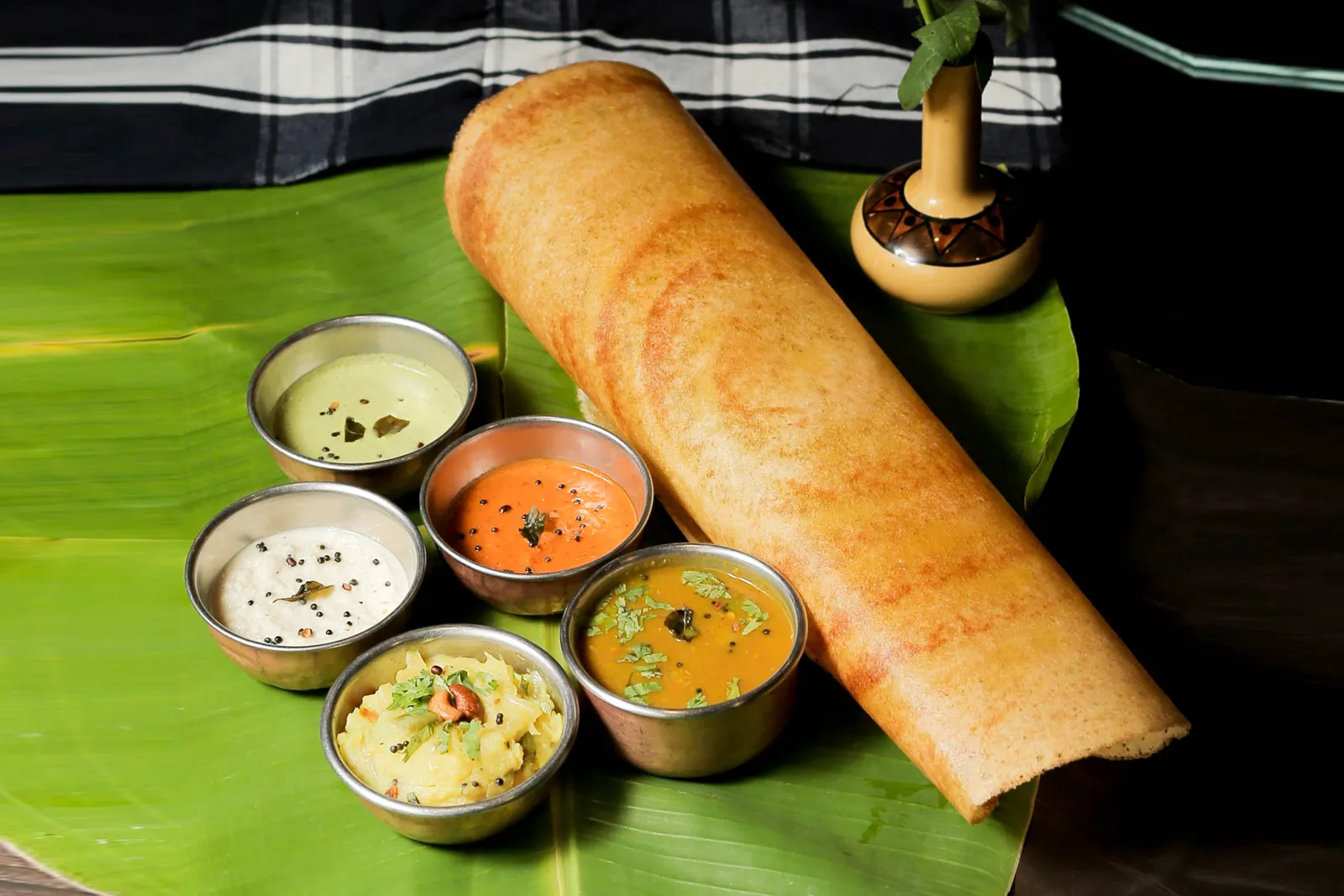
Dosa is one of the most satisfying ways to experience South Indian cuisine. At its simplest, it is a thin, crisp crepe made from fermented rice and black-lentil batter, but that description doesn’t quite capture what makes a great dosa special. The best versions arrive hot and freshly cooked, with crisp edges, a delicate interior, flavorful fillings, and bowls of sambar and chutney ready for dipping.
If you’re searching for the best dosa in West Village, you’ll discover that the neighborhood itself has relatively few dedicated South Indian restaurants, but the surrounding Greenwich Village area significantly expands your choices. That distinction matters: Semma, at 60 Greenwich Avenue, is one of the area’s standout South Indian destinations, while nearby options such as NY Dosas, Ananda, and Mint Masala give diners more affordable and casual ways to explore dosa.
Semma is particularly notable for its gunpowder dosa, a specialty that has received considerable attention from New York food publications. The restaurant’s South Indian cooking is strongly influenced by chef Vijay Kumar’s Tamil Nadu upbringing, giving the menu a distinctly regional identity rather than treating Indian cuisine as one broad category.
But you don’t necessarily have to spend fine-dining prices to enjoy a good dosa.
NY Dosas, located at Washington Square South, offers a much more casual and affordable experience. Its current business listing places it in the $10–20 range, making it an attractive option for a quick South Indian lunch.
Nearby Ananda has an extensive dosa menu, including plain, masala, paper, gunpowder, Mysore, Pondicherry, moong, and rava dosas. Its current menu also clearly identifies several options as vegan and gluten-free, which makes it particularly useful for diners with dietary preferences.
And for a more traditional neighborhood Indian restaurant experience, Mint Masala on MacDougal Street is another nearby option worth considering.
The great thing about exploring dosa around West Village is the sheer variety. You can order a classic masala dosa filled with seasoned potatoes, try a spicy Mysore dosa, explore podi or gunpowder dosa, or choose an ultra-thin paper dosa designed primarily for its crisp texture.
Dosa is also naturally suited to vegetarian dining. Many traditional versions are vegan, although diners should still check whether ghee, butter, or dairy has been used. At Ananda, for example, the current menu specifically marks several dosa varieties as vegan and gluten-free.
Whether you’re a South Indian food enthusiast, a vegetarian looking for a satisfying meal, a tourist exploring Greenwich Village, or someone who has never tried dosa before, this guide will help you understand where to go, what to order, how much to expect to spend, and what separates an ordinary dosa from an exceptional one.
Most importantly, we’ll look beyond the word “dosa” on a menu and explore the details that matter: fermentation, crispness, fillings, sambar, chutneys, regional styles, and freshness.
Because when a dosa arrives at the table perfectly crisp and fragrant, with hot sambar and fresh chutney alongside it, you quickly understand why this humble South Indian dish has become such a beloved part of New York City’s Indian food scene.
Why West Village Has Great Indian Restaurants
West Village may be best known for its historic streets, charming cafés, independent restaurants, and lively downtown atmosphere, but its Indian food scene has become increasingly interesting—especially for diners who want to explore regional Indian cuisine rather than only the familiar curry-house classics.
For dosa lovers, the neighborhood has one particularly important advantage: Semma, located at 60 Greenwich Avenue, has established itself as a major destination for South Indian cooking. Eater specifically calls Semma’s triangular gunpowder dosa the best around, while The Infatuation praises its podi-dusted rice-and-lentil dosa with soft masala potatoes, sambar, and chutneys.
A Neighborhood Where Regional Indian Food Stands Out
For years, many American diners associated Indian restaurant food primarily with dishes such as Chicken Tikka Masala, Butter Chicken, naan, and biryani. Those dishes remain popular, but New York City’s Indian dining scene has increasingly embraced the country’s enormous regional diversity.
That shift is particularly noticeable around West Village and Greenwich Village.
Semma focuses on South Indian cuisine, with a strong connection to Tamil Nadu through chef Vijay Kumar. Its menu introduces diners to ingredients, cooking techniques, and dishes that aren’t necessarily found on a typical North Indian restaurant menu.
For someone searching specifically for authentic South Indian dosa in West Village, that’s a significant advantage.
Dosa Gives Diners a Different Introduction to Indian Cuisine
Dosa is fundamentally different from a creamy curry.
It’s a thin savory crepe made from fermented rice and black-lentil batter. The fermentation creates a distinctive tangy aroma and helps produce the crisp texture that makes a well-made dosa so satisfying.
At Ananda, the current menu describes dosa as a thin crepe made from fermented rice and black lentils and serves it with sambar plus coconut and tomato chutneys.
That combination—crisp dosa + warm sambar + fresh chutney—is one of the simplest ways to understand why South Indian food has such a devoted following.
West Village Offers More Than One Type of Dosa Experience
Another strength of the area is that you can experience dosa at very different price points.
At the upscale end, Semma offers an elevated South Indian dining experience, with its gunpowder dosa receiving significant attention from New York food critics. Eater’s current West Village guide specifically highlights the dish.
For a much more casual experience, NY Dosas operates at 50 Washington Square South and is currently listed in the $10–20 range. Its location makes it particularly convenient for a quick lunch while exploring Washington Square Park and Greenwich Village.
Nearby Ananda offers an extensive dosa menu, including plain, masala, paper, gunpowder, Mysore, Pondicherry, moong, and rava varieties. Several are currently marked vegan and gluten-free on its menu.
This gives diners a useful range: premium regional Indian dining, casual street-style dosa, and a broad vegetarian South Indian menu.
Vegetarian Food Is a Major Strength
Dosa is also particularly appealing to vegetarian diners.
Traditional dosa batter itself is generally plant-based, and many classic fillings and accompaniments are vegetarian. At Ananda, current menu listings identify its plain, masala, paper, gunpowder, Mysore, and several other dosas as vegan and gluten-free.
That makes South Indian cuisine an excellent choice for groups with mixed dietary preferences.
A table can easily order:
- Masala dosa
- Gunpowder dosa
- Sambar
- Coconut chutney
- Tomato chutney
- Idli
- Vada
- Vegetable curry
without relying heavily on meat or dairy.
The Neighborhood Is Convenient for Tourists
West Village and Greenwich Village are also unusually convenient for visitors.
A dosa lunch can easily fit into a day that includes:
- Washington Square Park
- Bleecker Street
- Greenwich Village
- MacDougal Street
- Christopher Street
- West Village walking tours
This makes South Indian food a practical sightseeing stop rather than a destination that requires a special trip across Manhattan.
For tourists searching “best dosa near West Village”, that proximity is important. You don’t necessarily need to restrict your search to a restaurant whose address technically falls within West Village.
MacDougal Street Expands the Options
Nearby MacDougal Street adds another layer to the Indian food scene.
Mint Masala is located at 95 MacDougal Street, while Masala Times is at 194 Bleecker Street. These restaurants help create a broader Indian dining corridor around West Village and Greenwich Village.
They may not all specialize exclusively in dosa, but they are useful alternatives when you’re exploring Indian food more broadly.
There’s a Difference Between “Best Dosa” and “Best South Indian Restaurant”
This distinction matters.
A restaurant can be an excellent South Indian restaurant without having the city’s best dosa.
Likewise, a small dosa-focused operation can make a terrific dosa without offering an extensive regional menu.
That’s why this guide will evaluate dosa based on several factors:
- Crispness
- Fermentation
- Texture
- Filling
- Sambar
- Chutneys
- Freshness
- Value
- Overall dining experience
A dosa that arrives beautifully crisp but has bland sambar isn’t necessarily the complete experience.
Similarly, an expensive dosa isn’t automatically better than an affordable one.
What New York Diners Are Saying
Local food communities also show strong interest in comparing Semma with traditional South Indian dosa restaurants elsewhere in Manhattan.
In a recent FoodNYC discussion, diners debated Semma’s dosa against established South Indian restaurants, with several commenters praising Semma’s crispness and sambar while noting that other restaurants can offer greater value.
That’s a useful perspective because it highlights something important: “best” is subjective.
Some diners prioritize premium ingredients and a chef-driven experience. Others want a large, crisp masala dosa at an affordable price.
Both are valid ways to enjoy dosa.
Why Freshness Matters So Much
Unlike a curry, dosa doesn’t travel particularly well.
Its defining characteristic is crispness, and steam from packaging can quickly soften it.
That’s why the best dosa experience is usually fresh from the griddle and eaten immediately.
When a server brings a dosa to your table and you hear that faint crisp crack as you break into it, you’re experiencing the dish at its best.
This will become particularly important later in the guide when we discuss takeout and delivery.
West Village Is a Gateway to South Indian Food
Ultimately, the biggest strength of the area isn’t simply that it has good dosa.
It’s that West Village and nearby Greenwich Village provide an accessible introduction to South Indian cuisine.
You can start with a familiar masala dosa, then try gunpowder dosa, explore sambar and chutneys, move on to idli and vada, and eventually discover regional dishes at restaurants such as Semma.
That progression makes the area especially appealing to both first-time Indian food diners and experienced food enthusiasts.
If you’re searching for the best dosa in West Village, start by thinking beyond one dish.
Look for a restaurant that treats dosa as part of a broader South Indian culinary tradition.
And if your first bite is crisp, fragrant, lightly tangy from fermentation, and perfectly balanced with sambar and fresh chutney, you’ve probably found a very good place to begin.
Top Places for Dosa in West Village and Nearby Areas
When searching for the best dosa in West Village, it is important to make one distinction: the number of restaurants specializing in dosa inside the strict West Village boundary is limited. However, nearby Greenwich Village and the surrounding downtown area offer several excellent choices within an easy walk.
Rather than padding the list with restaurants that don’t currently specialize in dosa, this guide focuses on places with verifiable dosa offerings and a meaningful South Indian connection.
Semma — Best Overall Dosa Experience
At 60 Greenwich Avenue, Semma is the standout destination for diners who want an elevated South Indian dosa experience in the West Village. Eater specifically describes its triangular gunpowder dosa as the best around, while The Infatuation highlights the podi-dusted rice-and-lentil dosa filled with soft masala potatoes and served with sambar and chutneys.
What makes Semma particularly interesting is that the dosa isn’t simply a generic South Indian menu item. The restaurant’s broader cooking is rooted in Tamil Nadu, reflecting chef Vijay Kumar’s regional background. The dosa combines fermented rice-and-lentil batter with a spicy gunpowder seasoning and potato filling, creating a dish that’s simultaneously crisp, savory, spicy, and aromatic.
What it’s known for: Gunpowder dosa and regional Tamil cuisine
Best dish to try: Gunpowder dosa
Approximate cost: Higher-end, around $50–100 per person for the overall dining experience
Area: West Village
Best for: Date nights, food enthusiasts, special occasions, and serious South Indian food lovers
NY Dosas — Best Casual Dosa
If you want the opposite of a formal restaurant experience, NY Dosas is one of the most interesting options around West Village.
Located at 50 Washington Square South, this casual Indian takeaway is positioned right by Washington Square Park and focuses on South Indian dosa and vegetarian food. Its current business listing places it in the $10–20 range, making it considerably more accessible than Semma.
The appeal here is simplicity. Rather than turning dosa into an elaborate fine-dining experience, NY Dosas provides a casual way to enjoy South Indian food while exploring Greenwich Village. It’s particularly convenient for lunch or a quick meal between sightseeing stops.
What it’s known for: Casual South Indian dosa
Approximate cost: $10–20
Area: Washington Square South / Greenwich Village
Best for: Quick lunches, vegetarians, tourists, and budget diners
Ananda — Best Dosa Variety
For sheer variety, Ananda is one of the strongest choices near West Village.
Located at 210 Thompson Street, its current menu features an unusually broad dosa selection. Diners can choose from Masala Dosa, Paper Dosa, Gunpowder Dosa, Mysore Dosa, Pondicherry Dosa, Moong Dosa, Rava Dosa, Onion Rava Dosa, and several other variations.
Prices on the current menu are generally in the $14–19 range, depending on the dosa and filling. Several varieties are explicitly marked vegan and gluten-free, including Masala Dosa, Paper Dosa, Gunpowder Dosa, Mysore Dosa, and Moong Dosa.
That makes Ananda particularly valuable if you’re dining with someone who wants to compare different dosa styles in one visit.
What it’s known for: Extensive dosa menu and vegetarian Indian food
Popular choices: Masala, Paper, Gunpowder, Mysore, Rava Dosa
Approximate cost: $14–19 for many dosa varieties
Area: Greenwich Village / nearby downtown
Best for: Vegetarians, vegans, families, and dosa enthusiasts wanting variety
Mint Masala — Best Nearby Traditional Option
Mint Masala, at 95 MacDougal Street, is another nearby South Indian restaurant worth considering when you’re exploring Indian food around West Village and Greenwich Village.
It’s particularly useful for diners who want to combine dosa with a broader Indian meal. Rather than focusing exclusively on one signature dosa, the restaurant gives you the opportunity to explore other South Indian and Indian favorites during the same visit.
The MacDougal Street location is also convenient for tourists exploring Washington Square Park, Bleecker Street, and Greenwich Village.
What it’s known for: South Indian and traditional Indian dishes
Best for: Casual meals, lunch, vegetarian dining, and exploring Greenwich Village
Area: MacDougal Street / Greenwich Village
Ambo — Best Casual Indian Alternative Nearby
Ambo, at 55C East 8th Street, is another nearby Indian restaurant worth knowing about when expanding your search beyond the immediate West Village area.
Its current business listing places it in the $10–20 range and categorizes it as an Indian restaurant.
This is more of an alternative for diners who want to explore the broader downtown Indian food scene rather than a restaurant I’d put ahead of Semma specifically for dosa.
Approximate cost: $10–20
Area: East Village / downtown Manhattan
Best for: Casual Indian dining and budget-conscious food exploration
Madras Dosa Co. — Best Dedicated Dosa Alternative
If you’re willing to travel farther from West Village, Madras Dosa Co. is worth keeping in mind.
Its location at 668 Sixth Avenue makes it a practical downtown alternative, and its current business listing categorizes it specifically as a South Indian restaurant with a $10–20 price range.
It is especially relevant for diners whose priority is getting a dedicated South Indian meal rather than combining dosa with an upscale dining experience.
Approximate cost: $10–20
Best for: Dedicated South Indian dining, affordability, and dosa-focused meals
Which Dosa Restaurant Should You Choose?
The answer depends on what you’re looking for.
For the Best Overall Dosa
Semma is the obvious starting point.
Its gunpowder dosa has received strong recognition from Eater and The Infatuation, and the restaurant’s broader focus on Tamil Nadu cuisine gives the dish a strong regional context.
For the Most Dosa Variety
Ananda is the better choice.
With current menu options ranging from Masala and Paper Dosa to Gunpowder, Mysore, Pondicherry, Moong, and Rava varieties, you can explore several styles without visiting multiple restaurants.
For a Budget Meal
NY Dosas is particularly appealing.
Its current listing places it at $10–20, and its Washington Square South location makes it convenient for a quick lunch.
For a Traditional South Indian Restaurant
Mint Masala provides a broader menu and a casual neighborhood experience around MacDougal Street.
For Serious Dosa Enthusiasts
Try more than one.
A particularly interesting comparison would be:
Semma → Ananda → NY Dosas
That gives you three very different experiences:
- Semma: Elevated, chef-driven Tamil cuisine
- Ananda: Broad dosa selection
- NY Dosas: Casual and affordable South Indian street-style experience
Local FoodNYC discussions also reflect this debate. Diners comparing Semma with established dosa restaurants have praised Semma’s dosa and sambar while noting that traditional dosa restaurants can offer more variety and better value.
That’s an important reminder that the “best” dosa isn’t necessarily the most expensive one.
One Important Tip
If your goal is specifically the best dosa, prioritize restaurants where the dosa is made to order and eaten immediately.
Dosa is highly sensitive to time.
A beautifully crisp dosa can become soft after sitting in a container for even a relatively short period. That’s why a restaurant with an excellent dine-in experience may outperform a restaurant with a similar recipe when ordering delivery.
For the next part of this guide, we’ll look at the different types of dosa you can order—from classic Masala Dosa and Mysore Dosa to spicy Gunpowder Dosa, Paper Dosa, Rava Dosa, and more.
Popular South Indian Dosa Varieties You Should Try
One of the best things about exploring the best dosa in West Village is realizing that “dosa” isn’t just one dish. South Indian restaurants offer a surprisingly wide range of versions, each with its own texture, filling, spice level, and personality.
At Ananda, for example, the current menu includes plain, masala, paper, gunpowder, Mysore, Pondicherry, moong, rava, and onion rava dosas. Most are served with sambar plus coconut and tomato chutneys.
Masala Dosa
Masala Dosa is the classic starting point for anyone trying dosa for the first time.
A thin, crisp fermented rice-and-lentil crepe is filled with mildly spiced potatoes, usually accompanied by sambar and chutneys.
The contrast is what makes it so satisfying:
- Crisp dosa
- Soft potato filling
- Tangy sambar
- Fresh chutney
- Aromatic spices
At Ananda, the current menu lists Masala Dosa with a mildly spiced potato filling and identifies it as vegan and gluten-free.
Best for: First-time dosa diners and traditional South Indian food lovers.
Plain or Sada Dosa
If you want to understand the dosa itself rather than the filling, order a Sada Dosa.
There’s nowhere for a heavy potato filling or cheese to hide behind. The focus is on the fermented batter, griddle technique, crispness, and subtle tang.
A good plain dosa should be thin and crisp around the edges while remaining delicate enough to fold or break easily.
Ananda currently lists Sada Dosa as a crispy rice-and-lentil crepe served with sambar and chutneys.
Best for: Dosa purists and diners comparing batter quality.
Gunpowder Dosa
If you want something more exciting, try Gunpowder Dosa, also called Podi Dosa.
“Gunpowder” refers to a spicy South Indian lentil-and-chili powder rather than literal gunpowder. It adds heat, nuttiness, and a roasted spice character to the dosa.
This is arguably the signature dosa to seek out in West Village because Semma’s triangular gunpowder dosa has been specifically recognized by Eater as the best around.
The Infatuation also highlights Semma’s podi-dusted rice-and-lentil dosa with soft masala potatoes, sambar, and chutneys.
Best for: Spice lovers and experienced South Indian food diners.
Mysore Dosa
Mysore Dosa gets its distinctive flavor from a spicy Mysore-style masala spread over the dosa before it is finished on the griddle.
Compared with a plain masala dosa, it offers more heat and a deeper spice profile.
Ananda currently lists both Mysore Sada and Mysore Masala Dosa and describes them as crispy rice-and-lentil crepes with hot Mysore spices.
Best for: Diners who want more spice than a traditional masala dosa.
Paper Dosa
If your priority is maximum crispness, order a Paper Dosa.
It’s exceptionally thin and usually much longer than a standard dosa, creating a dramatic presentation when it reaches the table.
The texture is the main attraction. Instead of a substantial filling, you get a delicate, almost wafer-like dosa that cracks as you break it.
Ananda currently describes its Paper Dosa as an extra-thin, crispy crepe and lists both plain and masala versions.
Best for: Crisp-texture lovers and diners looking for an impressive presentation.
Ghee Roast Dosa
Ghee Roast Dosa is prepared with ghee, giving the dosa a richer flavor and deeper browning.
The buttery aroma pairs beautifully with the fermented batter, but this variety is obviously different from vegan dosa.
Ananda currently lists Ghee Roast Masala Dosa and identifies it as containing dairy.
Best for: Diners who enjoy rich, buttery flavors.
Not ideal for: Strict vegans.
Rava Dosa
Rava Dosa is made differently from traditional rice-and-lentil dosa. It uses semolina, or cream of wheat, along with rice flour.
The resulting crepe tends to have a lacy, delicate structure with plenty of crisp edges.
Ananda currently lists Rava Sada Dosa and Onion Rava Dosa and notes that rava dosa is made from cream of wheat and rice flour rather than the standard fermented batter.
Best for: Diners who want something lighter, lacy, and extra crisp.
One important dietary note: traditional rava dosa is not gluten-free because it contains wheat.
Onion Rava Dosa
Take the crisp, lacy character of rava dosa and add thinly sliced onions.
The onions caramelize and develop slightly sweet, savory notes as the dosa cooks.
Ananda currently offers Onion Rava and Onion Rava Masala versions.
Best for: Diners who enjoy crisp textures and savory onion flavor.
Pondicherry Masala Dosa
For something less familiar, try Pondicherry Masala Dosa.
Ananda currently describes its version as a spicy dosa rolled with potato and onion masala and marks it vegan and gluten-free.
It’s a useful choice when you’ve already tried the standard masala dosa and want to explore a more distinctive variation.
Moong Dosa
Moong Dosa replaces some or all of the traditional lentil component with whole mung beans.
It offers a different flavor and texture from the classic rice-and-urad-dal dosa.
Ananda currently lists both Moong Sada and Moong Masala Dosa and describes the dish as being made with whole moong beans.
Best for: Diners interested in alternative dosa batters and plant-based options.
Paneer Bhurji Dosa
For a more indulgent fusion-style dosa, look for Paneer Bhurji Dosa.
Ananda currently describes its version as a spicy dosa rolled with paneer, potato, and onion masala.
Because paneer is dairy, this isn’t a vegan option.
Best for: Vegetarian diners who enjoy rich, savory fillings.
Dosa vs. Uttapam
If you’re new to South Indian food, you may also see Uttapam on the menu.
Don’t confuse it with dosa.
A dosa is generally thin and crisp.
An uttapam is thicker and softer, with ingredients such as onions, tomatoes, cilantro, or other toppings cooked directly into the batter.
Ananda describes uttapam as a thick pancake with toppings cooked directly into the batter.
So if you want crispy, choose dosa.
If you want soft and substantial, try uttapam.
Which Dosa Should You Try First?
Here’s a simple guide:
| Dosa | Texture | Flavor | Best For |
|---|---|---|---|
| Masala Dosa | Crisp + soft | Mild, savory | First-timers |
| Sada Dosa | Thin + crisp | Simple, fermented | Purists |
| Gunpowder Dosa | Crisp | Spicy, roasted | Spice lovers |
| Mysore Dosa | Crisp | Hot, savory | Spice fans |
| Paper Dosa | Very crisp | Light | Texture lovers |
| Ghee Roast | Crisp + rich | Buttery | Indulgent meals |
| Rava Dosa | Lacy + crisp | Toasty | Crisp lovers |
| Onion Rava | Lacy + crisp | Savory onion | Flavor seekers |
| Moong Dosa | Crisp/soft | Earthy | Health-conscious diners |
| Paneer Bhurji Dosa | Crisp + rich | Cheesy, spicy | Vegetarian diners |
My Recommendation for a First Visit
If you’ve never had authentic South Indian dosa before, don’t overcomplicate your first order.
Start with:
Masala Dosa + Sambar + Coconut Chutney + Tomato Chutney
Then, if you enjoy it, try a Gunpowder Dosa on your next visit.
And if you’re visiting Semma specifically, the Gunpowder Dosa is the obvious dish to put on your list. Eater currently singles it out as the best dosa around, while recent local food discussions continue to praise Semma’s dosa for its crispness and flavor.
One recent 2026 diner review was more mixed about Semma overall but still singled out the gunpowder dosa as the meal’s standout, which reinforces an important point: a restaurant’s signature dish can be stronger than the overall experience for an individual diner.
Ultimately, the best way to explore South Indian dosa in West Village is to try different styles rather than deciding that one version is universally superior.
How to Order and Eat Dosa Like a Local
For someone trying dosa for the first time, the menu can feel a little unfamiliar. Should you start with the chutney? Do you pour the sambar over the dosa? Is it better to use your hands or utensils?
The good news is that there is no complicated rulebook for eating dosa. The most important thing is to enjoy it while it’s hot and crisp. Dosa is traditionally served hot with accompaniments such as sambar and chutney.
If you’re visiting restaurants around West Village and Greenwich Village, a few simple tips can make the experience much more enjoyable.
Start With the Dosa Itself
When your dosa arrives, don’t immediately cover the entire thing with sambar.
Take a bite of the dosa by itself first.
This lets you notice:
- Crispness
- Fermented tang
- Toasted rice flavor
- Aroma
- Texture
- The flavor of the filling, if you’re eating masala dosa
A well-made dosa should have enough flavor and texture to be enjoyable on its own.
This is particularly important when you’re trying a restaurant’s dosa for the first time.
Tear It Into Smaller Pieces
Traditionally, dosa can be eaten with your hands. Tear off a manageable piece, add a little filling if you’re eating masala dosa, and dip it into your preferred accompaniment.
One South Indian dining guide recommends breaking dosa into pieces rather than cutting it, while also emphasizing that using utensils is perfectly acceptable when you’re more comfortable with them.
You don’t need to feel pressured to eat with your hands, though.
At a New York restaurant, using a fork or spoon is completely reasonable.
The goal isn’t to perform a cultural ritual perfectly. It’s to enjoy the food respectfully and comfortably.
Try the Coconut Chutney First
Most dosa meals come with several accompaniments.
Coconut chutney is usually creamy, mildly spicy, and refreshing. It can provide a cooling contrast to a hot or heavily spiced dosa.
Take a small piece of dosa and dip it lightly into the chutney.
Don’t worry about finding the “correct” amount.
Some diners like a lot of chutney, while others prefer just enough to add another flavor.
Then Try Tomato Chutney
Tomato chutney provides a very different experience.
Compared with coconut chutney, it can be:
- Tangier
- More savory
- More acidic
- More chili-forward
- Slightly sweeter
Trying the same piece of dosa with coconut chutney and then tomato chutney is an easy way to appreciate how much the accompaniment can change the flavor.
Use Sambar Differently
Sambar is a lentil-and-vegetable stew flavored with spices and often tamarind, and it’s one of the classic accompaniments for dosa.
You can dip pieces of dosa directly into the sambar.
You can also spoon a little sambar onto a piece of dosa before eating it.
Some diners prefer to pour a little sambar over part of the dosa as they eat. There isn’t a single mandatory method; South Indian diners themselves use different approaches.
The one thing to avoid is soaking the entire dosa in sambar if you want to preserve its crisp texture.
Don’t Drown a Crispy Dosa
This is particularly important with Paper Dosa or a very crisp Masala Dosa.
The longer dosa sits in liquid, the softer it becomes.
If you want maximum crunch, dip only the piece you’re about to eat.
That gives you a combination of:
Crisp dosa + warm sambar + fresh chutney
instead of turning the entire plate into a soft mixture.
How to Eat Masala Dosa
Masala Dosa is slightly different because there’s a potato filling inside.
Start near one end and tear off a piece that includes:
Crispy dosa + potato masala
Then add your preferred chutney.
You can alternate between coconut chutney, tomato chutney, and sambar so you experience the filling in different ways.
For first-time diners, this is usually the easiest dosa to understand.
How to Eat Gunpowder Dosa
Gunpowder or podi dosa already has a spicy lentil-and-chili powder incorporated into the dish.
Because the podi adds additional savory heat, you may want to begin with coconut chutney.
The creamy chutney can soften the intensity of the spice.
Then try the dosa with sambar for a deeper, tangier combination.
At Semma, the gunpowder dosa is particularly notable. Eater has highlighted the dish as a standout dosa in the West Village area, making it one of the first choices for diners who want to explore a more sophisticated version of South Indian dosa.
Don’t Mix Everything Together Immediately
One common first-timer mistake is combining:
- Entire dosa
- All the sambar
- All the chutney
- Potato filling
into one mixture.
You certainly can do that if you enjoy it, but you’ll lose the opportunity to taste the individual components.
Instead, experiment.
Try:
Dosa alone
Then:
Dosa + coconut chutney
Then:
Dosa + tomato chutney
Then:
Dosa + sambar
Finally:
Dosa + potato masala + chutney + sambar
This gives you a much better understanding of the dish.
Eat Dosa Quickly
This may be the most important practical tip.
Dosa is at its best immediately after it is prepared.
The crisp exterior gradually softens as it sits, particularly when exposed to steam or liquid.
That’s why a restaurant can serve an excellent dosa that doesn’t taste quite as impressive when ordered for delivery.
A recent South Indian food guide similarly emphasizes eating dosa while hot and crisp because waiting can make it soggy.
If you’re serious about finding the best dosa in West Village, dine in whenever possible.
What to Drink With Dosa
Dosa pairs naturally with several Indian drinks.
Filter Coffee
South Indian filter coffee is an excellent choice if you want a traditional pairing.
It’s particularly enjoyable with a savory breakfast or lunch.
Masala Chai
A cup of masala chai provides warm spices and a little sweetness after the savory dosa.
Mango Lassi
If your dosa is particularly spicy, mango lassi provides a creamy, cooling contrast.
What Else Should You Order?
If you’re dining with friends, don’t limit the table to dosa.
Consider adding:
- Idli
- Medu vada
- Sambar
- Additional chutneys
- Uttapam
- South Indian filter coffee
This gives everyone an opportunity to sample different textures.
For example:
Dosa: crisp
Idli: soft and fluffy
Vada: crisp outside and tender inside
Uttapam: thicker and softer
That’s a much more interesting South Indian meal than ordering several identical dosas.
Best Way to Order for Two
For two diners trying South Indian food for the first time, consider:
- 1 Masala Dosa
- 1 Gunpowder or Mysore Dosa
- 1 Idli or Vada
- Sambar
- Coconut chutney
- Tomato chutney
- 2 drinks
This allows you to compare mild and spicy dosa styles while experiencing different textures.
If you’re visiting Ananda, its current menu makes this kind of comparison particularly easy because it offers a broad selection of dosa varieties, including Masala, Paper, Gunpowder, Mysore, Rava, Onion Rava, Moong, and Pondicherry versions.
Eating With Your Hands Is Optional
Some first-time diners worry that they will look inexperienced if they don’t eat dosa with their hands.
Don’t worry about it.
Using your hands is traditional, but utensils are completely acceptable.
If you want to try eating with your hands, use your fingertips to tear off pieces rather than grabbing the entire dosa.
And remember to wash your hands before eating.
The cultural point isn’t that everyone must eat dosa one specific way. It’s about enjoying the food and respecting the dining tradition.
Don’t Worry About Making a Little Mess
Dosa can be surprisingly large, especially Paper Dosa.
The potato filling can move around.
Chutney can get on the plate.
Sambar can spill.
That’s part of the experience.
As one Indian food community discussion put it, there isn’t a strict “right” way to eat dosa; diners use different combinations of chutney and sambar according to personal preference.
So don’t spend your meal worrying about perfect technique.
Focus on the flavors.
A Simple Dosa-Eating Formula
If you want one easy formula to remember:
1. Take a piece of dosa.
2. Taste it plain.
3. Add a little coconut chutney.
4. Try tomato chutney.
5. Dip another piece into sambar.
6. Add the potato masala if you’re eating Masala Dosa.
7. Experiment with different combinations.
8. Keep eating while the dosa is hot and crisp.
That’s all you need.
The Best Part: There Is No Single “Correct” Combination
Some people love coconut chutney.
Others prefer spicy tomato chutney.
Some dip every bite in sambar.
Others barely use it.
Some eat dosa entirely with their hands.
Others prefer a fork.
All of these approaches are fine.
The real goal is to experience the contrast between fermented crisp dosa, savory filling, aromatic sambar, and fresh chutneys.
Once you understand that combination, ordering dosa around West Village becomes much less intimidating—and a lot more fun.
Vegetarian and Vegan Indian Food Options
One of the biggest advantages of choosing South Indian food in and around West Village is how naturally many dishes fit vegetarian and vegan diets. Dosa, idli, vada, sambar, and several chutneys are traditionally plant-based, although ingredients and preparation methods can vary from restaurant to restaurant.
For diners searching for vegan dosa in West Village, nearby Greenwich Village is particularly useful. Ananda’s current menu, for example, identifies numerous dosa varieties as vegan and gluten-free, including Sada Dosa, Masala Dosa, Gunpowder Dosa, Mysore Dosa, Pondicherry Masala Dosa, and Moong Dosa.
Masala Dosa – A Naturally Vegetarian Favorite
Masala Dosa is one of the easiest choices for vegetarian diners.
The classic version combines a crisp fermented rice-and-lentil crepe with a mildly spiced potato filling. The potato masala is generally cooked with onions, mustard seeds, curry leaves, turmeric, and other spices.
At Ananda, the current Masala Dosa is explicitly listed as vegan and gluten-free.
That makes it a particularly convenient choice for someone who wants a substantial plant-based meal without needing special modifications.
Gunpowder Dosa for Vegan Spice Lovers
If you want a stronger flavor profile, Gunpowder Masala Dosa is an excellent option.
The dosa is seasoned with spicy South Indian podi, giving the crisp crepe a roasted, chili-forward character.
Ananda currently lists both Gunpowder Sada Dosa and Gunpowder Masala Dosa as vegan and gluten-free.
This is a good choice for diners who want something more intense than a traditional masala dosa.
For a premium South Indian experience, Semma’s gunpowder dosa is another important option around West Village. Recent 2026 diner discussion specifically singled out the gunpowder dosa as the strongest dish in one visit, although individual experiences naturally vary.
Mysore Dosa
Mysore Dosa brings additional spice to the meal through a hot Mysore-style masala spread.
Ananda currently offers both Mysore Sada and Mysore Masala Dosa and identifies them as vegan and gluten-free.
If you’re vegan and enjoy spicy food, this is one of the varieties worth trying.
Moong Dosa
For something different, consider Moong Dosa.
Instead of relying exclusively on the traditional rice-and-black-lentil batter, this version incorporates whole mung beans. It has a somewhat different flavor and nutritional profile from a classic dosa.
Ananda currently lists both Moong Sada and Moong Masala Dosa as vegan and gluten-free.
It’s a good option when you’ve already tried standard masala dosa and want to explore another South Indian preparation.
Idli – Light and Naturally Vegan
If you want something softer and lighter than dosa, order Idli.
These steamed rice-and-lentil cakes have a fluffy texture and are usually served with sambar and chutneys.
Ananda’s current menu identifies its Idli as vegan and gluten-free.
Idli makes an excellent starter to share before a dosa, particularly if your table wants to experience different South Indian textures.
Medhu Vada
Medhu Vada provides the opposite texture from idli.
It’s a savory lentil fritter with a crisp exterior and soft interior, generally served with sambar and chutney.
Ananda currently lists Medhu Vada as vegan and gluten-free.
A good combination for two people is:
Masala Dosa + Medhu Vada + Sambar + Chutneys
That gives you crisp, soft, spicy, tangy, and savory flavors in one meal.
Sambar Is Usually Vegan
Sambar is one of the most important accompaniments to dosa.
It’s a lentil-based vegetable stew flavored with spices and often tamarind.
Ananda’s current menu explicitly identifies its sambar as vegan and gluten-free.
For vegan diners, sambar is especially useful because it adds moisture and depth to a crisp dosa without requiring dairy.
Coconut and Tomato Chutneys
Chutneys can make a major difference in a dosa meal.
Coconut chutney adds creamy texture and cooling flavor.
Tomato chutney brings acidity, sweetness, and spice.
These are commonly vegan, but ingredients can vary, so strict vegans should still confirm with the restaurant.
What About Ghee Roast Dosa?
This is where vegan diners need to be careful.
A Ghee Roast Dosa is cooked with ghee, which is clarified butter and therefore dairy.
Ananda’s current menu specifically identifies its Ghee Roast Masala Dosa as containing dairy.
So if you’re vegan, choose:
- Sada Dosa
- Masala Dosa
- Gunpowder Dosa
- Mysore Dosa
- Moong Dosa
- Pondicherry Dosa
instead, assuming the restaurant’s current preparation remains the same.
Paneer Dosa Is Vegetarian but Not Vegan
Paneer is Indian cottage cheese, so dishes containing it are vegetarian but not vegan.
Ananda currently offers Paneer Bhurji Dosa and Paneer Rava Masala Dosa, both of which contain dairy.
If you’re vegetarian, these can be excellent choices.
If you’re vegan, skip them unless the restaurant offers an appropriate substitution.
Rava Dosa Requires a Different Dietary Check
There’s another important distinction with Rava Dosa.
Traditional rava dosa uses semolina, or cream of wheat, along with rice flour. Ananda’s current menu identifies its rava varieties as vegan, but because cream of wheat contains wheat, they are not gluten-free.
That’s an important difference for diners who are both vegan and gluten-sensitive.
If you need a gluten-free vegan meal, a traditional rice-and-lentil dosa is generally the safer menu category, but always confirm preparation with the restaurant.
Best Vegan Dosa Choices
| Dosa | Vegan? | Gluten-Free?* |
|---|---|---|
| Sada Dosa | Yes | Yes |
| Masala Dosa | Yes | Yes |
| Gunpowder Dosa | Yes | Yes |
| Mysore Dosa | Yes | Yes |
| Moong Dosa | Yes | Yes |
| Pondicherry Dosa | Yes | Yes |
| Ghee Roast Dosa | No | Yes |
| Paneer Dosa | No | Yes |
| Rava Dosa | Yes | No |
| Onion Rava Dosa | Yes | No |
*Based on Ananda’s current menu; preparation varies by restaurant.
Best Choice for a Vegan First-Timer
Start with:
Masala Dosa + Sambar + Coconut Chutney + Tomato Chutney
It’s flavorful without being excessively spicy and gives you the classic South Indian dosa experience.
Best Choice for Vegan Spice Lovers
Try:
Gunpowder Masala Dosa + Sambar
The podi adds a deeper roasted chili flavor, making the dish considerably more assertive.
Best Choice for a Light Meal
Try:
Idli + Sambar + Chutneys
It’s lighter than a large masala dosa but still gives you the essential flavors of South Indian cuisine.
Best Choice for Sharing
For two vegetarian or vegan diners, consider:
- Masala Dosa
- Gunpowder Dosa
- Idli
- Medhu Vada
- Sambar
- Coconut chutney
- Tomato chutney
This gives the table several textures and spice levels without requiring any meat or dairy.
Vegetarian Doesn’t Always Mean Vegan
This is one of the most important things to remember when eating Indian food.
A vegetarian dish can contain:
- Ghee
- Butter
- Cream
- Milk
- Yogurt
- Paneer
So don’t assume that a vegetarian dosa is automatically vegan.
If you’re strictly vegan, ask:
“Is this cooked with ghee or butter?”
and
“Does the batter or filling contain dairy?”
Also ask about chutneys and sauces if you have a serious allergy or dietary restriction.
Ananda’s current menu specifically advises customers with food allergies to inform staff because some ingredients, spices, nuts, and herbs may not be listed in the menu descriptions.
Jain and Other Dietary Preferences
Some Indian restaurants also accommodate Jain dietary preferences.
Ananda currently provides a dedicated Jain menu in addition to its standard menu.
If you follow a specific religious or dietary practice, explain your requirements clearly rather than simply asking whether something is vegetarian.
Vegetarian Dining Beyond Dosa
Once you’ve found your favorite dosa, explore the rest of the South Indian menu.
Good options include:
- Idli
- Medhu Vada
- Uttappam
- Sambar
- Rasam
- Tamarind Rice
- Lemon Rice
- Vegetable Biryani
- Bisi Bele Bath
Ananda’s current menu includes several of these dishes and identifies many as vegan and gluten-free.
This is one of the reasons South Indian cuisine works so well for plant-based diners: you can build an entire meal around vegetables, lentils, rice, fermented grains, spices, and chutneys without feeling like you’re eating a limited version of the menu.
The Bottom Line
If you’re searching for vegetarian and vegan Indian food near West Village, dosa is one of your best starting points.
For a classic vegan meal, choose Masala Dosa.
For something spicy, try Gunpowder or Mysore Dosa.
For something lighter, order Idli and Sambar.
And if you’re dining at a restaurant with a broad dosa menu, use the opportunity to compare several varieties.
The most important thing is to verify current preparation, particularly if you avoid dairy or gluten for medical or dietary reasons.
That little bit of attention can turn a simple dosa lunch into one of the most satisfying vegan South Indian food experiences in downtown Manhattan.
Best Budget-Friendly Dosa Restaurants in West Village and Nearby Areas
One of the best things about dosa is that you don’t need a large restaurant budget to enjoy it. Unlike many upscale Indian dining experiences in Manhattan, a satisfying dosa meal can often be built around $15–20 per person, especially at casual South Indian restaurants.
For diners searching for the best affordable dosa near West Village, the key is to look beyond the neighborhood’s strict boundaries. Nearby Greenwich Village and downtown Manhattan provide several options, ranging from inexpensive dosa specialists to restaurants with extensive South Indian menus.
Ananda — Best Value for Dosa Variety
Ananda is one of the strongest choices when price and variety are equally important.
Its current menu lists a large selection of dosas, including Sada Dosa at $12.99, Masala Dosa at $14.99, Gunpowder Masala Dosa at $16.99, Mysore Masala Dosa at $16.99, Pondicherry Masala Dosa at $17.99, and Moong Masala Dosa at $15.99.
That gives diners the opportunity to explore several South Indian dosa styles without committing to an expensive dinner.
For a first visit, Masala Dosa is the obvious value choice. If you want something spicier, move up to Gunpowder or Mysore Masala Dosa.
Ananda also makes the restaurant particularly attractive for vegetarian and vegan diners because many of its dosa varieties are explicitly marked vegan and gluten-free on the current menu.
Best for: Dosa variety, vegetarians, vegans, families, and budget-conscious diners
Approximate dosa price: $13–18
Best value order: Masala Dosa + Sambar + Chutneys
NY Dosas — Best Casual Budget Experience
For a truly casual dosa meal, NY Dosas is another option worth considering.
Located at Washington Square South, the operation is much more informal than a full-service restaurant. That makes it especially appealing if you’re exploring Greenwich Village and want to grab South Indian food without planning a long restaurant meal.
Its current business listing places the restaurant in the $10–20 range, making it one of the more accessible dosa options around West Village.
The casual format is part of the appeal. Instead of paying for an elaborate dining room or cocktail program, you’re concentrating on the food.
Best for: Quick lunches, tourists, students, vegetarians, and casual dosa cravings
Approximate budget: $10–20
Semma — Best Premium Dosa Worth the Splurge
Semma isn’t the cheapest option on this list, but it’s important to include because budget doesn’t always mean choosing the lowest-priced dish.
If you’re willing to spend more for an elevated South Indian dining experience, Semma’s gunpowder dosa is one of the area’s most recognized versions.
The Infatuation describes Semma’s dosa as a podi-dusted rice-and-lentil dosa filled with soft masala potatoes and served with sambar and chutneys.
Food-community comparisons also frequently put Semma’s dosa ahead of less expensive alternatives on quality, while acknowledging that other South Indian restaurants can offer more variety and better value. So Semma is best viewed as the special-occasion dosa, not the everyday budget dosa.
Best for: Food enthusiasts, date nights, special occasions
Budget level: $$$$
Best splurge: Gunpowder Dosa
How to Eat Dosa on a Budget
You don’t necessarily need several dishes to enjoy a complete South Indian meal.
A single masala dosa typically comes with enough components to make a satisfying meal:
- Crisp dosa
- Potato masala
- Sambar
- Coconut chutney
- Tomato chutney
At Ananda, the current menu explicitly states that its dosas are served with sambar and coconut and tomato chutneys.
That means you can order one dosa and get several different flavors without adding multiple expensive sides.
Best Budget Order for One Person
Try:
Masala Dosa + Sambar + Chutneys
This is generally enough for a satisfying lunch.
If you’re especially hungry, add an idli or vada rather than ordering another full entrée.
Best Budget Order for Two People
For two diners who want to explore South Indian food, try:
- 1 Masala Dosa
- 1 Gunpowder or Mysore Dosa
- 1 shared appetizer
- Sambar
- Chutneys
This gives you two different dosa styles without ordering four or five separate dishes.
At Ananda, for example, Masala Dosa and Gunpowder Masala Dosa are currently priced at $14.99 and $16.99 respectively.
That’s a particularly useful combination if you’re trying to keep the meal affordable while still experiencing different flavors.
Best Dosa Under $15
If your goal is specifically dosa under $15, Ananda offers several current options.
Its menu lists:
- Sada Dosa — $12.99
- Masala Dosa — $14.99
- Moong Masala Dosa — $15.99
- Gunpowder Sada Dosa — $14.99
- Mysore Sada Dosa — $14.99
Prices can change, so check the restaurant’s current menu before visiting.
For the best balance of price and flavor, Masala Dosa is probably the safest choice.
For something more distinctive at roughly the same price, Gunpowder Sada Dosa is worth trying.
Best Budget Dosa for Vegans
Vegan diners have particularly good choices around this part of Manhattan.
Ananda currently marks its Sada, Masala, Gunpowder, Mysore, Pondicherry, and Moong dosa varieties as vegan.
That means you don’t have to settle for a plain dosa simply because you avoid dairy.
A good vegan order would be:
Gunpowder Masala Dosa + Sambar + Coconut Chutney + Tomato Chutney
The combination gives you spice, creaminess from the potato filling, acidity, freshness, and crunch.
Just remember to confirm preparation if you have a strict dietary restriction, since restaurant recipes can change.
Best Budget Dosa for First-Time Diners
If you’ve never eaten South Indian food before, don’t start with the most complicated dosa on the menu.
Choose:
Masala Dosa
It’s familiar enough to understand immediately but still gives you the complete dosa experience.
You’ll get:
- Crisp fermented crepe
- Mildly spiced potatoes
- Sambar
- Coconut chutney
- Tomato chutney
Once you understand that combination, you can move to:
Mysore Dosa → Gunpowder Dosa → Rava Dosa → specialty varieties
Don’t Forget About Rava Dosa
Rava Dosa can be an inexpensive way to try something different.
It’s made with semolina and rice flour and has a thinner, lacy texture than traditional fermented dosa.
Ananda currently lists Rava Sada Dosa at $14.99 and Onion Rava Masala at $17.99.
One important dietary consideration: because rava refers to semolina/cream of wheat, this style isn’t appropriate for diners avoiding gluten.
Dosa vs. Full Indian Dinner: Which Is Better Value?
If your goal is simply to get full, dosa is often an excellent value.
A single dosa can provide:
Carbohydrates + vegetables + lentils + fermented grains + multiple accompaniments
A traditional North Indian dinner might require ordering:
- Curry
- Rice
- Naan
- Vegetable side
With dosa, several of those elements arrive together.
That’s one reason South Indian food is so appealing to budget-conscious diners.
Why Dine-In Is Usually Better Than Delivery
There’s another important value consideration: dosa is at its best fresh from the griddle.
If you’re paying for delivery and the dosa arrives soft because of steam inside the packaging, you’ve lost part of what you’re paying for.
For maximum value, eat dosa immediately at the restaurant whenever possible.
This is especially important with:
- Paper Dosa
- Sada Dosa
- Rava Dosa
- Gunpowder Dosa
Their crispness is a major part of the experience.
Ananda’s current menu even notes that its paper and rava dosas are dine-in only, reinforcing how important freshness and texture are for these varieties.
Best Overall Value
Ananda is the strongest choice if you’re judging purely on the combination of selection, price, vegetarian choices, and dosa variety.
Cheapest Casual Experience
NY Dosas is particularly appealing when you want a quick and inexpensive South Indian meal around Washington Square.
Best Splurge
Semma wins if your idea of value is paying more for an elevated, memorable dosa experience.
That distinction matters because the “best value” isn’t always the cheapest plate. A $15 dosa that satisfies you may be better value for an everyday lunch, while a more expensive signature dosa may be worth it for a special occasion.
The Bottom Line
If you’re searching for affordable dosa near West Village, start with Ananda for variety and strong value.
Choose NY Dosas when you want a casual, inexpensive lunch while exploring Greenwich Village.
And if you’re celebrating something or simply want to experience one of New York’s most talked-about South Indian dishes, make the splurge on Semma’s gunpowder dosa.
The best strategy is simple: save the expensive dosa experience for when you want it, and rely on casual South Indian restaurants for everyday cravings.
That way, exploring the best dosa in West Village doesn’t have to become an expensive habit.
Best Fine Dining and Premium South Indian Dosa Experiences
Dosa is traditionally associated with affordable South Indian breakfasts and casual lunches, but New York has increasingly shown that the dish can also appear in a more elevated dining environment. Around West Village, the clearest example is Semma, where dosa is treated as part of a chef-driven Tamil Nadu menu rather than simply as an inexpensive vegetarian entrée.
Semma — The Premium Dosa Experience
Semma
Located at 60 Greenwich Avenue, Semma is the standout premium South Indian restaurant in West Village. Eater specifically calls its triangular gunpowder dosa “the best around,” while describing the restaurant’s broader cooking as rooted in southern Indian cuisine and Tamil Nadu.
The dish is considerably more distinctive than a basic masala dosa. It combines a crisp rice-and-lentil crepe with potato masala and gunpowder/podi seasoning, accompanied by chutneys and sambar. Recent 2026 coverage continues to recommend the gunpowder dosa as one of the restaurant’s signature orders.
Best for:
- Special occasions
- Date nights
- Serious South Indian food enthusiasts
- Visitors looking for an elevated Indian dining experience
- Diners who want regional Tamil cuisine rather than standard Indian restaurant fare
Why Semma’s Dosa Feels Different
The difference isn’t simply the price.
At a premium restaurant, you’re paying attention to the entire experience:
- Presentation
- Texture
- Seasoning
- Regional ingredients
- Cooking technique
- Service
- Dining-room atmosphere
- The overall progression of the meal
Semma’s dosa has become particularly well known because it combines a recognizable South Indian format with the restaurant’s more focused Tamil Nadu culinary identity. Eater specifically highlights the triangular presentation and crisp texture.
Recent diner discussions are also interesting. Some diners consider the gunpowder dosa the clear standout of their Semma meal, while others feel the overall experience doesn’t always justify the difficulty of getting a reservation.
That disagreement is worth mentioning because it illustrates an important point: a premium restaurant isn’t automatically the best choice for every diner.
If your only goal is a large, inexpensive masala dosa, a casual South Indian restaurant will probably offer better value.
If you want a memorable chef-driven interpretation of dosa, Semma makes much more sense.
What to Order at a Premium Dosa Dinner
If you’re visiting Semma specifically for dosa, don’t make the mistake of ordering only the dosa.
The restaurant’s appeal is its broader regional menu.
A good strategy is:
Start: Gunpowder Dosa
Add: A regional Tamil Nadu dish
Share: Rice or another substantial entrée
Finish: Dessert or a drink
Recent 2026 restaurant guides continue to recommend starting with the gunpowder dosa and then exploring Semma’s less familiar regional dishes.
This gives you a better understanding of why the restaurant has become such an important part of New York’s Indian dining scene.
Premium Dosa vs. Budget Dosa
It’s useful to compare the experiences directly.
| Feature | Premium Dosa | Budget Dosa |
|---|---|---|
| Restaurant style | Upscale | Casual |
| Presentation | Elaborate | Traditional/simple |
| Regional focus | Strong | Varies |
| Price | Higher | Lower |
| Best for | Special occasions | Everyday meals |
| Variety | Often broader regional menu | Often dosa-focused |
| Atmosphere | Date night / celebration | Lunch / casual |
| Value | Experience-driven | Price-driven |
A $20+ dosa doesn’t necessarily contain dramatically more food than a $15 dosa.
The difference is often context and execution.
Kanyakumari — Another Premium South Indian Option Nearby
Kanyakumari
If you’re willing to travel outside West Village, Kanyakumari at 20 East 17th Street is another upscale South Indian restaurant worth knowing about.
Its current business listing places it in the $50–100 price category and identifies it specifically as a South Indian restaurant.
It isn’t a West Village dosa destination in the same way Semma is, so it shouldn’t be presented as one. Instead, consider it a nearby premium South Indian alternative when you’re exploring downtown Manhattan.
The restaurant is particularly useful for diners who want to explore South Indian cuisine beyond dosa.
Why Premium Dosa Is Worth Trying Once
If you’ve already eaten plenty of inexpensive masala dosas, a premium version can be an interesting comparison.
You may notice differences in:
Batter
Fermentation affects aroma, tanginess, browning, and texture.
Crispness
A well-executed dosa should have a satisfying crisp exterior without becoming unpleasantly dry.
Potato Masala
The filling shouldn’t simply taste like mashed potatoes. Tempering spices, onions, chilies, curry leaves, and aromatics can dramatically change the character.
Podi
High-quality podi adds roasted lentil, chili, and spice flavors without simply making the dosa painfully hot.
Chutneys
Fresh chutneys provide acidity, sweetness, heat, and cooling contrast.
Sambar
A good sambar should taste layered rather than simply like watery lentil soup.
These details become more noticeable when the dosa is served as part of an elevated meal.
Fine Dining Doesn’t Mean Dosa Has to Become Complicated
One of the appealing things about Semma’s gunpowder dosa is that it remains recognizable.
It is still fundamentally:
Dosa + Potato Masala + Podi + Sambar + Chutney
The restaurant doesn’t need to transform it into something unrecognizable to make it special.
That’s one reason the dish has resonated with both Indian food enthusiasts and diners discovering South Indian cuisine for the first time.
Best Premium Dosa for a Date Night
If you’re planning a date night and both diners enjoy Indian food, Semma is particularly compelling.
The restaurant has become known as one of West Village’s harder reservations, and Condé Nast Traveler recently described it as a West Village legend and one of New York’s challenging reservations to secure.
The restaurant also has a bar area that can provide an alternative for diners who don’t have a traditional table reservation.
That makes it possible to combine:
South Indian food + cocktails + downtown atmosphere + a signature dosa
rather than treating dosa simply as a quick lunch.
Is Premium Dosa Worth the Price?
The answer depends on what you value.
Yes, if you want:
- A special occasion
- Regional Indian cuisine
- Chef-driven cooking
- A memorable dining room
- One of NYC’s most talked-about dosas
- An introduction to sophisticated South Indian food
Probably not, if you want:
- The cheapest possible meal
- A huge portion
- Quick takeout
- Several different dosa varieties
- A casual lunch
For those needs, Ananda or NY Dosas are likely better choices.
Best Premium Dosa Strategy for First-Time Visitors
If you’re visiting West Village specifically because you’ve heard about Semma, don’t try to recreate a typical Indian restaurant dinner.
Instead, embrace the restaurant’s regional focus.
Order the gunpowder dosa first, then choose one or two dishes that are unfamiliar to you.
The point isn’t simply to eat a more expensive dosa.
It’s to understand how a familiar South Indian dish fits into a much broader Tamil Nadu-inspired menu.
A Note About Reservations
Semma has developed a reputation for being difficult to book. Recent coverage continues to describe it as one of West Village’s more challenging reservations.
If you’re planning a special occasion, check the restaurant’s current reservation system in advance rather than assuming you’ll be able to walk in.
Walk-ins can sometimes be possible, particularly around the bar, but availability isn’t guaranteed.
Best Premium Dosa Choices at a Glance
| Category | Recommendation |
|---|---|
| Best premium dosa | Semma Gunpowder Dosa |
| Best West Village fine dining | Semma |
| Best for a date night | Semma |
| Best for regional Tamil cuisine | Semma |
| Best casual alternative | NY Dosas |
| Best dosa variety | Ananda |
| Best budget option | NY Dosas / Ananda |
| Best premium alternative outside West Village | Kanyakumari |
The Bottom Line
For a premium South Indian dosa experience in West Village, Semma is the clear destination.
Its gunpowder dosa has been repeatedly singled out by New York food publications and diners, and its broader Tamil Nadu-focused menu gives the dish a deeper culinary context.
But premium doesn’t automatically mean better for every occasion.
For everyday dosa cravings, Ananda and NY Dosas offer stronger value.
For exploring multiple dosa styles, Ananda is more practical.
For a special dinner where dosa is part of an elevated South Indian experience, Semma is the one to try.
And that’s ultimately what makes West Village’s dosa scene interesting: you can experience the dish at almost every level—from an inexpensive casual lunch to one of New York’s most celebrated chef-driven Indian dining experiences.
Best Neighborhoods and Areas for Dosa and Indian Food Around West Village
If you’re searching for the best dosa in West Village, don’t limit your search to a few blocks around the neighborhood’s official boundaries. The most interesting South Indian options are spread across West Village, Greenwich Village, and nearby downtown Manhattan, making this one of the better areas in New York for exploring different styles of Indian food.
The key is knowing which streets and neighborhoods are best for which kind of experience.
West Village — Best for Premium South Indian Dining
The first place to start is the West Village itself, particularly around Greenwich Avenue.
The standout destination is Semma at 60 Greenwich Avenue. Eater currently identifies Semma as a West Village restaurant focused on southern Indian states including Tamil Nadu, Kerala, Karnataka, Goa, and Andhra Pradesh, and specifically calls its gunpowder dosa one of the best in town.
Semma is the right destination when you want more than an inexpensive dosa lunch. Its menu is designed around regional South Indian cooking, and the dosa is part of a broader chef-driven dining experience.
Best for:
- Premium South Indian food
- Gunpowder dosa
- Date nights
- Special occasions
- Regional Tamil cuisine
- Food-focused travelers
The restaurant is also a useful example of how Indian dining in New York has evolved beyond the traditional North Indian restaurant model.
Greenwich Village — Best Overall Area for Dosa Variety
If you expand your search just east of West Village into Greenwich Village, the number of useful dosa options increases significantly.
This is probably the most important area to explore if your goal is comparing different dosa styles rather than visiting just one restaurant.
Ananda at 210 Thompson Street is especially relevant. Its current menu includes Masala Dosa, Paper Dosa, Gunpowder Dosa, Mysore Dosa, Pondicherry Dosa, Moong Dosa, Rava Dosa, and Onion Rava Dosa.
That variety makes Greenwich Village particularly useful for dosa enthusiasts.
You can visit once for a classic masala dosa and return later to compare it with:
- Gunpowder dosa
- Mysore dosa
- Paper dosa
- Rava dosa
- Moong dosa
A recent FoodNYC discussion also specifically recommended Ananda for dosa around Washington Square Park and Greenwich Village.
Best for:
- Dosa variety
- Vegetarian dining
- Vegan options
- Casual Indian meals
- Exploring different South Indian preparations
Washington Square Park — Best for Casual Dosa
Washington Square Park is one of the most convenient landmarks for dosa lovers visiting downtown Manhattan.
Just south of the park, NY Dosas operates at 50 Washington Square South. Its current listing places it in the $10–20 range and categorizes it as an Indian takeaway.
The location is ideal for tourists.
You can explore Washington Square Park, walk around Greenwich Village, and grab a casual dosa without planning an elaborate restaurant visit.
This is a completely different experience from Semma.
NY Dosas is about convenience, affordability, and casual South Indian food.
Best for:
- Budget travelers
- Quick lunch
- Students
- Vegetarians
- Tourists
- Takeaway
If you’re spending the afternoon around Washington Square Park, this is one of the easiest places to incorporate dosa into your itinerary.
MacDougal Street — Best for Indian Food Variety
MacDougal Street is another important Indian-food corridor near West Village.
Mint Masala at 95 MacDougal Street offers a broader Indian dining experience, while Thelewala at 112 MacDougal Street provides a casual Indian street-food option.
The area is particularly useful when your group can’t agree on one specific style of Indian cuisine.
One person can explore South Indian food while another orders North Indian curry or Indian street food.
For dosa purists, however, I’d prioritize Greenwich Avenue or Thompson Street before choosing MacDougal Street.
Best for:
- Mixed Indian cuisine
- Casual dining
- Indian street food
- Late-night food
- Exploring Greenwich Village
Bleecker Street — Best for a Broad Downtown Indian Food Crawl
Bleecker Street cuts through the heart of Greenwich Village and provides several Indian food options.
Masala Times is located at 194 Bleecker Street, while Madam Ji Ki Shaadi is at 154 Bleecker Street.
This area is particularly useful if you’re creating a broader Indian food itinerary in West Village and Greenwich Village rather than focusing exclusively on dosa.
You can combine an Indian lunch with sightseeing and then explore another restaurant later in the day.
Best for:
- Indian food exploration
- Casual restaurants
- Groups
- Dinner
- Combining food with sightseeing
Sixth Avenue — Best for Dedicated South Indian Alternatives
If you’re willing to walk farther south or east from West Village, Sixth Avenue provides another option.
Madras Dosa Co. at 668 Sixth Avenue is currently listed as a South Indian restaurant in the $10–20 range.
It’s a useful alternative when your priority is a more dedicated South Indian meal rather than an upscale restaurant.
FoodNYC discussions have also specifically mentioned Madras Dosa Co. as a recommended dosa destination in Manhattan.
Best for:
- Dedicated South Indian food
- Casual dining
- Budget meals
- Dosa-focused diners
Union Square and the Flatiron Area — Best for Expanding Your Search
If you’re willing to venture beyond Greenwich Village, the Union Square and Flatiron area gives you additional South Indian options.
Kanyakumari at 20 East 17th Street is currently listed as a South Indian restaurant in the $50–100 category.
This is more of a premium destination than an everyday dosa stop.
The advantage of expanding your search here is that you can compare different interpretations of South Indian cooking rather than assuming that the West Village’s closest restaurant is automatically the best.
Best Areas Based on What You Want
| Area | Best For | Recommended Style |
|---|---|---|
| West Village / Greenwich Ave | Premium Indian dining | Gunpowder dosa |
| Greenwich Village | Dosa variety | Masala, Mysore, Paper, Rava |
| Washington Square | Budget/casual | Classic dosa |
| MacDougal Street | Indian food variety | Casual Indian & street food |
| Bleecker Street | Indian food crawl | Mixed Indian cuisine |
| Sixth Avenue | Dedicated South Indian | Dosa-focused meals |
| Union Square | Premium alternatives | South Indian dining |
Best Area for First-Time Visitors
For someone visiting New York for the first time, I’d recommend starting around:
Washington Square Park → Greenwich Village → West Village
This gives you an easy walking route through several neighborhoods while keeping plenty of Indian food options nearby.
You could have lunch around Washington Square, walk toward Thompson Street, continue through Greenwich Village, and finish with dinner around Greenwich Avenue.
A Simple Dosa Food Crawl
If you’re a serious dosa enthusiast, you could turn the area into a mini food crawl.
Stop 1: NY Dosas
Start around Washington Square with a casual dosa.
The current listing places it in the $10–20 range, making it a good low-cost starting point.
Stop 2: Ananda
Move toward Thompson Street and compare a different style.
Because Ananda has such an extensive dosa menu, this is where you can experiment with Mysore, Gunpowder, Paper, or Rava Dosa.
Stop 3: Semma
Finish the comparison at Semma on Greenwich Avenue.
Here, the goal isn’t simply another dosa. It’s experiencing a more elevated interpretation of South Indian cuisine.
Eater’s current West Village guide specifically highlights the gunpowder dosa as the best around.
Of course, don’t try to eat three full dosas in one afternoon. Share dishes if you’re doing a serious comparison.
Where to Go for Vegetarian Indian Food
Greenwich Village is particularly convenient for vegetarian diners.
Ananda’s current menu includes numerous vegan and gluten-free dosa options, including Masala, Gunpowder, Mysore, Pondicherry, and Moong varieties.
That means vegetarian and vegan travelers can explore the area without having to rely on salads or side dishes.
For a larger Indian food experience, you can also explore restaurants along MacDougal and Bleecker Streets.
Where to Go for Budget Indian Food
For affordable dining, prioritize:
Washington Square → Greenwich Village → Sixth Avenue
NY Dosas and Madras Dosa Co. are particularly relevant for budget-conscious diners, with current business listings placing both in the $10–20 range.
Ananda also offers several dosa options in the mid-teens, making it another practical choice for an affordable South Indian lunch.
Where to Go for a Special Occasion
For a special occasion, Greenwich Avenue is the obvious starting point.
Semma’s regional South Indian menu and highly regarded gunpowder dosa make it the area’s strongest premium choice. Eater describes the restaurant as focusing on southern Indian states and highlights its dosa as one of the city’s best.
For a more casual celebration, Greenwich Village gives you plenty of choices without requiring the price commitment of a fine-dining restaurant.
Don’t Confuse Neighborhood Boundaries
This is particularly important when searching online for “Indian restaurants in West Village.”
Some restaurants commonly associated with West Village dining are technically located in nearby Greenwich Village.
That’s not necessarily a problem for a visitor.
In fact, for dosa lovers, expanding the search slightly is an advantage.
Semma is at 60 Greenwich Avenue and is clearly associated with the West Village dining scene, while Ananda and NY Dosas provide nearby Greenwich Village options.
So think of the area as a connected dining district rather than an isolated neighborhood.
The Bottom Line
For the best dosa around West Village, three areas deserve the most attention:
Greenwich Avenue for premium South Indian dining at Semma.
Greenwich Village and Thompson Street for dosa variety at Ananda.
Washington Square for casual, affordable NY Dosas.
Then expand toward MacDougal Street, Bleecker Street, and Sixth Avenue if you want to explore more Indian restaurants.
The beauty of this part of Manhattan is that you don’t have to choose between authentic South Indian food and a convenient location. Several distinct dining experiences are within a manageable walking distance.
For a first visit, start around Washington Square Park, explore Greenwich Village, and finish around Greenwich Avenue. You’ll experience not only some of the area’s best dosa but also one of downtown Manhattan’s most enjoyable food neighborhoods.
Takeout and Delivery Tips for Dosa in West Village
Dosa is one of those Indian dishes where freshness matters almost as much as the recipe itself. A dosa that arrives directly from the griddle can be wonderfully crisp, delicate, and aromatic. The same dosa can become soft and chewy after sitting inside a sealed delivery container.
That doesn’t mean you can’t enjoy dosa at home. It simply means you need to choose the right restaurant, dosa style, and ordering method.
Dine-In Is Usually Better for Dosa
If your main goal is to experience the best dosa in West Village, dining in is generally the best option.
Dosa is designed to be eaten shortly after it comes off the griddle. Steam trapped inside takeout packaging gradually softens the crispy surface.
This is particularly noticeable with:
- Paper Dosa
- Sada Dosa
- Rava Dosa
- Onion Rava Dosa
- Gunpowder Dosa
Ananda’s current menu actually specifies that its paper and rava dosas are dine-in only, which illustrates how important freshness is for these particularly crisp varieties.
Choose Dosa Styles That Travel Better
If you absolutely want delivery, some varieties are more practical than others.
Better for takeout:
- Masala Dosa
- Gunpowder Masala Dosa
- Mysore Masala Dosa
- Moong Masala Dosa
Better eaten immediately at the restaurant:
- Paper Dosa
- Rava Dosa
- Onion Rava Dosa
- Very thin Sada Dosa
A filled masala dosa can remain enjoyable even after losing some crispness because the potato filling provides additional texture and flavor.
Ananda — Convenient for Pickup and Delivery
Ananda is one of the most practical options around West Village for diners who want South Indian food at home.
Its official website currently states that customers can order for pickup or delivery, and that it works with online delivery platforms.
The restaurant’s current menu includes several dosa options alongside idli, vada, sambar, chutneys, and other South Indian dishes.
For delivery, a good order would be:
Masala Dosa + Sambar + Coconut Chutney + Tomato Chutney
If you’re ordering for two, add idli or vada rather than ordering several large dosas.
Keep Sambar and Chutneys Separate
This is one of the most important takeout tips.
The dosa should remain as dry as possible during transportation.
If sambar is poured directly over it before delivery, the crisp surface will quickly disappear.
Ideally, you want:
Dosa → separate container
Sambar → separate container
Coconut chutney → separate container
Tomato chutney → separate container
Then add the accompaniments immediately before eating.
Don’t Seal Hot Dosa in an Airtight Container
Steam is the enemy of crisp dosa.
When a restaurant places a piping-hot dosa into an airtight plastic container, condensation forms inside. That moisture gets absorbed into the dosa and changes its texture.
Good packaging should allow enough ventilation to reduce excessive condensation while still keeping the food warm.
You can’t always control the restaurant’s packaging, but you can minimize the problem by choosing a nearby restaurant and eating soon after delivery.
Order From the Closest Restaurant
When searching for dosa delivery near West Village, distance matters.
A restaurant five minutes away can produce a much better delivery experience than one twenty or thirty minutes away, even if the farther restaurant has slightly better reviews.
Shorter delivery time means:
- Less cooling
- Less condensation
- Better crispness
- Warmer sambar
- Fresher chutneys
For dosa, proximity is part of food quality.
Pickup Can Be Better Than Delivery
If you’re only a few blocks from the restaurant, pickup is often the best compromise.
You avoid:
- Delivery fees
- Longer waiting times
- Extra handling
- Delivery delays
And you can eat the dosa shortly after picking it up.
This is particularly useful around Greenwich Village, where several South Indian restaurants are within walking distance of West Village.
What to Order for a Delivery Meal for One
Keep it simple:
Masala Dosa
Sambar
Coconut Chutney
Tomato Chutney
That’s enough for a complete meal.
If you want a second item, choose Idli because its steamed texture generally travels better than an extremely thin crispy dosa.
Ananda currently lists Idli at $8.99 and describes it as steamed rice-and-lentil patties served with sambar and coconut and tomato chutneys.
What to Order for Two
For two people, try:
- 2 Masala Dosas
- 1 Idli
- 1 Medhu Vada
- Extra sambar
- Coconut chutney
- Tomato chutney
This gives you several textures without overloading the order.
Ananda’s current menu also offers Medhu Vada for $8.99, served with sambar and chutneys.
Vegan Delivery
Dosa is especially convenient for vegan diners.
Ananda’s current menu identifies its:
- Sada Dosa
- Masala Dosa
- Gunpowder Dosa
- Mysore Dosa
- Pondicherry Masala Dosa
- Moong Dosa
as vegan options.
For a vegan delivery order, try:
Gunpowder Masala Dosa + Sambar + Coconut Chutney + Tomato Chutney
Always confirm current preparation if you have a strict allergy or dietary requirement.
Watch Out for Ghee
Not every dosa is vegan.
Ananda currently identifies its Ghee Roast Masala Dosa and paneer/cheese variations as containing dairy.
So if you’re ordering vegan, avoid terms such as:
- Ghee Roast
- Butter
- Paneer
- Cheese
- Cream
unless the restaurant confirms a dairy-free preparation.
Rava Dosa and Gluten
Rava Dosa presents another delivery and dietary consideration.
Ananda’s current menu explains that rava dosa is made with cream of wheat and rice flour. It lists the dish as vegan, but unlike its regular dosa varieties, it isn’t gluten-free.
If you’re avoiding gluten, choose a traditional rice-and-lentil dosa instead.
How to Reheat Dosa
If your dosa has softened during delivery, don’t microwave it for several minutes.
That can make the dosa chewy.
Instead, use a dry skillet or tawa.
Place the dosa on the heated surface for a short time and allow some moisture to escape. You can turn it once if necessary.
The goal isn’t to cook it again.
The goal is simply to restore some of the crispness.
Reheat Sambar Separately
Sambar should be reheated in its own container or saucepan.
Don’t pour hot sambar over the dosa until you’re ready to eat.
This keeps the dosa crisp for as long as possible.
Don’t Expect Delivery to Taste Exactly Like Dine-In
This is an important expectation to set.
Even excellent restaurants can’t completely eliminate the effects of:
Heat + steam + transportation + time.
That’s why a restaurant can have an outstanding dine-in dosa but receive mixed delivery reviews.
The dish itself is highly sensitive to time.
Recent local discussion about Semma illustrates this point indirectly: diners continue to praise its gunpowder dosa, with one 2025 diner saying it was good enough to order as takeout after eating at the restaurant.
That is a strong endorsement, but it doesn’t mean every dosa will arrive with its original griddle-fresh texture.
Best Dosa for Takeout
If you want the best balance between flavor and travelability, I’d choose:
1. Masala Dosa
The potato filling makes it more forgiving.
2. Gunpowder Masala Dosa
The podi and potato provide strong flavor even after some loss of crispness.
3. Mysore Masala Dosa
The spicy Mysore masala remains flavorful during transportation.
4. Moong Masala Dosa
A good alternative for diners looking for a different batter.
Best Dosa to Eat Immediately
If you’re dining in, take advantage of the opportunity.
Order:
Paper Dosa
or
Rava Dosa
or
Gunpowder Dosa
These varieties are particularly rewarding when they’re fresh from the griddle.
The Best Delivery Strategy
If you’re ordering dosa in West Village, use this simple formula:
Choose a nearby restaurant.
Order a masala-based dosa.
Request chutneys and sambar separately when possible.
Eat immediately after delivery.
Reheat gently in a dry pan if necessary.
Avoid microwaving the dosa.
And if you’re close enough to walk, choose pickup instead of delivery.
The Bottom Line
Dosa is one of those foods where freshness is part of authenticity.
For the ultimate experience, sit down at the restaurant and eat it directly from the griddle.
For convenient home dining, choose a masala dosa from a nearby restaurant such as Ananda, keep the sambar and chutneys separate, and eat as soon as possible. Ananda currently offers both pickup and delivery and provides a broad range of dosa and South Indian dishes.
And if you’re determined to experience the crispest possible dosa, don’t have it delivered at all.
Walk in, order it fresh, break off that first crisp piece, dip it into sambar, add a little coconut chutney—and eat it while it’s still hot.
That’s when dosa is at its best.
How to Find Authentic South Indian Dosa in West Village
Finding authentic South Indian dosa in West Village is about more than choosing the restaurant with the highest rating or the longest dosa on the menu. Dosa is a deceptively simple dish. The batter, fermentation, griddle temperature, filling, podi, sambar, chutneys, and even the timing between the kitchen and your table can dramatically affect the final experience.
The good news is that West Village and nearby Greenwich Village give diners several ways to explore the dish, from casual vegetarian dosa to chef-driven regional South Indian cooking.
Start With the Batter
The foundation of a traditional dosa is its batter.
Classic dosa is made primarily from rice and black gram, or urad dal, which is soaked, ground, and fermented before cooking. That fermentation creates the subtle tang and characteristic aroma that distinguish dosa from an ordinary crepe.
When you bite into a good dosa, you should notice more than just crunch.
Look for:
- A lightly fermented aroma
- Subtle tanginess
- Toasted rice flavor
- Delicate crispness
- A pleasant contrast between crisp exterior and softer interior
Ananda’s current menu describes its standard dosa varieties as rice-and-lentil crepes and offers several styles based on this foundation.
Crispness Matters—But It Isn’t Everything
A common misconception is that the crispiest dosa is automatically the best dosa.
Not necessarily.
Texture should match the style.
A Paper Dosa should be exceptionally thin and crisp. A traditional Masala Dosa should have crisp edges but also work with the soft potato filling. A Rava Dosa should have a delicate, lacy structure.
The goal is intentional texture, not simply maximum crunch.
If a dosa is brittle, excessively oily, or tastes burnt, that’s not necessarily a sign of quality.
Look at the Color
A properly cooked dosa generally develops an attractive golden-brown surface.
You’re looking for:
Golden brown → toasted → crisp
rather than:
Pale → undercooked
or:
Dark brown/black → burnt
Some darker spots are perfectly normal and can add pleasant roasted flavor. The problem comes when bitterness dominates.
Taste the Dosa Before Adding Chutney
One of the easiest ways to evaluate a dosa is also one of the simplest.
Take your first bite without chutney or sambar.
Ask yourself:
- Does the batter taste fresh?
- Is there a pleasant fermented tang?
- Is the surface crisp?
- Does it taste greasy?
- Is there a roasted aroma?
- Does the texture change as you chew?
Only after tasting it plain should you start experimenting with the accompaniments.
Sambar Is Part of the Experience
A restaurant shouldn’t be judged solely by its dosa.
Sambar matters.
It’s one of the primary accompaniments and should provide acidity, spice, lentils, vegetables, and aromatic depth.
Semma’s current menu lists its Gunpowder Dosa with potato masala and sambar, while current food coverage specifically praises the restaurant’s dosa and sambar combination.
This is important because a dosa can be technically excellent but still feel incomplete if the accompanying sambar is bland.
Fresh Chutneys Are Another Clue
Good South Indian restaurants typically offer chutneys that provide different flavor dimensions.
You might encounter:
- Coconut chutney
- Tomato chutney
- Mint or coriander chutney
- Peanut chutney
- Spicy chili chutney
The purpose isn’t simply to make the dosa wetter.
Each chutney should add something different.
Coconut can provide creaminess and cooling contrast, while tomato-based chutney can add acidity and spice.
Look for Regional Variety
One of the strongest indicators of a restaurant’s South Indian expertise is whether its menu goes beyond a single generic “Masala Dosa.”
Ananda is a good example. Its current menu includes:
- Masala Dosa
- Paper Dosa
- Gunpowder Dosa
- Mysore Dosa
- Pondicherry Masala Dosa
- Moong Dosa
- Rava Dosa
- Onion Rava Dosa
That variety doesn’t automatically guarantee that every dish will be exceptional, but it demonstrates that diners can explore different South Indian preparations.
Look for Regional Indian Identity
Semma offers a different example of authenticity.
Its current listing describes a menu focused on southern Indian states including Kerala, Karnataka, Goa, Andhra Pradesh, and Tamil Nadu, with chef Vijay Kumar’s Tamil Nadu background strongly influencing the cuisine. Eater specifically identifies its gunpowder dosa as one of the best in New York.
That’s different from a restaurant simply adding dosa to an otherwise generic Indian menu.
For diners interested in authentic regional cuisine, that distinction is valuable.
Don’t Assume Expensive Means Authentic
This is an important point for anyone searching for the best dosa near West Village.
Semma’s gunpowder dosa currently costs $21, according to a June 2026 menu capture.
Ananda’s current menu, meanwhile, lists Masala Dosa at $14.99, Gunpowder Masala Dosa at $16.99, and several other varieties in a similar range.
Both can provide worthwhile experiences.
A higher price may reflect:
- Restaurant setting
- Service
- Ingredients
- Chef-driven menu
- Location
- Overall dining experience
It doesn’t automatically mean the dosa itself is four times better.
In fact, a recent FoodNYC discussion comparing Semma with Saravanaa Bhavan produced exactly this debate: some diners preferred Semma’s dosa and sambar, while others felt the lower-priced restaurant offered better value.
Consider Who Is Making the Food
Authenticity isn’t about requiring a particular chef’s nationality or background.
Instead, look for evidence that the restaurant understands the culinary tradition it is presenting.
That can include:
- Regional menu knowledge
- Traditional techniques
- Appropriate ingredients
- Proper fermentation
- Staff who can explain unfamiliar dishes
- Consistent preparation
- Respect for regional distinctions
Semma’s Tamil Nadu connection is one example of regional culinary identity, while Ananda’s extensive South Indian menu provides another approach.
Ask Your Server a Better Question
Instead of asking:
“What’s your most popular dosa?”
try asking:
“Which dosa best represents your South Indian cooking?”
That’s a much more useful question.
You can also ask:
- “Which dosa is the spiciest?”
- “Is the batter fermented today?”
- “Which dosa do you recommend for a first-time diner?”
- “Is this dosa cooked with ghee?”
- “Which chutney pairs best with it?”
A knowledgeable answer can tell you a lot about the restaurant.
Check Whether the Dosa Is Made Fresh
Dosa should generally be prepared to order.
If a restaurant is producing dosa ahead of time and allowing it to sit for long periods, the texture will suffer.
This is particularly important with:
- Paper dosa
- Rava dosa
- Sada dosa
- Thin specialty dosas
A current 2026 description of Ananda specifically highlights its large, crispy dosas as being made fresh to order, along with house-made chutneys and sambar.
That’s exactly the kind of preparation you want.
Don’t Ignore the Menu’s Dietary Information
Authenticity and dietary transparency can coexist.
For example, Ananda currently identifies several dosa varieties as vegan and gluten-free, while clearly noting that ghee roast and paneer versions contain dairy.
This makes it easier for diners to explore South Indian cuisine without guessing about ingredients.
If you’re vegan, vegetarian, gluten-free, or have an allergy, however, always confirm preparation with the restaurant rather than relying solely on a menu label.
Watch for Ghee
Ghee is an important ingredient in some South Indian preparations.
It also means the dish is not vegan.
A Ghee Roast Dosa can have a wonderfully rich aroma and deep browning, but diners following a strict vegan diet should avoid it unless the restaurant offers another preparation.
Ananda currently identifies its Ghee Roast Masala Dosa as containing dairy.
Understand the Difference Between Rava and Traditional Dosa
If you’re looking for authentic dosa, don’t assume every dosa uses the same batter.
Rava Dosa is different.
Ananda’s current menu describes its Rava Dosa as a cream-of-wheat and rice-flour crepe, producing a different texture from traditional fermented rice-and-lentil dosa.
That’s why Rava Dosa tends to be:
- Lacy
- Thin
- Delicate
- Extremely crisp
It is also important for gluten-sensitive diners to understand that cream of wheat contains wheat.
Look Beyond Online Star Ratings
A four-star restaurant isn’t necessarily better for dosa than a 4.5-star restaurant.
Reviews may reflect:
- Cocktails
- Service
- Ambiance
- Location
- Other dishes
- Price
Instead, search reviews for specific terms such as:
“dosa”
“sambar”
“masala dosa”
“gunpowder dosa”
“South Indian”
This gives you much more relevant information.
Local FoodNYC discussions are particularly useful for identifying what regular diners think about specific dosa restaurants, although these comments are personal experiences rather than definitive quality measurements.
Freshness Is a Major Authenticity Test
Perhaps the simplest test is:
How does the dosa taste five minutes after it reaches your table?
If it remains crisp, aromatic, and flavorful, that’s a very good sign.
If it immediately becomes soggy or greasy, you may want to consider whether the issue is the batter, cooking technique, or accompaniments.
And remember that even a great dosa can soften when covered with sambar.
That’s why experienced diners often eat it piece by piece.
A Simple Authentic Dosa Checklist
Before deciding whether you’ve found an excellent South Indian dosa, look for:
- Freshly prepared batter
- Pleasant fermented aroma
- Golden-brown cooking
- Crisp texture appropriate to the dosa style
- Balanced oil or ghee
- Flavorful filling
- Fresh chutneys
- Well-seasoned sambar
- Regional dosa varieties
- Clear dietary information
- Made-to-order preparation
The more of these boxes a restaurant checks, the more confidence you can have in the experience.
Best Places to Explore Authentic Dosa Around West Village
For different definitions of authenticity, these are the strongest starting points:
Semma — Best for regional, chef-driven South Indian cuisine and its signature gunpowder dosa. Eater currently calls the gunpowder dosa one of the best in town.
Ananda — Best for exploring many traditional dosa styles at relatively accessible prices. Its current menu provides detailed descriptions of the dosa varieties and dietary characteristics.
NY Dosas — Best for a casual, affordable South Indian experience near Washington Square. Its current business listing places it at 50 Washington Square South with a $10–20 price range. NY Dosas
Mint Masala — A nearby South Indian option on MacDougal Street for diners who want to explore beyond a single dosa specialty. Mint Masala
The Most Important Rule
Don’t judge authenticity by how unfamiliar the food looks.
And don’t judge it by how spicy it is.
Authenticity is about execution, context, ingredients, technique, and respect for the cuisine.
A dosa doesn’t need to be painfully spicy, enormous, or covered in exotic ingredients to be authentic.
Sometimes the best dosa is simply a beautifully fermented batter, cooked until crisp, filled with well-seasoned potatoes, and served with excellent sambar and fresh chutney.
That’s the kind of simplicity that makes South Indian food so compelling.
If you’re exploring authentic dosa in West Village, start with Semma for the premium regional experience, Ananda for variety and value, and NY Dosas for a casual option. Then let your curiosity take you further into the world of South Indian food.
Because once you understand what makes a dosa good, you’re no longer simply searching for the best dosa near me.
You’re learning how to recognize one when you taste it.
Final Guide: Finding the Best Dosa in West Village
After exploring the restaurants, dosa varieties, neighborhoods, price points, dietary options, and dining styles, one thing is clear: the best dosa in West Village depends on what kind of experience you’re looking for.
West Village itself has a limited number of dedicated South Indian restaurants, but nearby Greenwich Village significantly expands the choices. For a serious dosa search, it’s worth treating the two neighborhoods as one convenient downtown food area while still being accurate about restaurant locations.
Best Dosa Restaurants at a Glance
| Category | Best Choice | Why |
|---|---|---|
| Best Overall | Semma | Standout regional South Indian experience |
| Best Signature Dosa | Semma Gunpowder Dosa | Crisp, spicy, Tamil Nadu-inspired |
| Best Dosa Variety | Ananda | Extensive selection of dosa styles |
| Best Budget Option | NY Dosas | Casual and affordable |
| Best Value | Ananda | Strong variety at accessible prices |
| Best Vegan Options | Ananda | Multiple clearly marked vegan dosas |
| Best for First-Timers | Ananda | Classic Masala Dosa and broad selection |
| Best Premium Experience | Semma | Elevated South Indian dining |
| Best Casual Lunch | NY Dosas | Quick Washington Square option |
| Best for Exploring Regional Cuisine | Semma | Strong Tamil Nadu/South Indian identity |
Best Overall: Semma
For diners who want the most memorable dosa experience in the West Village area, Semma is the strongest recommendation.
Located at 60 Greenwich Avenue, the restaurant focuses on South Indian cuisine and has become particularly famous for its gunpowder dosa.
Eater has specifically highlighted Semma’s triangular gunpowder dosa as one of the best dosas in New York, while other food coverage praises its combination of crisp dosa, podi seasoning, potato masala, sambar, and chutneys.
This isn’t necessarily the cheapest dosa you’ll find, but it offers something different from a standard neighborhood Indian restaurant.
Choose Semma if you want:
- Premium South Indian food
- A signature dosa
- Regional Tamil Nadu flavors
- Date-night dining
- A memorable restaurant experience
Best Dosa Variety: Ananda
If your goal is to compare different dosa styles, Ananda is arguably the most useful restaurant in the area.
Its current menu includes:
- Sada Dosa
- Masala Dosa
- Gunpowder Dosa
- Mysore Dosa
- Pondicherry Dosa
- Moong Dosa
- Paper Dosa
- Rava Dosa
- Onion Rava Dosa
Several varieties are also currently identified as vegan and gluten-free.
This makes Ananda especially valuable for people who already know they love dosa and want to explore beyond the standard masala version.
Choose Ananda if you want:
- Variety
- Vegetarian food
- Vegan options
- Different dosa styles
- Good value
- A casual-to-moderate-priced meal
Best Budget Dosa: NY Dosas
For a more casual experience, NY Dosas near Washington Square is a strong option.
Its current business listing places it at 50 Washington Square South and in the $10–20 price range.
It’s particularly convenient if you’re sightseeing around:
- Washington Square Park
- Greenwich Village
- MacDougal Street
- Bleecker Street
You can grab a dosa without committing to a long sit-down meal.
Choose NY Dosas if you want:
- Affordable food
- Quick lunch
- Casual dining
- Vegetarian-friendly options
- A convenient location
Best Dosa for First-Time Diners
If you’ve never tried dosa before, don’t immediately order the spiciest version.
Start with:
Masala Dosa
The combination of:
Crisp dosa + potato masala + sambar + coconut chutney + tomato chutney
provides the classic South Indian experience.
Once you understand the basic dish, try:
Mysore Dosa → Gunpowder Dosa → Rava Dosa → specialty varieties
This progression lets you appreciate how much the batter, spice blend, and cooking method can change the dish.
Best Dosa for Spice Lovers
Choose Gunpowder Dosa or Mysore Dosa.
Gunpowder dosa uses podi, a roasted spice and lentil powder that adds heat and depth without simply making the dish taste like chili.
Mysore dosa uses a spicy masala spread that gives the dosa a stronger, more intense flavor.
For the most talked-about version around West Village, Semma’s gunpowder dosa is the obvious choice.
Best Dosa for Vegans
Ananda is particularly useful for vegan diners.
Its current menu identifies several dosa varieties as vegan, including:
- Sada Dosa
- Masala Dosa
- Gunpowder Dosa
- Mysore Dosa
- Pondicherry Masala Dosa
- Moong Dosa
A good vegan order would be:
Gunpowder Masala Dosa + Sambar + Coconut Chutney + Tomato Chutney
However, always confirm preparation if you have a strict allergy or dietary requirement.
Best Dosa for a Special Occasion
For a birthday, anniversary, date night, or food-focused celebration, Semma is the strongest choice.
The appeal is not simply the dosa.
It’s the combination of:
- Regional Indian cooking
- Restaurant atmosphere
- Chef-driven menu
- Signature dishes
- Downtown location
- Elevated service
If you’re already familiar with Indian food, this is the restaurant where you can move beyond the usual Chicken Tikka Masala and explore something more regional.
Best Dosa for a Family
For families, Ananda is likely the more practical option.
Its extensive menu allows different people to choose different styles.
One person can order:
Masala Dosa
Another can try:
Mysore Dosa
A vegan diner can choose:
Moong or Gunpowder Dosa
And someone who doesn’t want dosa can choose another Indian entrée.
That flexibility makes a major difference when dining with a mixed group.
Best Dosa for Tourists
For tourists, I’d recommend exploring the area rather than visiting one restaurant in isolation.
A simple route could be:
Washington Square Park → NY Dosas → Greenwich Village → Ananda → West Village → Semma
You don’t need to eat at all three restaurants in one day. Instead, use the locations as a food-and-neighborhood itinerary.
This allows you to combine Indian food with some of downtown Manhattan’s most recognizable streets and attractions.
Best Dosa for Takeout
For takeout, Masala Dosa is generally a safer choice than Paper Dosa or Rava Dosa.
Why?
Because the potato filling and thicker structure can remain enjoyable even after some crispness is lost.
For the best takeout experience:
- Choose the closest restaurant.
- Ask for sambar separately.
- Keep chutneys separate.
- Eat as soon as possible.
- Reheat gently in a dry pan if necessary.
- Avoid microwaving the dosa.
If you are close enough to walk, pickup is often better than delivery.
Best Dosa to Eat Fresh at the Restaurant
If you’re dining in, take advantage of the opportunity to order the most delicate varieties.
Paper Dosa
Best for maximum crispness.
Rava Dosa
Best for a thin, lacy texture.
Sada Dosa
Best for appreciating the fermented batter itself.
These varieties lose some of their magic during delivery.
How Much Should You Expect to Spend?
Your budget can vary dramatically depending on the restaurant.
Budget
Around $10–20
NY Dosas and other casual South Indian options can provide an inexpensive meal.
Mid-Range
Around $13–20 for many individual dosas
Ananda’s current menu falls into this range for many dosa varieties.
Premium
Around $20+ for a signature dosa
Semma’s gunpowder dosa is a premium example and is better understood as part of an elevated restaurant experience rather than simply a cheap meal.
A Perfect Dosa Meal
If you’re visiting the area for the first time, here’s a simple order I’d recommend:
Starter: Medhu Vada
Main: Masala Dosa
Second Dosa to Share: Gunpowder Dosa
Sides: Sambar + Coconut Chutney + Tomato Chutney
Drink: South Indian Filter Coffee or Mango Lassi
This gives you several different textures and flavors without making the meal unnecessarily complicated.
The Best Way to Explore West Village Dosa
Don’t judge every restaurant by the same criteria.
For a premium experience, choose Semma.
For variety, choose Ananda.
For budget dining, choose NY Dosas.
For casual South Indian food, explore nearby Greenwich Village and MacDougal Street.
And remember that neighborhood boundaries shouldn’t stop you from exploring a restaurant that’s only a short walk away.
The best dosa experiences around West Village are concentrated across a relatively compact part of downtown Manhattan.